Department of Lymphoma/Myeloma, University of Texas MD Anderson Cancer Center, 1515 Holcombe Blvd. Unit 0429, Houston, TX, 77030-4009, USA.
J Hematol Oncol. 2018 Jun 15;11(1):83. doi: 10.1186/s13045-018-0621-5.
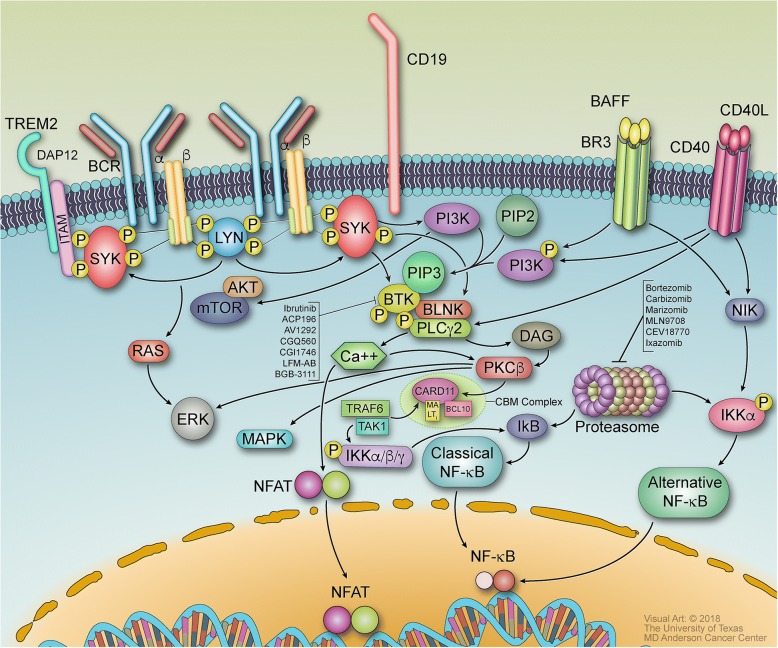
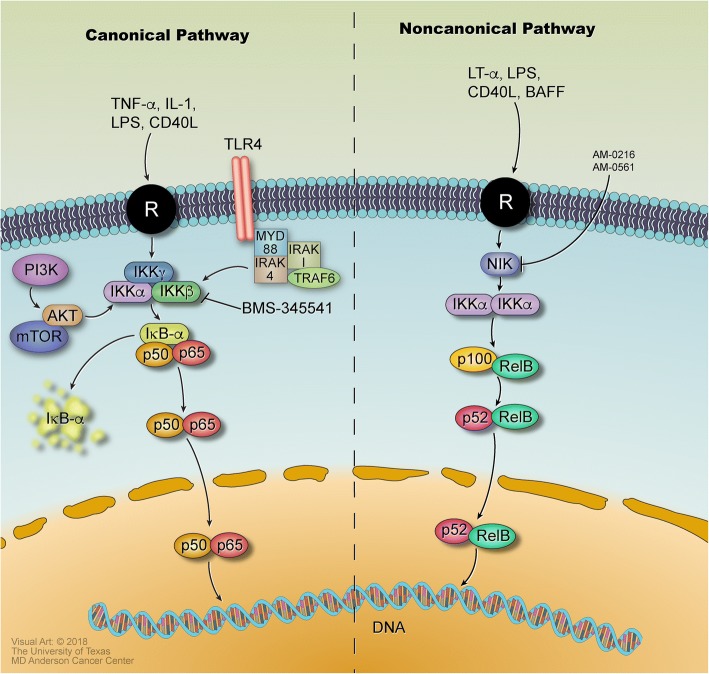
Mantle cell lymphoma is an aggressive subtype of non-Hodgkin B cell lymphoma that is characterized by a poor prognosis determined by Ki67 and Mantle Cell International Prognostic Index scores, but it is becoming increasingly treatable. The majority of patients, especially if young, achieve a progression-free survival of at least 5 years. Mantle cell lymphoma can initially be treated with an anti-CD20 antibody in combination with a chemotherapy backbone, such as VR-CAP (the anti-CD20 monoclonal antibody rituximab administered with cyclophosphamide, doxorubicin, and prednisone) or R-CHOP (the anti-CD20 monoclonal antibody rituximab administered with cyclophosphamide, doxorubicin, vincristine, and prednisone). While initial treatment can facilitate recovery and complete remission in a few patients, many patients experience relapsed or refractory mantle cell lymphoma within 2 to 3 years after initial treatment. Targeted agents such as ibrutinib, an inhibitor of Bruton's tyrosine kinase, which has been approved only in the relapsed setting, can be used to treat patients with relapsed or refractory mantle cell lymphoma. However, mantle cell lymphoma cells often acquire resistance to such targeted agents and continue to survive by activating alternate signaling pathways such as the PI3K-Akt pathway or the NF-κB pathways.NF-κB is a transcription factor family that regulates the growth and survival of B cells; mantle cell lymphoma cells depend on NF-κB signaling for continued growth and proliferation. The NF-κB signaling pathways are categorized into canonical and non-canonical types, wherein the canonical pathway prompts inflammatory responses, immune regulation, and cell proliferation, while the non-canonical leads to B cell maturation and lymphoid organogenesis. Since these pathways upregulate survival genes and tumor-promoting cytokines, they can be activated to overcome the inhibitory effects of targeted agents, thereby having profound effects on tumorigenesis. The NF-κB pathways are also highly targetable in that they are interconnected with numerous other pathways, including B cell receptor signaling, PI3K/Akt/mTOR signaling, and toll-like receptor signaling pathways. Additionally, elements of the non-canonical NF- κB pathway, such as NF-κB-inducing kinase, can be targeted to overcome resistance to targeting of the canonical NF- κB pathway.Targeting the molecular mechanisms of the NF-κB pathways can facilitate the development of novel agents to treat malignancies and overcome drug resistance in patients with relapsed or refractory mantle cell lymphoma.
套细胞淋巴瘤是一种侵袭性非霍奇金 B 细胞淋巴瘤亚型,其预后不良,由 Ki67 和套细胞国际预后指数评分决定,但现在越来越具有可治疗性。大多数患者,尤其是年轻患者,至少有 5 年的无进展生存期。套细胞淋巴瘤最初可以用抗 CD20 抗体联合化疗方案治疗,如 VR-CAP(抗 CD20 单克隆抗体利妥昔单抗联合环磷酰胺、多柔比星和泼尼松)或 R-CHOP(抗 CD20 单克隆抗体利妥昔单抗联合环磷酰胺、多柔比星、长春新碱和泼尼松)。虽然初始治疗可以促进少数患者的恢复和完全缓解,但许多患者在初始治疗后 2 至 3 年内会复发或出现难治性套细胞淋巴瘤。靶向药物,如 Bruton 酪氨酸激酶抑制剂伊布替尼,仅在复发时被批准使用,可用于治疗复发或难治性套细胞淋巴瘤患者。然而,套细胞淋巴瘤细胞往往会对这些靶向药物产生耐药性,并通过激活替代信号通路(如 PI3K-Akt 通路或 NF-κB 通路)继续存活。NF-κB 是一种转录因子家族,调节 B 细胞的生长和存活;套细胞淋巴瘤细胞依赖 NF-κB 信号持续生长和增殖。NF-κB 信号通路分为经典型和非经典型,经典型通路促进炎症反应、免疫调节和细胞增殖,而非经典型通路则导致 B 细胞成熟和淋巴器官发生。由于这些通路上调了生存基因和肿瘤促进细胞因子,它们可以被激活以克服靶向药物的抑制作用,从而对肿瘤发生产生深远影响。NF-κB 通路也具有高度的靶向性,因为它们与许多其他通路相互关联,包括 B 细胞受体信号、PI3K/Akt/mTOR 信号和 Toll 样受体信号通路。此外,非经典 NF-κB 通路的元件,如 NF-κB 诱导激酶,可被靶向以克服对经典 NF-κB 通路的靶向耐药性。针对 NF-κB 通路的分子机制可以促进新型药物的开发,以治疗恶性肿瘤,并克服复发或难治性套细胞淋巴瘤患者的耐药性。