Aoki Tomohiro, Shimada Kazuyuki, Sakamoto Akihiko, Sugimoto Keiki, Morishita Takanobu, Kojima Yuki, Shimada Satoko, Kato Seiichi, Iriyama Chisako, Kuno Shunsuke, Harada Yasuhiko, Tomita Akihiro, Hayakawa Fumihiko, Kiyoi Hitoshi
Department of Hematology and Oncology, Nagoya University Graduate School of Medicine, Nagoya, Japan.
Institute for Advanced Research, Nagoya University, Nagoya, Japan.
Oncotarget. 2017 Feb 21;8(8):13085-13098. doi: 10.18632/oncotarget.14393.
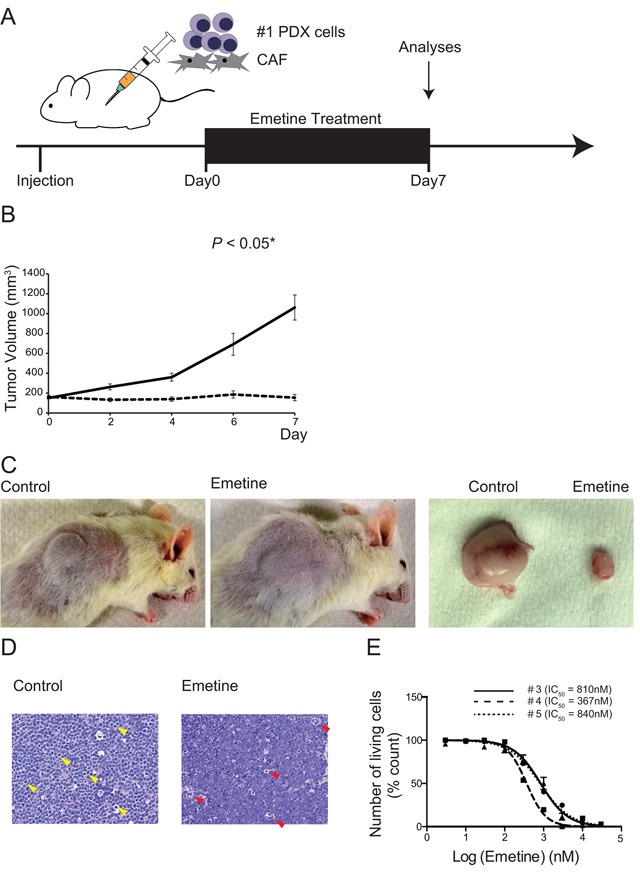
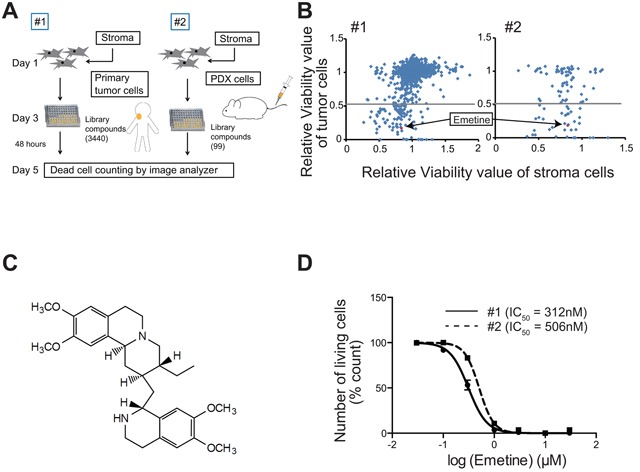
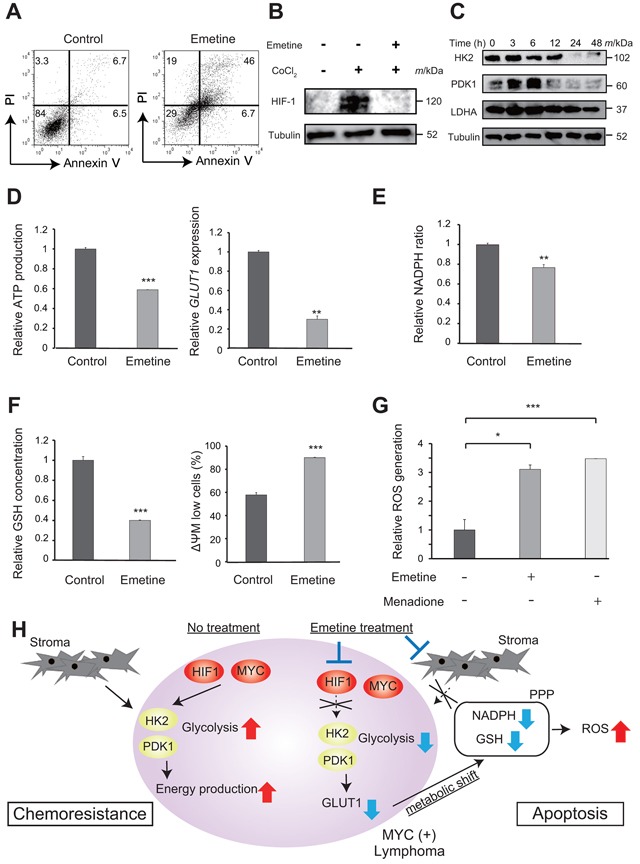
Despite improved clinical outcomes of diffuse large B-cell lymphoma, a certain proportion of patients still develop a primary refractory disease. To overcome these lymphomas that are intractable to existing treatment strategies, the tumor microenvironment has been identified as a potential therapeutic target. Here we describe our search for effective drugs for primary refractory lymphoma cells with MYC rearrangement. Through the drug screening of 3,440 known compounds, we identified a unique compound, emetine. This compound was effective against lymphoma cells with MYC rearrangement from two different patients that were co-cultured with cancer associated fibroblasts. Emetine induced the death of these cells with a half maximal inhibitory concentration of 312 nM and 506 nM, respectively. Subsequent analyses of the mechanism of action of emetine showed that the drug induced apoptosis of tumor cells via alteration of glucose metabolism through inhibition of hypoxia inducible factor-1α. Moreover, emetine inhibited the potential of cancer associated fibroblasts to support tumor cell viability in vitro and demonstrated significant inhibition of tumor growth in in vivo analyses. Emetine also induced cell death in other primary refractory lymphoma cells with MYC rearrangement. Our combined data indicate that emetine is a potential promising drug for the treatment of intractable lymphomas, which targets both the tumor and its microenvironment.
尽管弥漫性大B细胞淋巴瘤的临床疗效有所改善,但仍有一定比例的患者会发展为原发性难治性疾病。为了克服这些对现有治疗策略难以治愈的淋巴瘤,肿瘤微环境已被确定为一个潜在的治疗靶点。在此,我们描述了我们对具有MYC重排的原发性难治性淋巴瘤细胞有效药物的探索。通过对3440种已知化合物进行药物筛选,我们鉴定出一种独特的化合物——吐根碱。该化合物对与癌症相关成纤维细胞共培养的两名不同患者的具有MYC重排的淋巴瘤细胞有效。吐根碱分别以312 nM和506 nM的半数最大抑制浓度诱导这些细胞死亡。随后对吐根碱作用机制的分析表明,该药物通过抑制缺氧诱导因子-1α改变葡萄糖代谢,从而诱导肿瘤细胞凋亡。此外,吐根碱在体外抑制了癌症相关成纤维细胞支持肿瘤细胞存活的能力,并在体内分析中显示出对肿瘤生长的显著抑制作用。吐根碱还能诱导其他具有MYC重排的原发性难治性淋巴瘤细胞死亡。我们的综合数据表明,吐根碱是一种治疗难治性淋巴瘤的潜在有前景的药物,它同时靶向肿瘤及其微环境。