Bai Zhenjiang, Fang Fang, Xu Zhong, Lu Chunjiu, Wang Xueqin, Chen Jiao, Pan Jian, Wang Jian, Li Yanhong
Pediatric Intensive Care Unit, Children's Hospital of Soochow University, Suzhou, JiangSu province, China.
Institute of Pediatric Research, Children's Hospital of Soochow University, Suzhou, JiangSu province, China.
BMC Pediatr. 2018 Jun 15;18(1):192. doi: 10.1186/s12887-018-1175-y.
Fibroblast growth factor 23 (FGF23) and insulin-like growth factor binding protein 7 (IGFBP-7) are suggested to be biomarkers for predicting acute kidney injury (AKI). We compared them with proposed AKI biomarker of cystatin C (CysC), and aimed (1) to examine whether concentrations of these biomarkers vary with age, body weight, illness severity assessed by pediatric risk of mortality III score, and kidney function assessed by estimated glomerular filtration rate (eGFR), (2) to determine the association between these biomarkers and AKI, and (3) to evaluate whether these biomarkers could serve as early independent predictors of AKI in critically ill children.
This prospective single center study included 144 critically ill patients admitted to the pediatric intensive care unit (PICU) regardless of diagnosis. Serum and spot urine samples were collected during the first 24 h after PICU admission. AKI was diagnosed based on the AKI network (AKIN) criteria.
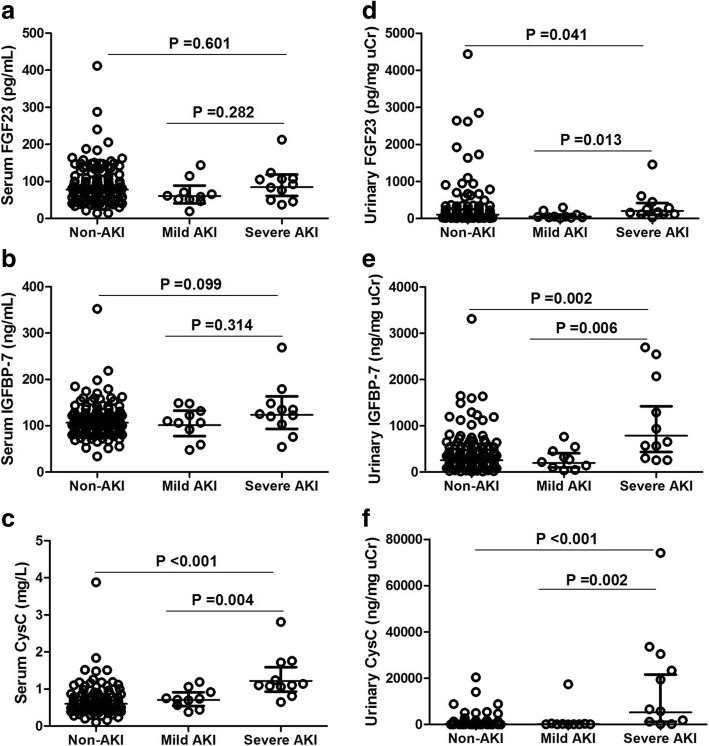
Twenty-one patients developed AKI within 120 h of sample collection, including 11 with severe AKI defined as AKIN stages 2 and 3. Serum FGF23 levels were independently associated with eGFR after adjustment in a multivariate linear analysis (P < 0.001). Urinary IGFBP-7 (Adjusted OR = 2.94 per 1000 ng/mg increase, P = 0.035), serum CysC (Adjusted OR = 5.28, P = 0.005), and urinary CysC (Adjusted OR = 1.13 per 1000 ng/mg increase, P = 0.022) remained significantly associated with severe AKI after adjustment for body weight and illness severity, respectively. Urinary IGFBP-7 level was predictive of severe AKI and achieved the AUC of 0.79 (P = 0.001), but was not better than serum (AUC = 0.89, P < 0.001) and urinary (AUC = 0.88, P < 0.001) CysC in predicting severe AKI.
Serum FGF23 levels were inversely related to measures of eGFR. In contrast to serum and urinary FGF23 which are not associated with AKI in a general and heterogeneous PICU population, an increased urinary IGFBP-7 level was independently associated with the increased risk of severe AKI diagnosed within the next 5 days after sampling, but not superior to serum or urinary CysC in predicting severe AKI in critically ill children.
成纤维细胞生长因子23(FGF23)和胰岛素样生长因子结合蛋白7(IGFBP - 7)被认为是预测急性肾损伤(AKI)的生物标志物。我们将它们与已提出的AKI生物标志物胱抑素C(CysC)进行比较,目的是(1)检查这些生物标志物的浓度是否随年龄、体重、用儿童死亡风险III评分评估的疾病严重程度以及用估计肾小球滤过率(eGFR)评估的肾功能而变化,(2)确定这些生物标志物与AKI之间的关联,以及(3)评估这些生物标志物是否可作为危重症儿童AKI的早期独立预测指标。
这项前瞻性单中心研究纳入了144名入住儿科重症监护病房(PICU)的危重症患者,无论其诊断如何。在入住PICU后的头24小时内采集血清和随机尿样。根据急性肾损伤网络(AKIN)标准诊断AKI。
21名患者在样本采集后的120小时内发生了AKI,其中11名患有定义为AKIN 2期和3期的严重AKI。在多变量线性分析调整后,血清FGF23水平与eGFR独立相关(P < 0.001)。分别在调整体重和疾病严重程度后,尿IGFBP - 7(每增加1000 ng/mg调整后比值比[OR]=2.94,P = 0.035)、血清CysC(调整后OR = 5.28,P = 0.005)和尿CysC(每增加1000 ng/mg调整后OR = 1.13,P = 0.022)仍与严重AKI显著相关。尿IGFBP - 7水平可预测严重AKI,曲线下面积(AUC)为0.79(P = 0.001),但在预测严重AKI方面不如血清(AUC = 0.89,P < 0.001)和尿(AUC = 0.88,P < 0.001)CysC。
血清FGF23水平与eGFR指标呈负相关。与血清和尿FGF23在一般且异质性的PICU人群中与AKI无关不同,尿IGFBP - 7水平升高与采样后接下来5天内诊断出的严重AKI风险增加独立相关,但在预测危重症儿童的严重AKI方面并不优于血清或尿CysC。