Department of Zoology, Faculty of Science, Charles University, Viničná 7, CZ-128 44, Praha 2, Czech Republic.
Department of Biological Sciences, University of Cape Town, 7701, Rondebosch, South Africa.
Sci Rep. 2018 Jun 15;8(1):9203. doi: 10.1038/s41598-018-26062-8.
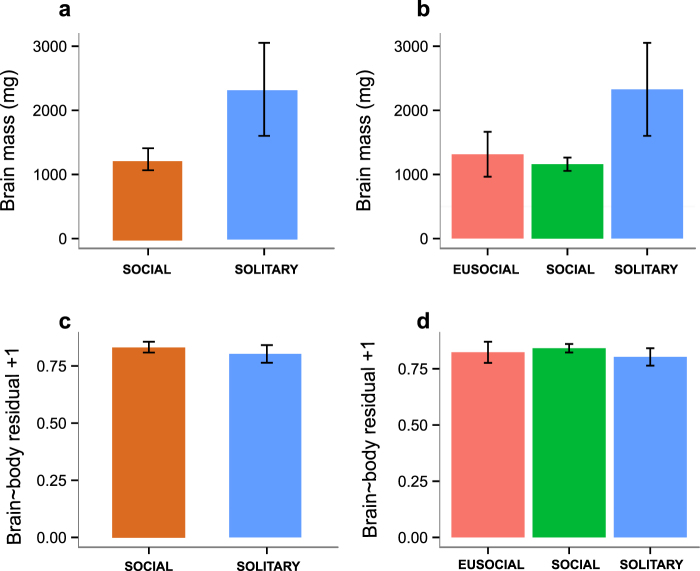
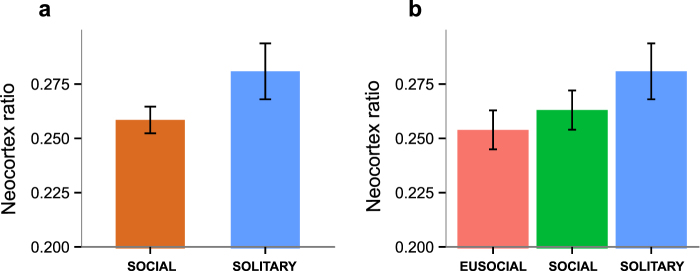
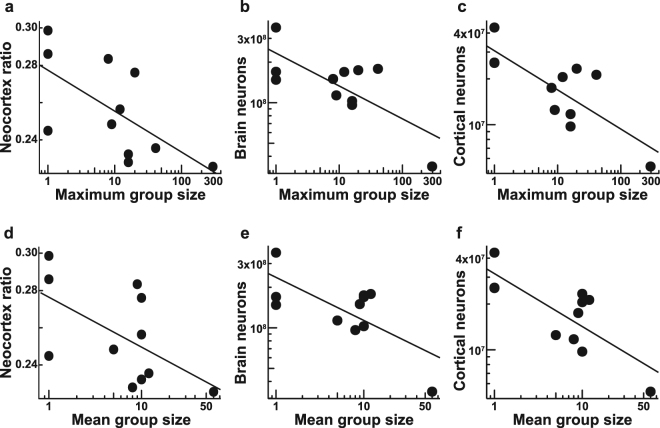
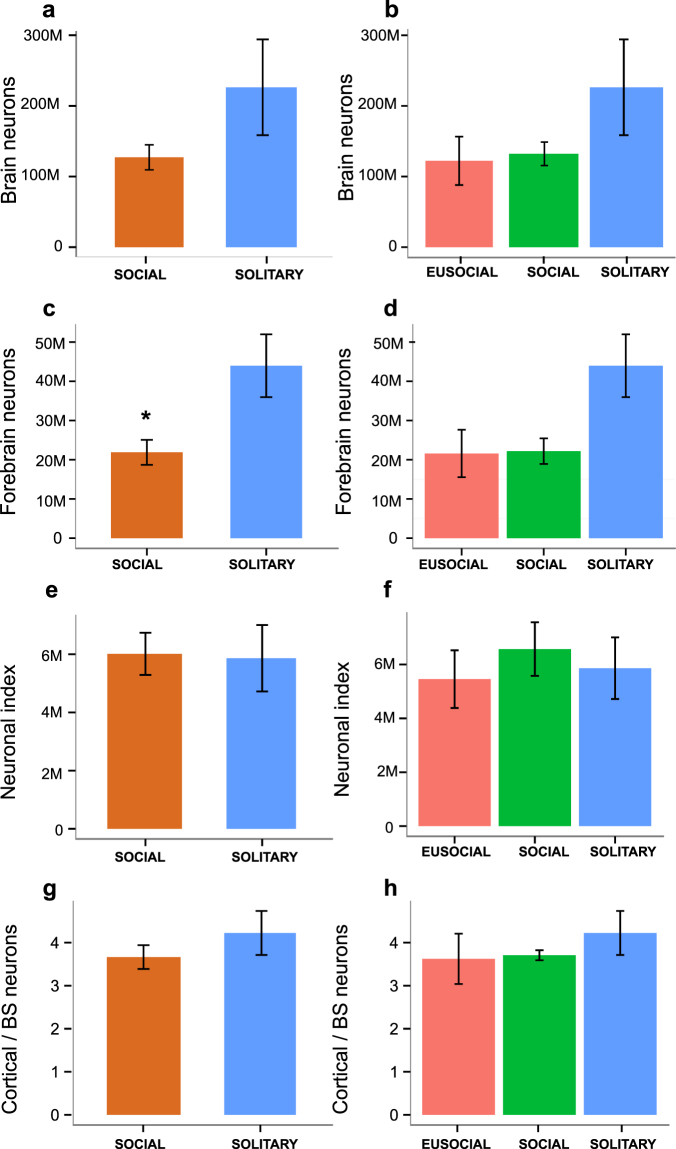
The social brain hypothesis (SBH) posits that the demands imposed on individuals by living in cohesive social groups exert a selection pressure favouring the evolution of large brains and complex cognitive abilities. Using volumetry and the isotropic fractionator to determine the size of and numbers of neurons in specific brain regions, here we test this hypothesis in African mole-rats (Bathyergidae). These subterranean rodents exhibit a broad spectrum of social complexity, ranging from strictly solitary through to eusocial cooperative breeders, but feature similar ecologies and life history traits. We found no positive association between sociality and neuroanatomical correlates of information-processing capacity. Solitary species are larger, tend to have greater absolute brain size and have more neurons in the forebrain than social species. The neocortex ratio and neuronal counts correlate negatively with social group size. These results are clearly inconsistent with the SBH and show that the challenges coupled with sociality in this group of rodents do not require brain enlargement or fundamental reorganization. These findings suggest that group living or pair bonding per se does not select strongly for brain enlargement unless coupled with Machiavellian interactions affecting individual fitness.
社会脑假说(SBH)认为,生活在有凝聚力的社会群体中对个体施加的需求会产生选择压力,有利于大脑的进化和复杂认知能力的发展。本文使用体视学和各向同性分数器来确定特定脑区的神经元数量和大小,以此在非洲鼹鼠科(Bathyergidae)中检验这一假说。这些地下啮齿动物表现出广泛的社会复杂性,从严格的独居到社会性的合作繁殖者,但具有相似的生态和生活史特征。我们没有发现社会性与信息处理能力的神经解剖学相关性之间存在正相关关系。独居物种体型较大,前脑的绝对脑容量较大,神经元数量也较多。大脑新皮层比率和神经元计数与社会群体大小呈负相关。这些结果显然与 SBH 不一致,表明在这组啮齿动物中,与社会性相关的挑战并不需要大脑增大或根本的重新组织。这些发现表明,群体生活或配对结合本身并不强烈选择大脑增大,除非与影响个体适应性的马基雅维利式的相互作用有关。