Department of Pediatrics, Perelman School of Medicine, University of Pennsylvania, Philadelphia, PA, USA.
Division of Human Genetics, The Children's Hospital of Philadelphia, Philadelphia, PA, USA.
Genet Med. 2018 Dec;20(12):1663-1676. doi: 10.1038/s41436-018-0004-x. Epub 2018 Jun 15.
Hearing loss (HL) is the most common sensory disorder in children. Prompt molecular diagnosis may guide screening and management, especially in syndromic cases when HL is the single presenting feature. Exome sequencing (ES) is an appealing diagnostic tool for HL as the genetic causes are highly heterogeneous.
ES was performed on a prospective cohort of 43 probands with HL. Sequence data were analyzed for primary and secondary findings. Capture and coverage analysis was performed for genes and variants associated with HL.
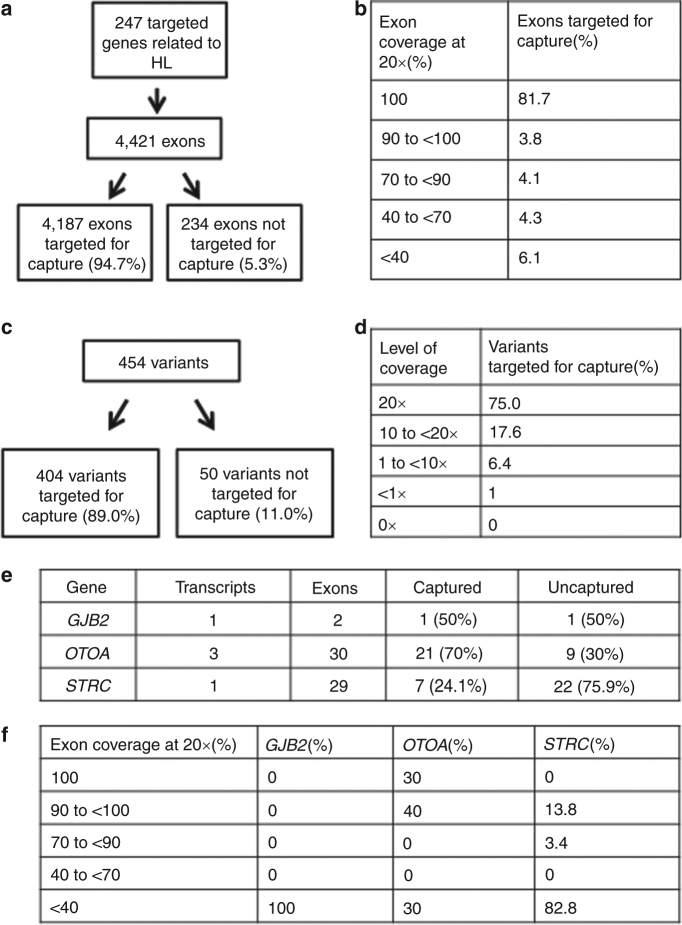
The diagnostic rate using ES was 37.2%, compared with 15.8% for the clinical HL panel. Secondary findings were discovered in three patients. For 247 genes associated with HL, 94.7% of the exons were targeted for capture and 81.7% of these exons were covered at 20× or greater. Further analysis of 454 randomly selected HL-associated variants showed that 89% were targeted for capture and 75% were covered at a read depth of at least 20×.
ES has an improved yield compared with clinical testing and may capture diagnoses not initially considered due to subtle clinical phenotypes. Technical challenges were identified, including inadequate capture and coverage of HL genes. Additional considerations of ES include secondary findings, cost, and turnaround time.
听力损失(HL)是儿童最常见的感觉障碍。及时的分子诊断可以指导筛查和管理,特别是在 HL 是唯一表现特征的综合征病例中。外显子组测序(ES)是 HL 的一种有吸引力的诊断工具,因为遗传原因高度异质。
对 43 名 HL 先证者进行前瞻性队列 ES。对原发性和继发性发现进行序列数据分析。对与 HL 相关的基因和变异进行捕获和覆盖分析。
ES 的诊断率为 37.2%,而临床 HL 面板的诊断率为 15.8%。在 3 名患者中发现了次要发现。对于与 HL 相关的 247 个基因,94.7%的外显子被捕获,其中 81.7%的外显子在 20×或更高倍数下被覆盖。对随机选择的 454 个 HL 相关变异的进一步分析表明,89%的外显子被捕获,75%的外显子在至少 20×的读深度下被覆盖。
与临床检测相比,ES 的检出率有所提高,并且可能捕获到由于微妙的临床表型而最初未考虑的诊断。鉴定出技术挑战,包括 HL 基因的捕获和覆盖不足。ES 的其他考虑因素包括次要发现、成本和周转时间。