The University of Texas MD Anderson Cancer Center, Houston, USA.
The Cleveland Clinic Foundation, Cleveland, USA.
Ann Oncol. 2018 Aug 1;29(8):1869-1876. doi: 10.1093/annonc/mdy137.
Alterations involving the RET kinase are implicated in the pathogenesis of lung, thyroid and other cancers. However, the clinical activity of multikinase inhibitors (MKIs) with anti-RET activity in RET-altered patients appears limited, calling into question the therapeutic potential of targeting RET. LOXO-292 is a selective RET inhibitor designed to inhibit diverse RET fusions, activating mutations and acquired resistance mutations.
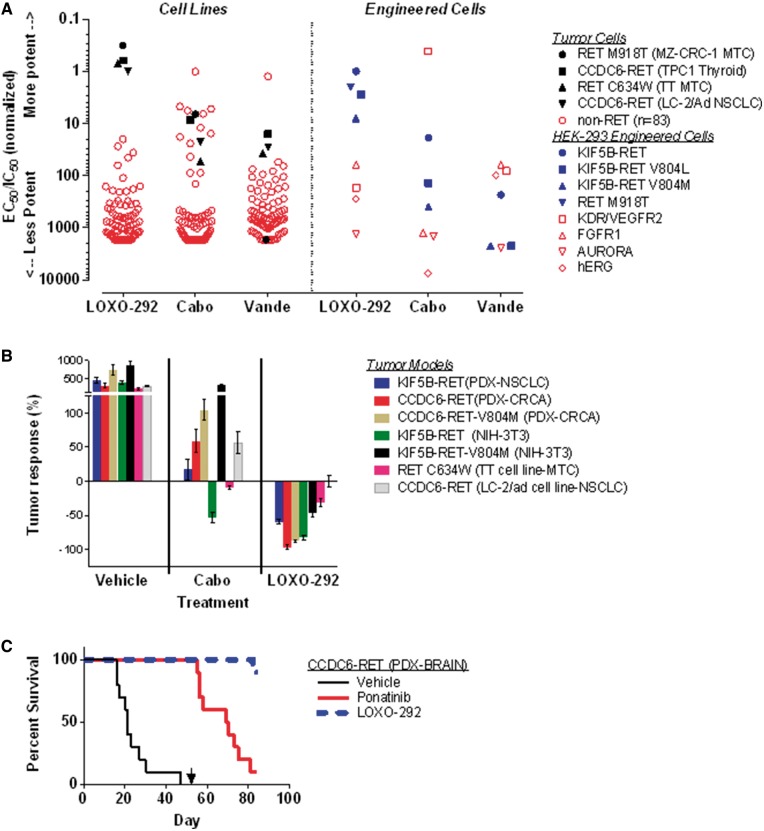
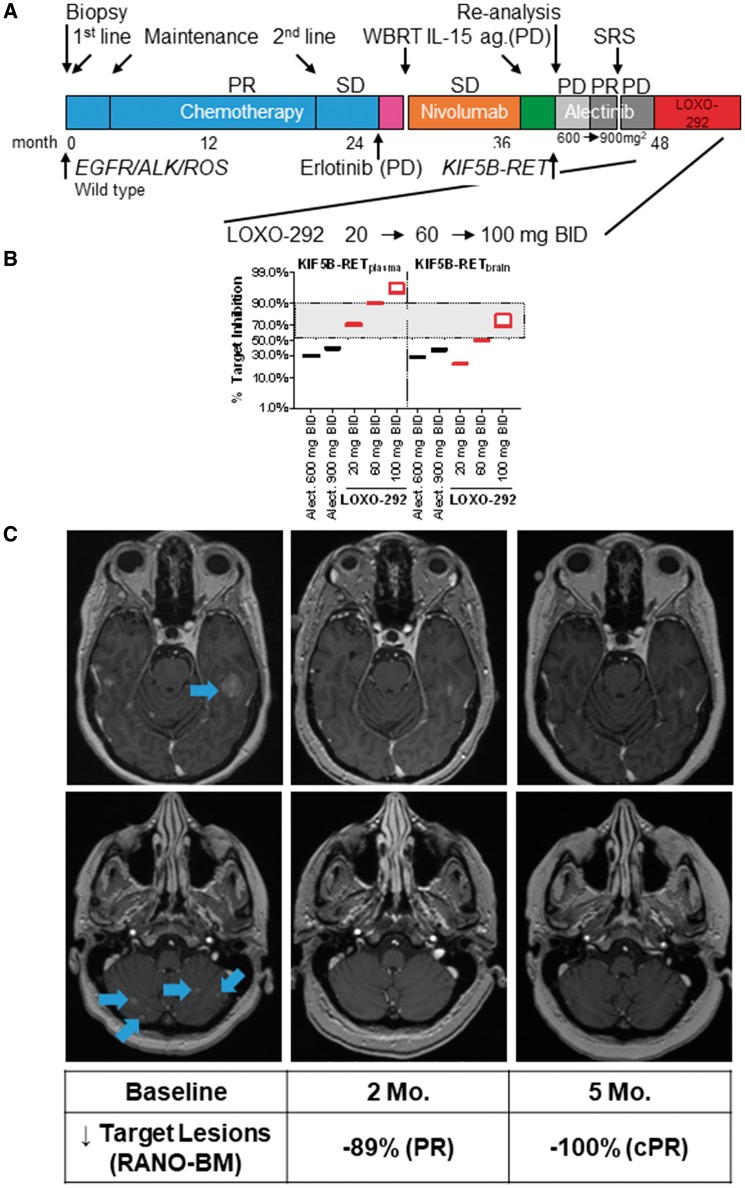
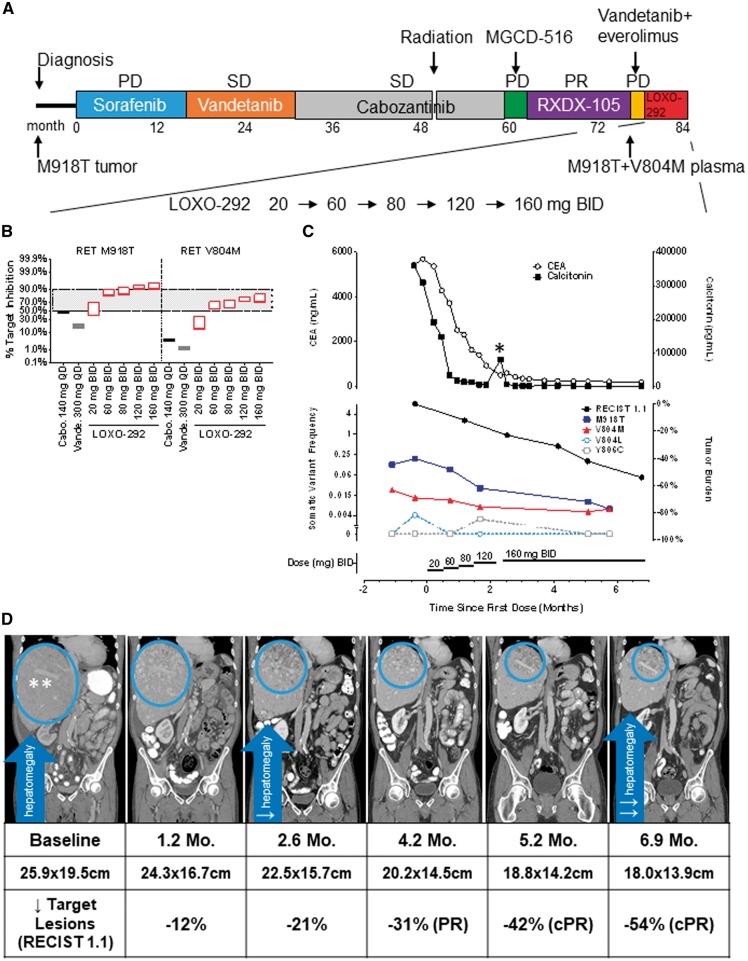
Potent anti-RET activity, high selectivity, and central nervous system coverage were confirmed preclinically using a variety of in vitro and in vivo RET-dependent tumor models. Due to clinical urgency, two patients with RET-altered, MKI-resistant cancers were treated with LOXO-292, utilizing rapid dose-titration guided by real-time pharmacokinetic assessments to achieve meaningful clinical exposures safely and rapidly.
LOXO-292 demonstrated potent and selective anti-RET activity preclinically against human cancer cell lines harboring endogenous RET gene alterations; cells engineered to express a KIF5B-RET fusion protein -/+ the RET V804M gatekeeper resistance mutation or the common RET activating mutation M918T; and RET-altered human cancer cell line and patient-derived xenografts, including a patient-derived RET fusion-positive xenograft injected orthotopically into the brain. A patient with RET M918T-mutant medullary thyroid cancer metastatic to the liver and an acquired RET V804M gatekeeper resistance mutation, previously treated with six MKI regimens, experienced rapid reductions in tumor calcitonin, CEA and cell-free DNA, resolution of painful hepatomegaly and tumor-related diarrhea and a confirmed tumor response. A second patient with KIF5B-RET fusion-positive lung cancer, acquired resistance to alectinib and symptomatic brain metastases experienced a dramatic response in the brain, and her symptoms resolved.
These results provide proof-of-concept of the clinical actionability of RET alterations, and identify selective RET inhibition by LOXO-292 as a promising treatment in heavily pretreated, multikinase inhibitor-experienced patients with diverse RET-altered tumors.
涉及 RET 激酶的改变与肺癌、甲状腺癌和其他癌症的发病机制有关。然而,具有抗 RET 活性的多激酶抑制剂 (MKI) 在改变 RET 的患者中的临床活性似乎有限,这使得靶向 RET 的治疗潜力受到质疑。LOXO-292 是一种选择性 RET 抑制剂,旨在抑制多种 RET 融合、激活突变和获得性耐药突变。
使用多种体外和体内依赖 RET 的肿瘤模型,预先证实了 LOXO-292 具有强大的抗 RET 活性、高选择性和中枢神经系统覆盖范围。由于临床紧迫性,两名患有改变 RET、MKI 耐药癌症的患者接受了 LOXO-292 治疗,利用实时药代动力学评估指导的快速剂量滴定,安全快速地实现有意义的临床暴露。
LOXO-292 在临床上对携带内源性 RET 基因改变的人癌细胞系表现出强大而选择性的抗 RET 活性;表达 KIF5B-RET 融合蛋白 +/-RET V804M 门控耐药突变或常见 RET 激活突变 M918T 的工程细胞;以及改变 RET 的人癌细胞系和患者来源的异种移植物,包括原位注射入脑的 RET 融合阳性异种移植物。一名患有 RET M918T 突变型甲状腺髓样癌转移至肝脏并获得 RET V804M 门控耐药突变的患者,先前接受了六种 MKI 治疗方案,经历了肿瘤降钙素、CEA 和无细胞 DNA 的快速减少、疼痛性肝肿大和肿瘤相关腹泻的缓解以及确认的肿瘤反应。另一名患有 KIF5B-RET 融合阳性肺癌的患者,对阿来替尼产生获得性耐药并伴有症状性脑转移,其大脑中的肿瘤反应显著,且症状缓解。
这些结果提供了 RET 改变的临床可操作性的概念验证,并确定了 LOXO-292 的选择性 RET 抑制作为一种有前途的治疗方法,适用于多种改变 RET 的肿瘤、接受过大量预处理和多激酶抑制剂治疗的患者。