Department of Gastroenterology and Hepatology, Musashino Red Cross Hospital, Tokyo, Japan.
First Department of Internal Medicine, Faculty of Medicine, University of Yamanashi, Yamanashi, Japan.
PLoS One. 2018 Jun 18;13(6):e0198812. doi: 10.1371/journal.pone.0198812. eCollection 2018.
The present study aimed to investigate the impact of pre-sarcopenia on the prognosis of patients with advanced hepatocellular carcinoma (HCC) treated with sorafenib.
We enrolled 214 patients (71 ± 10 years old; 166 men and 48 women; 90% Child-Pugh grade A and 10% Child-Pugh grade B) treated with sorafenib in our hospital from July 2009 to August 2016. The muscle volume was measured from CT images just before sorafenib administration using software (SliceOmatic). Skeletal muscle mass index was calculated, and the presence of pre-sarcopenia was judged according to the standard (42 cm2/m2 for men and 38 cm2/m2 for women) proposed by the Japan Society of Hepatology.
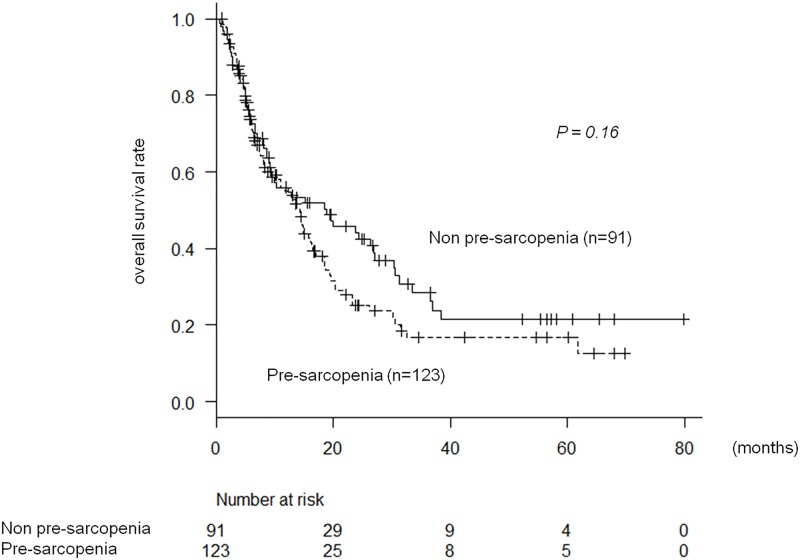
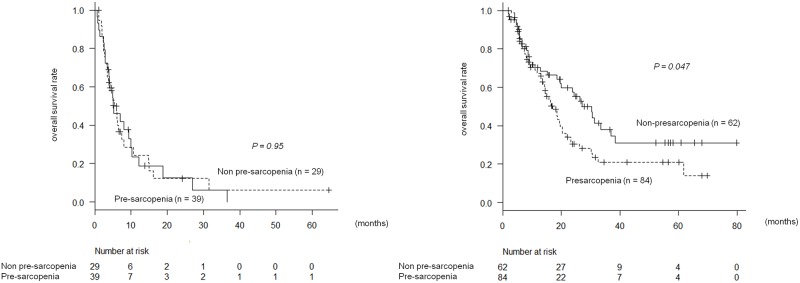
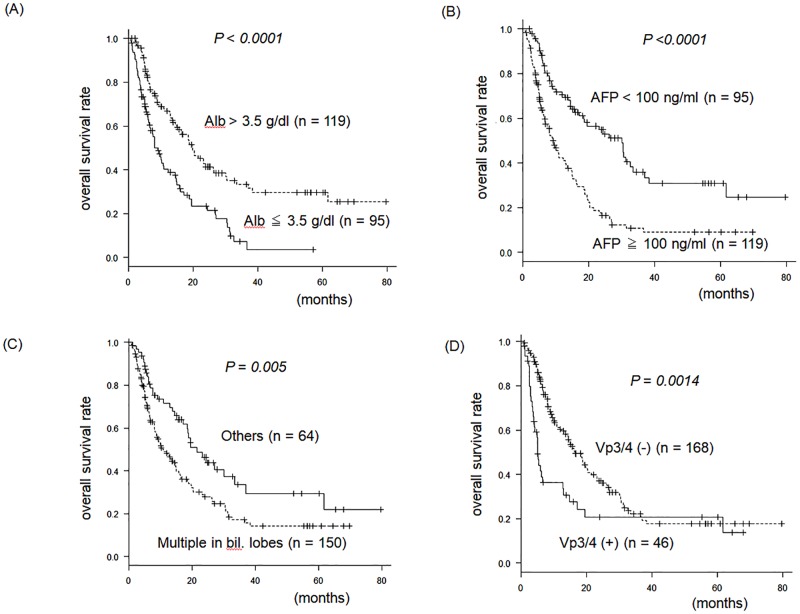
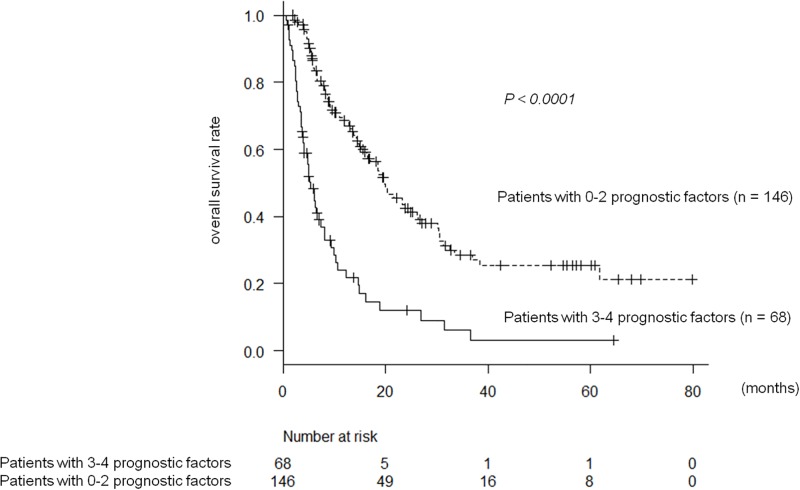
Pre-sarcopenia was found in 123 patients (57%). The overall survival (OS) in patients with pre-sarcopenia tended to be worse than in patients without pre-sarcopenia (median 252 vs. 284 days, respectively; p = 0.16). Multivariate Cox hazard analysis revealed a baseline serum albumin level of ≤3.5 g/dl [hazard ratio (HR) 1.9; p = 0.0006], a baseline alpha-fetoprotein(AFP) level of ≥100 ng/ml (HR 2.1; p = 0.002), presence of lesions in bilateral hepatic lobes (HR 1.7; p = 0.03), and presence of major portal vein invasion (HR 1.8; p = 0.01) to be independent prognostic factors. In the 68 patients who had three or more negative prognostic factors, the presence of pre-sarcopenia did not correlate with prognosis. Of the 146 patients who had two or less prognostic factors, OS was significantly worse in 84 patients (58%) with pre-sarcopenia than in 62 patients without pre-sarcopenia (median 417 vs. 562 days, respectively; p = 0.047), and Cox hazard analysis revealed pre-sarcopenia to be an important prognostic factor (HR 1.6; p = 0.047).
In sorafenib treatment for advanced HCC, pre-sarcopenia is a significant prognostic factor in patients with two or less negative prognostic factors, and could be the target of intervention to improve prognosis.
本研究旨在探讨预肌少症对接受索拉非尼治疗的晚期肝细胞癌(HCC)患者预后的影响。
我们纳入了 214 名于 2009 年 7 月至 2016 年 8 月在我院接受索拉非尼治疗的患者(71±10 岁;166 名男性和 48 名女性;90%为 Child-Pugh 分级 A,10%为 Child-Pugh 分级 B)。使用软件(SliceOmatic)从索拉非尼治疗前的 CT 图像中测量肌肉体积。计算骨骼肌质量指数,并根据日本肝病学会提出的标准(男性 42cm2/m2,女性 38cm2/m2)判断是否存在预肌少症。
123 名患者(57%)存在预肌少症。存在预肌少症的患者总生存期(OS)似乎比不存在预肌少症的患者更差(中位值分别为 252 天和 284 天,p=0.16)。多因素 Cox 风险分析显示,基线血清白蛋白水平≤3.5g/dl[风险比(HR)1.9;p=0.0006]、基线甲胎蛋白(AFP)水平≥100ng/ml(HR 2.1;p=0.002)、双侧肝叶存在病变(HR 1.7;p=0.03)和存在主门静脉侵犯(HR 1.8;p=0.01)是独立的预后因素。在 68 名存在 3 个或更多阴性预后因素的患者中,预肌少症与预后无相关性。在 146 名存在 2 个或更少预后因素的患者中,84 名(58%)存在预肌少症的患者的 OS 明显差于 62 名不存在预肌少症的患者(中位值分别为 417 天和 562 天,p=0.047),Cox 风险分析显示预肌少症是一个重要的预后因素(HR 1.6;p=0.047)。
在索拉非尼治疗晚期 HCC 中,对于存在 2 个或更少阴性预后因素的患者,预肌少症是一个重要的预后因素,可能是改善预后的干预靶点。