Institute of Pharmacology and Toxicology, Biomedical Research Center Seltersberg, Justus Liebig University Giessen, Giessen, Germany.
Institute of Medical Virology, Biomedical Research Center Seltersberg, Justus Liebig University Giessen, Giessen, Germany.
PLoS One. 2018 Jun 18;13(6):e0199200. doi: 10.1371/journal.pone.0199200. eCollection 2018.
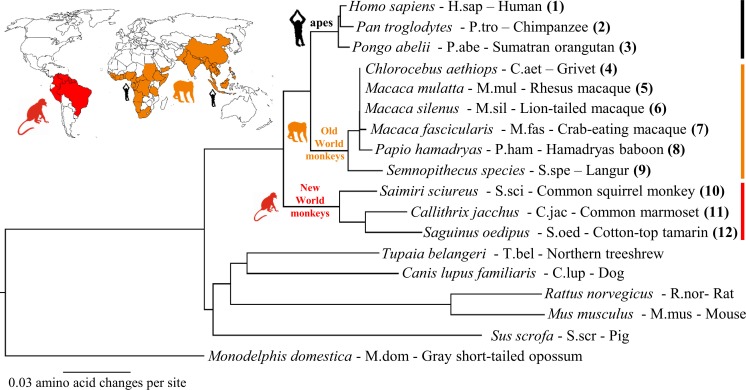
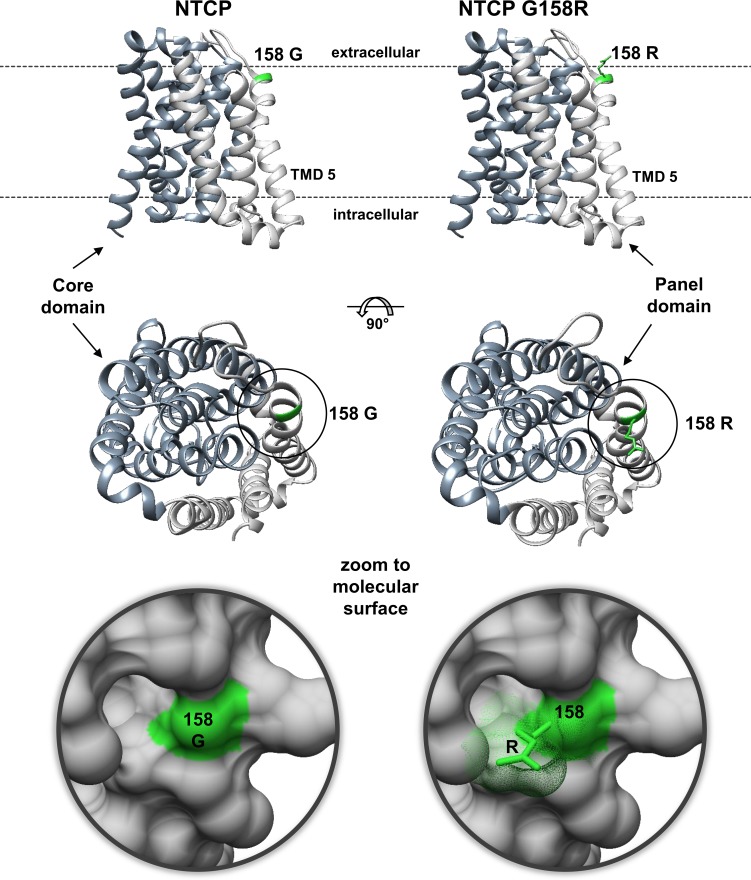
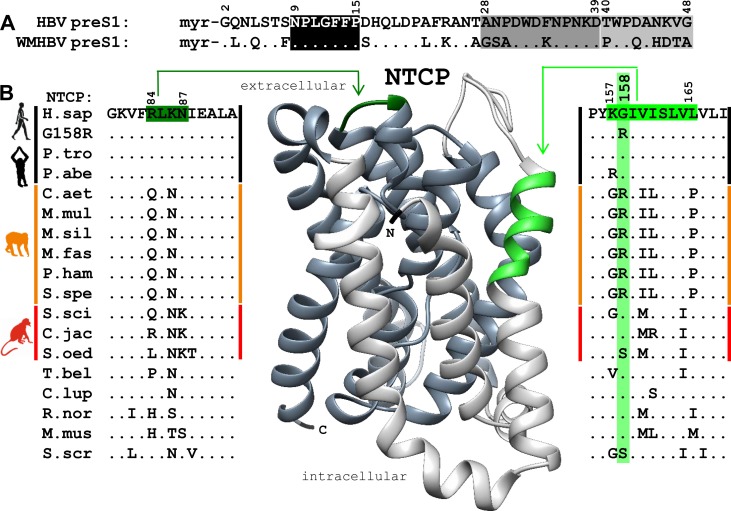
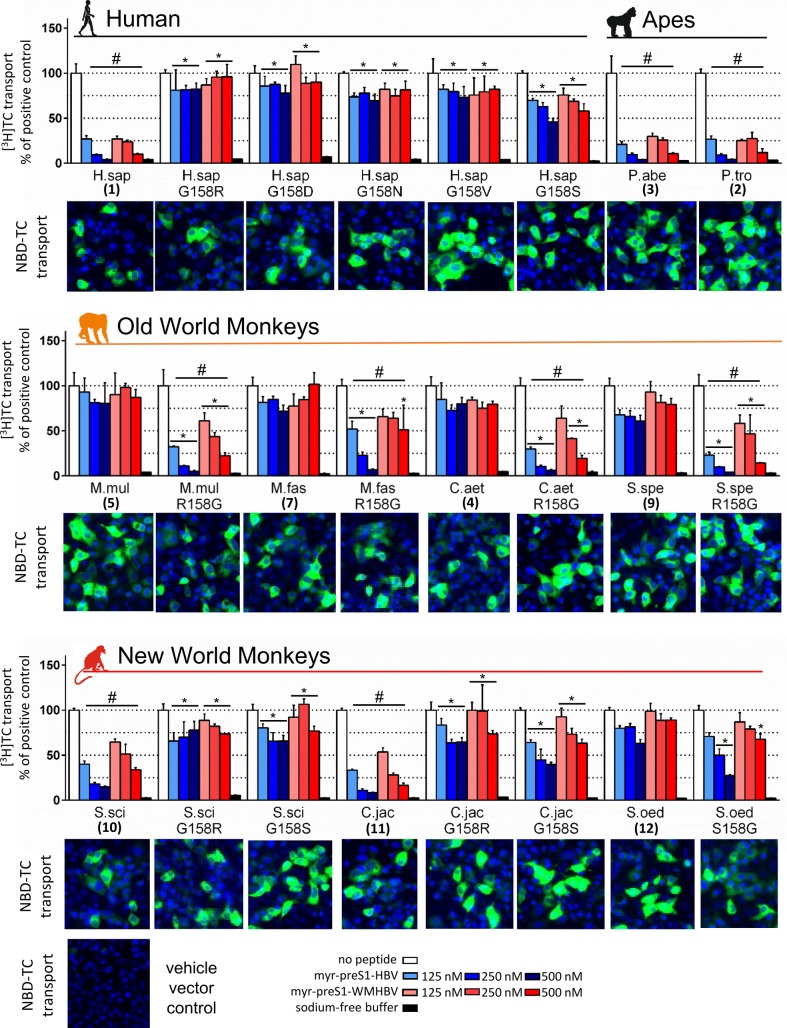
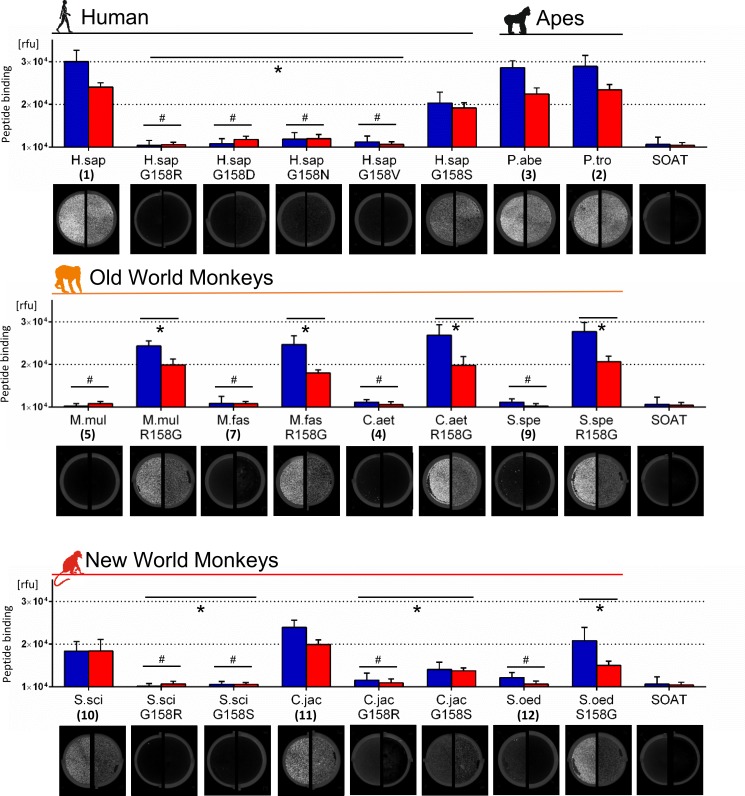
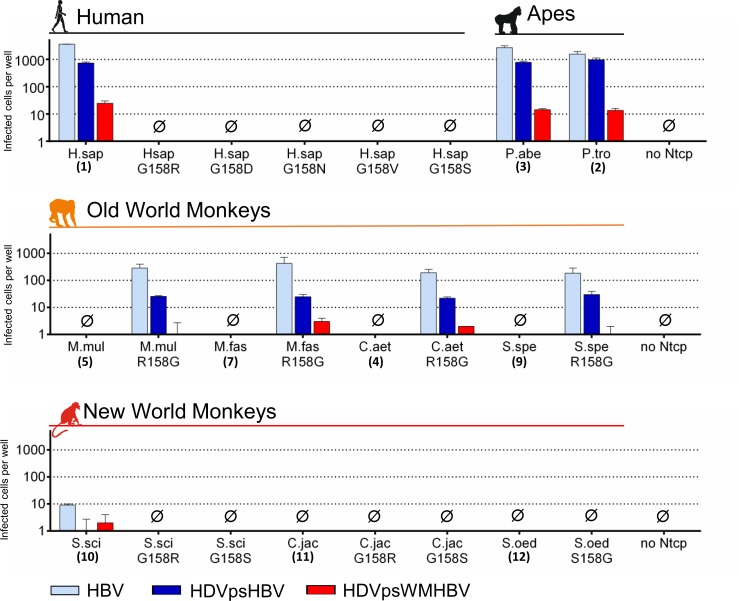
The hepatic Na+/taurocholate co-transporting polypeptide (NTCP in man, Ntcp in animals) is the high-affinity receptor for the hepatitis B (HBV) and hepatitis D (HDV) viruses. Species barriers for human HBV/HDV within the order Primates were previously attributed to Ntcp sequence variations that disable virus-receptor interaction. However, only a limited number of primate Ntcps have been analysed so far. In the present study, a total of 11 Ntcps from apes, Old and New World monkeys were cloned and expressed in vitro to characterise their interaction with HBV and HDV. All Ntcps showed intact bile salt transport. Human NTCP as well as the Ntcps from the great apes chimpanzee and orangutan showed transport-competing binding of HBV derived myr-preS1-peptides. In contrast, all six Ntcps from the group of Old World monkeys were insensitive to HBV myr-preS1-peptide binding and HBV/HDV infection. This is basically predetermined by the amino acid arginine at position 158 of all studied Old World monkey Ntcps. An exchange from arginine to glycine (as present in humans and great apes) at this position (R158G) alone was sufficient to achieve full transport-competing HBV myr-preS1-peptide binding and susceptibility for HBV/HDV infection. New World monkey Ntcps showed higher sequence heterogeneity, but in two cases with 158G showed transport-competing HBV myr-preS1-peptide binding, and in one case (Saimiri sciureus) even susceptibility for HBV/HDV infection. In conclusion, amino acid position 158 of NTCP/Ntcp is sufficient to discriminate between the HBV/HDV susceptible group of humans and great apes (158G) and the non-susceptible group of Old World monkeys (158R). In the case of the phylogenetically more distant New World monkey Ntcps amino acid 158 plays a significant, but not exclusive role.
人源和动物源钠离子-牛磺胆酸共转运多肽(NTCP)是乙型肝炎(HBV)和丁型肝炎(HDV)病毒的高亲和力受体。种属屏障是灵长类动物中人类 HBV/HDV 感染的关键因素,此前归因于 NTCP 序列的变异导致病毒-受体相互作用的失活。然而,迄今为止,仅对少数灵长类 NTCP 进行了分析。在本研究中,我们共克隆并体外表达了来自猿类、旧大陆猴和新大陆猴的 11 种 NTCP,以研究其与 HBV 和 HDV 的相互作用。所有 NTCP 均显示完整的胆盐转运功能。人源 NTCP 以及来自大猿(黑猩猩和猩猩)的 NTCP 均显示与 HBV 衍生的前 S1 肽竞争结合。相比之下,来自旧大陆猴的 6 种 NTCP 均不敏感于 HBV 前 S1 肽结合和 HBV/HDV 感染。这主要是由所有研究的旧大陆猴 NTCP 中位置 158 的氨基酸精氨酸决定的。仅在该位置(158 位)将精氨酸突变为甘氨酸(如在人类和大猿中)即可实现完全竞争结合 HBV 前 S1 肽并使 NTCP 易感 HBV/HDV 感染。新大陆猴 NTCP 显示出更高的序列异质性,但在两种情况下 158 位为甘氨酸时,显示与 HBV 前 S1 肽竞争结合,在一种情况下(松鼠猴)甚至对 HBV/HDV 感染敏感。总之,NTCP/Ntcp 的 158 位氨基酸足以区分人类和大猿(158G)的 HBV/HDV 易感组和旧大陆猴(158R)的非易感组。对于进化上更为遥远的新大陆猴 NTCP,氨基酸 158 虽然发挥了重要作用,但并非唯一作用。