Department of Systems Medicine, University of Tor Vergata, Via Montpellier 1, 00133, Rome, Italy.
Int J Mol Sci. 2018 Jun 16;19(6):1787. doi: 10.3390/ijms19061787.
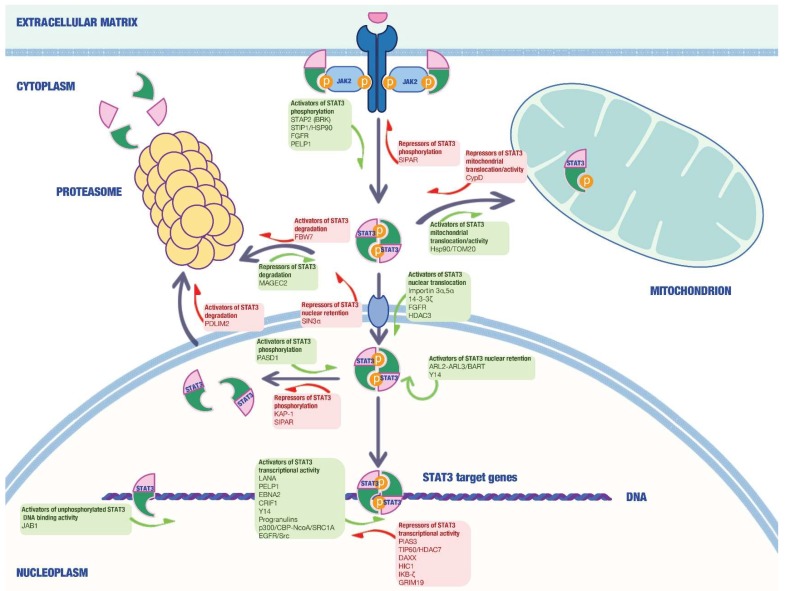
Signal transducers and activators of transcription (STATs) mediate essential signaling pathways in different biological processes, including immune responses, hematopoiesis, and neurogenesis. Among the STAT members, STAT3 plays crucial roles in cell proliferation, survival, and differentiation. While STAT3 activation is transient in physiological conditions, STAT3 becomes persistently activated in a high percentage of solid and hematopoietic malignancies (e.g., melanoma, multiple myeloma, breast, prostate, ovarian, and colon cancers), thus contributing to malignant transformation and progression. This makes STAT3 an attractive therapeutic target for cancers. Initial strategies aimed at inhibiting STAT3 functions have focused on blocking the action of its activating kinases or sequestering its DNA binding ability. More recently, the diffusion of proteomic-based techniques, which have allowed for the identification and characterization of novel STAT3-interacting proteins able to modulate STAT3 activity via its subcellular localization, interact with upstream kinases, and recruit transcriptional machinery, has raised the possibility to target such cofactors to specifically restrain STAT3 oncogenic functions. In this article, we summarize the available data about the function of STAT3 interactors in malignant cells and discuss their role as potential therapeutic targets for cancer treatment.
信号转导子和转录激活子(STATs)在不同的生物学过程中介导必需的信号通路,包括免疫反应、造血和神经发生。在 STAT 成员中,STAT3 在细胞增殖、存活和分化中发挥关键作用。虽然 STAT3 在生理条件下的激活是短暂的,但在高比例的实体瘤和造血恶性肿瘤(例如黑色素瘤、多发性骨髓瘤、乳腺癌、前列腺癌、卵巢癌和结肠癌)中,STAT3 持续激活,从而有助于恶性转化和进展。这使得 STAT3 成为癌症治疗的一个有吸引力的靶点。最初旨在抑制 STAT3 功能的策略集中在阻断其激活激酶的作用或隔离其 DNA 结合能力。最近,蛋白质组学技术的普及,使得能够识别和表征新型能够通过其亚细胞定位、与上游激酶相互作用和募集转录机制来调节 STAT3 活性的 STAT3 相互作用蛋白,从而有可能将这些共因子作为特定靶点来限制 STAT3 的致癌功能。本文总结了关于 STAT3 相互作用物在恶性细胞中的功能的现有数据,并讨论了它们作为癌症治疗潜在治疗靶点的作用。