Agazzi Anna, Fadanelli Gloria, Vittadello Fabio, Zulian Francesco, Martini Giorgia
Paediatric Rheumatology Unit, Department of Woman and Child Health, University of Padova, Via Giustiniani 2, 35128, Padova, Italy.
Paediatric Unit, Santa Chiara Hospital, Trento, Italy.
Pediatr Rheumatol Online J. 2018 Jun 18;16(1):37. doi: 10.1186/s12969-018-0254-9.
To assess reliability of the two indexes of Localized Scleroderma Cutaneous Assessment Tool (LoSCAT), the modified Localized Scleroderma Skin Severity Index (mLoSSI) and the Localized Scleroderma Skin Damage Index (LoSDI), when applied by clinicians with different experience in scoring and managing patients with JLS. Secondary aim was to compare LoSCAT and infrared thermography (IRT) in monitoring lesions over time.
Consecutive children with Juvenile Localized Scleroderma (JLS) were blindly evaluated by three examiners with different experience in Paediatric Rheumatology and with no experience in LoSCAT use. At each visit, patients were assessed by LoSCAT and IRT. Sensitivity to change of LoSCAT and IRT was assessed in a group of patients 3-6 months later. Inter-rater reliability was assessed by Intraclass Correlation Coefficient (ICC) and variance analysis (ANOVA).
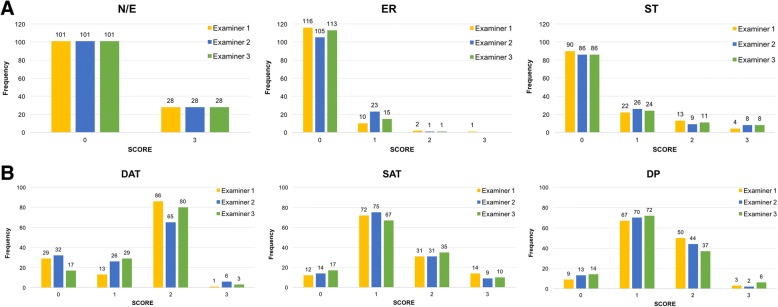
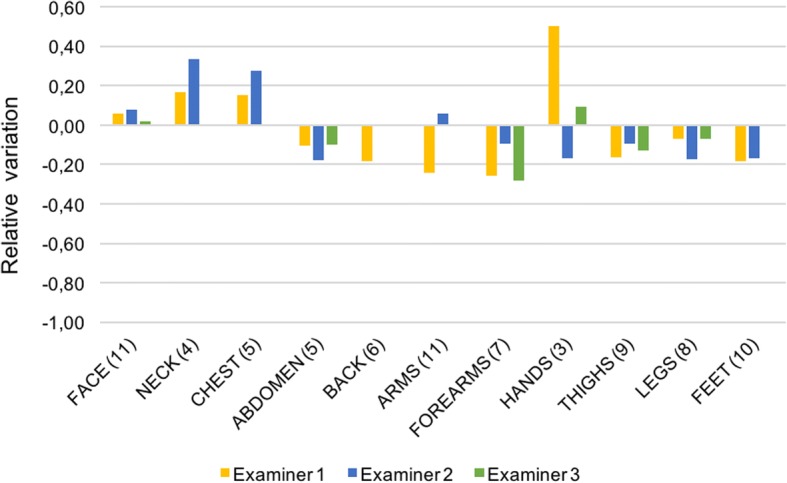
Forty-seven patients (129 lesions) entered the study, and 26 (79 lesions) were re-evaluated with same modality after 4.5 (SD 1.5) months. mLoSSI showed excellent inter-rater reliability expressed by ICC 0.965 confirmed by ANOVA. Similarly, inter-rater reliability for LoSDI was good (ICC = 0.774) but worse concordance among examiners was observed. A comparable improvement of mLoSSI in all anatomic sites was noted by all examiners in 79 lesions examined in two subsequent visits and was consistent with thermography.
Different clinical experience in JLS did not influence clinical judgement in mLoSSI which showed excellent concordance, whereas LoSDI is less precise in damage assessment and not completely reliable in monitoring skin changes. Infrared thermography confirms to be a helpful tool for detecting disease activity and reliable in monitoring lesions over time.
评估局限性硬皮病皮肤评估工具(LoSCAT)的两个指标,即改良局限性硬皮病皮肤严重程度指数(mLoSSI)和局限性硬皮病皮肤损伤指数(LoSDI),在不同经验的临床医生对青少年局限性硬皮病(JLS)患者进行评分和管理时的可靠性。次要目的是比较LoSCAT和红外热成像(IRT)在随时间监测病变方面的效果。
由三位在儿科风湿病方面经验不同且无LoSCAT使用经验的检查者对连续的青少年局限性硬皮病(JLS)患儿进行盲法评估。每次就诊时,对患者进行LoSCAT和IRT评估。在一组患者3至6个月后评估LoSCAT和IRT对变化的敏感性。通过组内相关系数(ICC)和方差分析(ANOVA)评估评分者间的可靠性。
47例患者(129个病变)进入研究,其中26例(79个病变)在4.5(标准差1.5)个月后以相同方式重新评估。mLoSSI显示出由ICC 0.965表示的出色评分者间可靠性,ANOVA证实了这一点。同样,LoSDI的评分者间可靠性良好(ICC = 0.774),但检查者之间的一致性较差。在两次后续就诊中检查的79个病变中,所有检查者都注意到mLoSSI在所有解剖部位有类似的改善,并且与热成像结果一致。
在JLS方面不同的临床经验并未影响mLoSSI的临床判断,其显示出出色的一致性,而LoSDI在损伤评估中不太精确,在监测皮肤变化方面也不完全可靠。红外热成像被证实是检测疾病活动的有用工具,并且在随时间监测病变方面可靠。