Department of Haematology, Oxford Haemophilia & Thrombosis Centre, Churchill Hospital, Oxford University Hospitals NHS Trust, Oxford, UK.
NIHR BRC Blood Theme, Oxford University, Oxford, UK.
Crit Care. 2018 Jun 18;22(1):164. doi: 10.1186/s13054-018-2086-x.
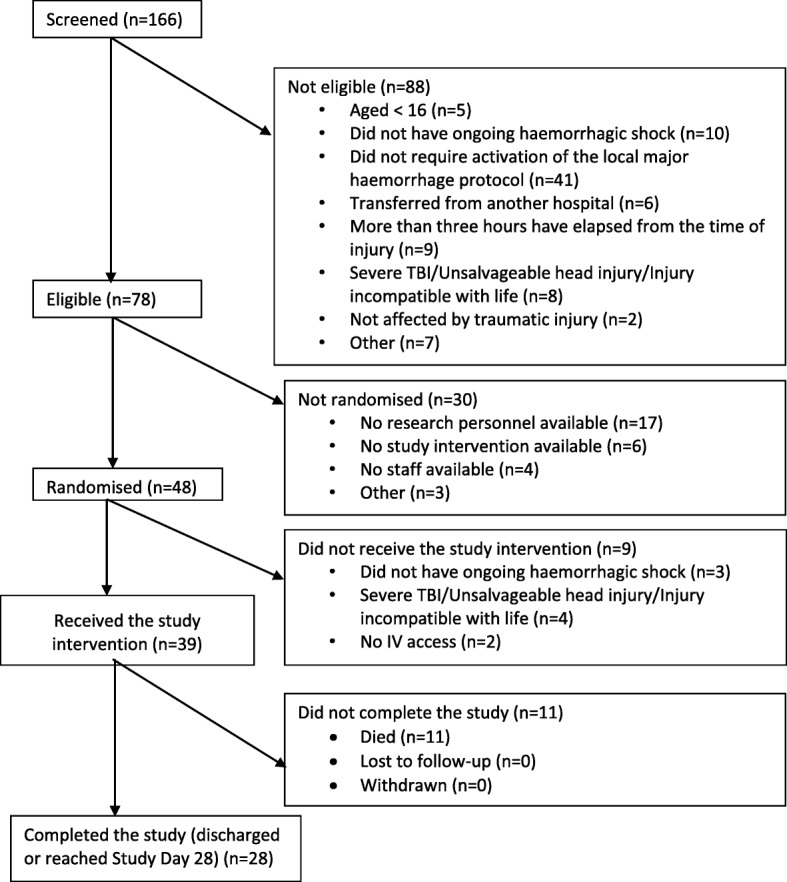
There is increasing interest in the timely administration of concentrated sources of fibrinogen to patients with major traumatic bleeding. Following evaluation of early cryoprecipitate in the CRYOSTAT 1 trial, we explored the use of fibrinogen concentrate, which may have advantages of more rapid administration in acute haemorrhage. The aims of this pragmatic study were to assess the feasibility of fibrinogen concentrate administration within 45 minutes of hospital admission and to quantify efficacy in maintaining fibrinogen levels ≥ 2 g/L during active haemorrhage.
We conducted a blinded, randomised, placebo-controlled trial at five UK major trauma centres with adult trauma patients with active bleeding who required activation of the major haemorrhage protocol. Participants were randomised to standard major haemorrhage therapy plus 6 g of fibrinogen concentrate or placebo.
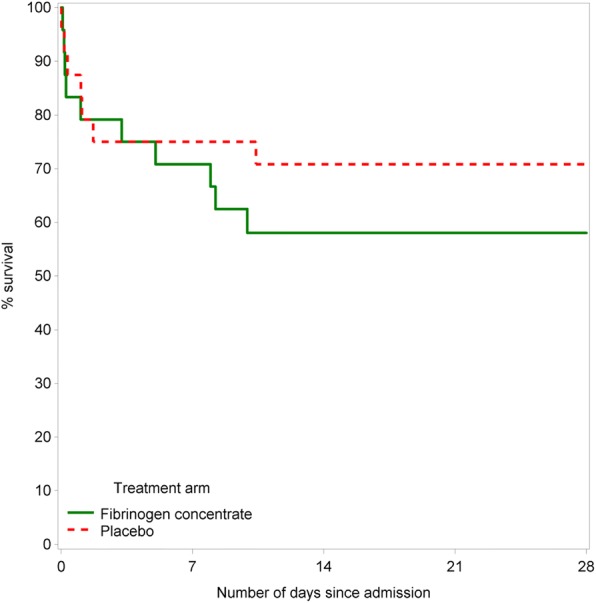
Twenty-seven of 39 participants (69%; 95% CI, 52-83%) across both arms received the study intervention within 45 minutes of admission. There was some evidence of a difference in the proportion of participants with fibrinogen levels ≥ 2 g/L between arms (p = 0.10). Fibrinogen levels in the fibrinogen concentrate (FgC) arm rose by a mean of 0.9 g/L (SD, 0.5) compared with a reduction of 0.2 g/L (SD, 0.5) in the placebo arm and were significantly higher in the FgC arm (p < 0.0001) at 2 hours. Fibrinogen levels were not different at day 7. Transfusion use and thromboembolic events were similar between arms. All-cause mortality at 28 days was 35.5% (95% CI, 23.8-50.8%) overall, with no difference between arms.
In this trial, early delivery of fibrinogen concentrate within 45 minutes of admission was not feasible. Although evidence points to a key role for fibrinogen in the treatment of major bleeding, researchers need to recognise the challenges of timely delivery in the emergency setting. Future studies must explore barriers to rapid fibrinogen therapy, focusing on methods to reduce time to randomisation, using 'off-the-shelf' fibrinogen therapies (such as extended shelf-life cryoprecipitate held in the emergency department or fibrinogen concentrates with very rapid reconstitution times) and limiting the need for coagulation test-based transfusion triggers.
ISRCTN67540073 . Registered on 5 August 2015.
人们对及时给予富含纤维蛋白原的浓缩物治疗大出血患者的兴趣日益增加。CRYOSTAT 1 试验评估了早期冷沉淀的效果后,我们探讨了纤维蛋白原浓缩物的应用,它在急性出血时可能具有更快的给药优势。本实用研究的目的是评估在入院 45 分钟内给予纤维蛋白原浓缩物的可行性,并定量评估在活动性出血期间将纤维蛋白原水平维持在≥2g/L 的效果。
我们在英国五家大型创伤中心进行了一项双盲、随机、安慰剂对照试验,纳入了需要启动大出血方案的活动性出血成年创伤患者。参与者被随机分配到标准大出血治疗加 6g 纤维蛋白原浓缩物或安慰剂。
在两个治疗组中,有 27/39 名参与者(69%;95%CI,52-83%)在入院 45 分钟内接受了研究干预。在两组中,纤维蛋白原水平≥2g/L 的参与者比例有一定的差异(p=0.10)。纤维蛋白原浓缩物(FgC)组的纤维蛋白原水平平均升高 0.9g/L(SD,0.5),而安慰剂组则降低 0.2g/L(SD,0.5),FgC 组的纤维蛋白原水平显著更高(p<0.0001),在 2 小时时。第 7 天的纤维蛋白原水平无差异。两组间输血使用和血栓栓塞事件相似。28 天的全因死亡率为 35.5%(95%CI,23.8-50.8%),两组间无差异。
在本试验中,入院 45 分钟内早期给予纤维蛋白原浓缩物是不可行的。尽管有证据表明纤维蛋白原在治疗大出血方面起着关键作用,但研究人员必须认识到在紧急情况下及时给予的挑战。未来的研究必须探索快速纤维蛋白原治疗的障碍,重点是减少随机分组时间的方法,使用“即用型”纤维蛋白原治疗(如在急诊室保存的延长货架期冷沉淀或具有非常快速再配置时间的纤维蛋白原浓缩物),并限制基于凝血试验的输血触发的需要。
ISRCTN67540073。于 2015 年 8 月 5 日注册。