Division of Endocrinology, Qilu Hospital of Shandong University, Jinan, Shandong, China.
Division of Endocrinology, The General Hospital of Jinan Military Command, 25 Shifan Road, Jinan, 250031, Shandong, China.
Lipids Health Dis. 2018 Jun 19;17(1):141. doi: 10.1186/s12944-018-0791-8.
A low-protein diet (LPD) is believed to be beneficial in slowing the progression of kidney disease. It is reported that low protein diet can improve protein, sugar and lipid metabolism, and reduce the symptoms and complications of renal insufficiency. However, there has been controversial regarding the effects of protein restriction on diabetic nephropathy (DN).
To investigate the efficacy of LPD on renal function in patients with type 1 or 2 DN by meta-analysis of randomized controlled trials (RCTs).
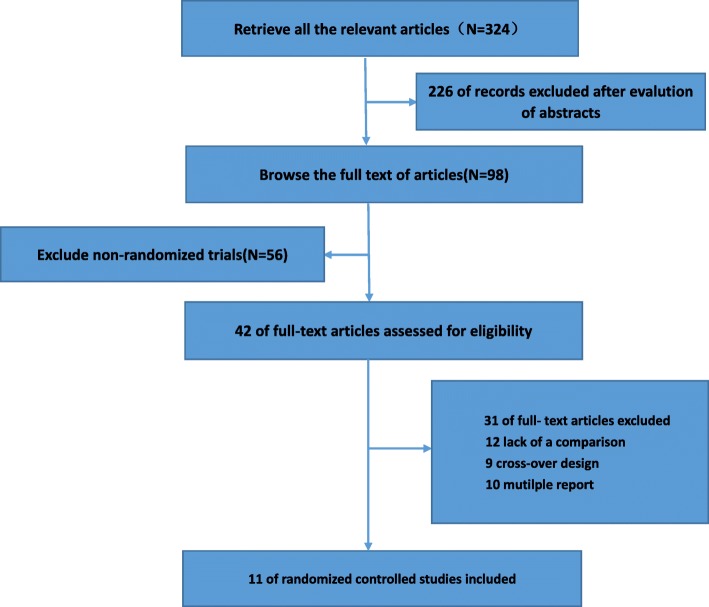
PubMed, MEDLINE, EMBASE and China National Knowledge Infrastructure databases were searched. Eleven randomized controlled trials met the inclusion criteria, of which 10 were English and 1 was Chinese. The primary outcome was a change in glomerular filtration rate (GFR). The secondary outcome was a change in proteinuria. Random-effects models were used to calculate the standardized mean difference (SMD) and the corresponding 95% confidence intervals (CI). Subgroup analyses were also performed.
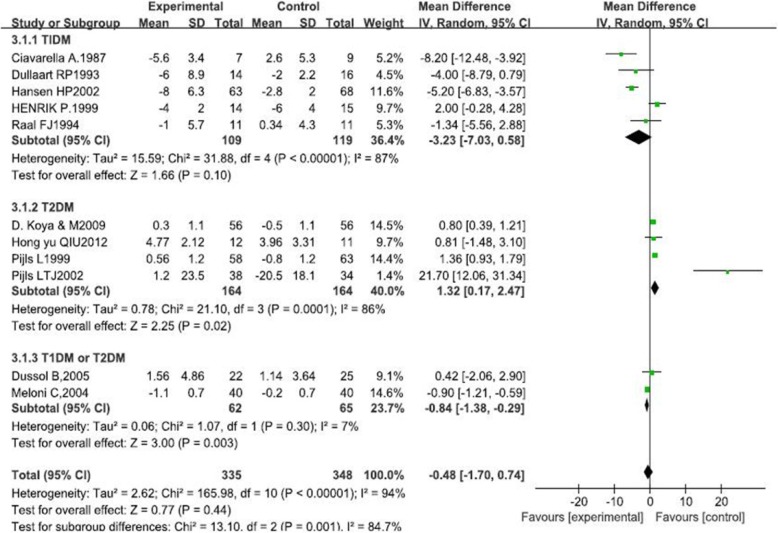
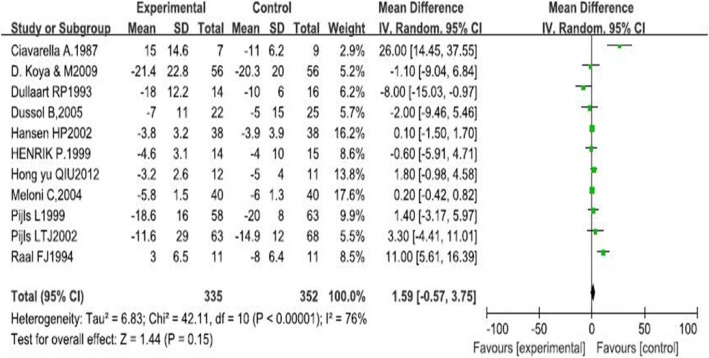
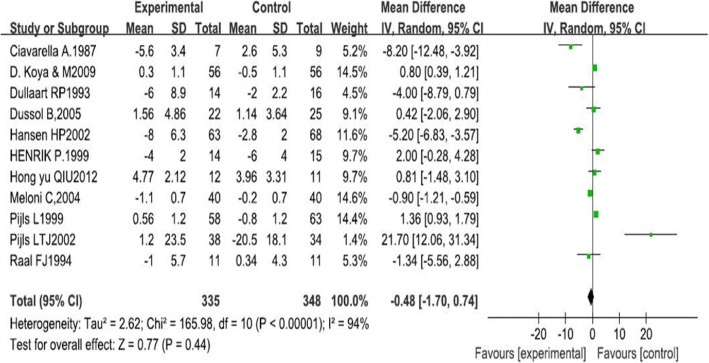
Our research indicated that LPD was not associated with a significant improvement in GFR (1.59 ml · min · 1.73 m, 95% CI -0.57, 3.75, I = 76%; p = 0.15). This effect was consistent across the subgroups regardless of type of diabetes, course of diabetes and intervention period. Our results also showed that there was no significant difference on improvement of proteinuria in patients of LPD and those in normal-protein diet groups (- 0.48, 95%CI-1.70, 0.74, I = 94%, p = 0.44). Subgroup analysis revealed that LPD resulted in increased excretion of proteinuria in patients with type 2 diabetes (1.32, 95% CI 0.17, 2.47, I = 86%, p = 0.02).
The present research showed that LPD was not significantly associated with improvement of renal function in patients with either type 1 or 2 diabetic nephropathy. Although these results do not completely eliminate the possibility that LPD is beneficial for patients with diabetic nephropathy, it does not seem to be significant benefit to renal function.
低蛋白饮食(LPD)被认为有益于减缓肾脏病的进展。据报道,低蛋白饮食可以改善蛋白质、糖和脂质代谢,减轻肾功能不全的症状和并发症。然而,关于蛋白质限制对糖尿病肾病(DN)的影响一直存在争议。
通过对随机对照试验(RCT)的荟萃分析,研究 LPD 对 1 型或 2 型 DN 患者肾功能的影响。
检索 PubMed、MEDLINE、EMBASE 和中国知网数据库。符合纳入标准的 11 项 RCT,其中 10 项为英文,1 项为中文。主要结局为肾小球滤过率(GFR)的变化。次要结局为蛋白尿的变化。采用随机效应模型计算标准化均数差(SMD)及其相应的 95%置信区间(CI)。还进行了亚组分析。
我们的研究表明,LPD 与 GFR 的显著改善无关(1.59 ml·min·1.73 m,95%CI-0.57,3.75,I=76%;p=0.15)。这种效应在不同类型的糖尿病、糖尿病病程和干预期的亚组中是一致的。我们的结果还表明,LPD 组和正常蛋白饮食组在改善蛋白尿方面没有显著差异(-0.48,95%CI-1.70,0.74,I=94%,p=0.44)。亚组分析显示,LPD 导致 2 型糖尿病患者蛋白尿排泄增加(1.32,95%CI 0.17,2.47,I=86%,p=0.02)。
本研究表明,LPD 与 1 型或 2 型糖尿病肾病患者的肾功能改善无显著相关性。尽管这些结果并没有完全排除 LPD 对糖尿病肾病患者有益的可能性,但它对肾功能似乎没有明显的益处。