Howard Hughes Medical Institute and Department of Molecular Biology, Massachusetts General Hospital, Boston, MA 02114.
Department of Systems Biology, Harvard Medical School, Boston, MA 02115.
Proc Natl Acad Sci U S A. 2018 Jul 3;115(27):E6283-E6290. doi: 10.1073/pnas.1711888115. Epub 2018 Jun 18.
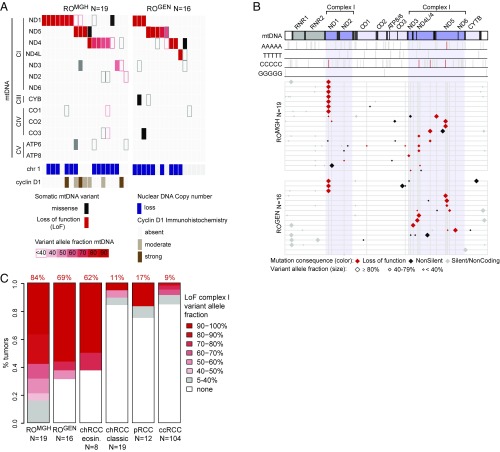
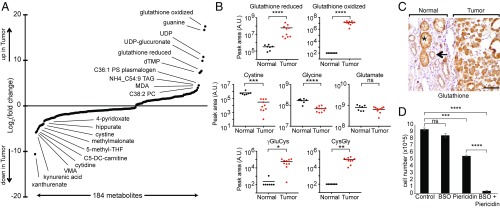
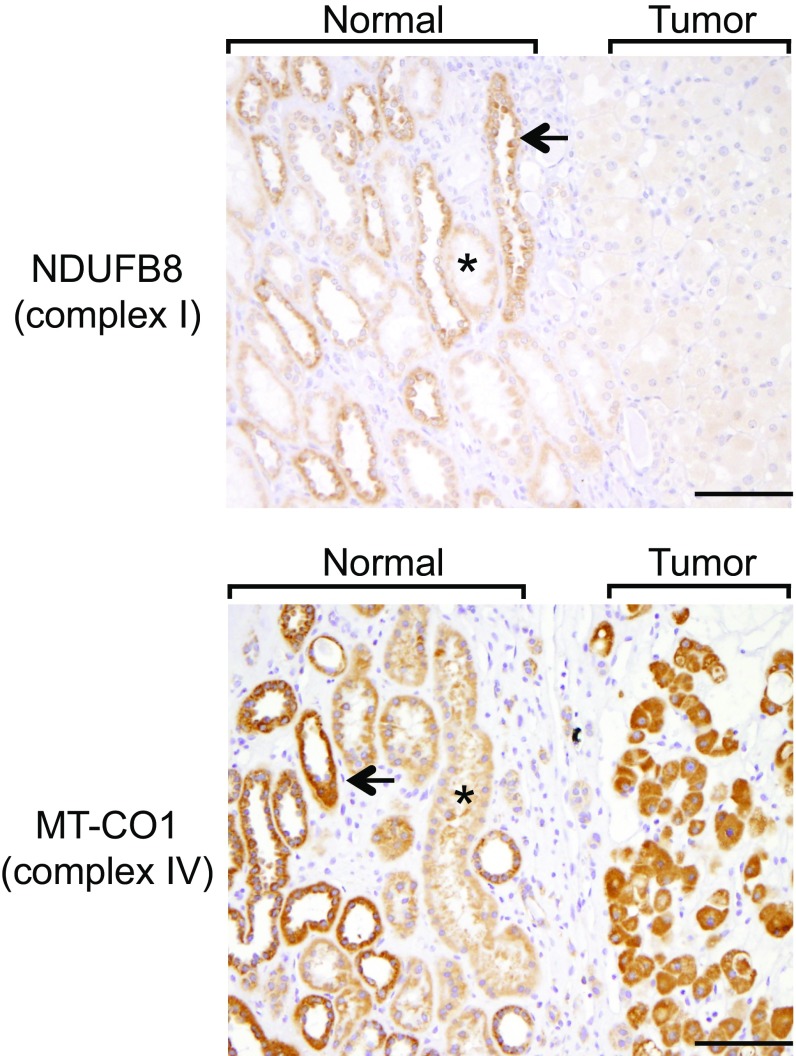
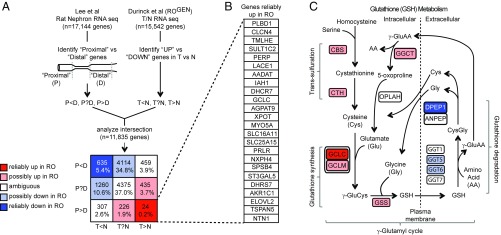
Renal oncocytomas are benign tumors characterized by a marked accumulation of mitochondria. We report a combined exome, transcriptome, and metabolome analysis of these tumors. Joint analysis of the nuclear and mitochondrial (mtDNA) genomes reveals loss-of-function mtDNA mutations occurring at high variant allele fractions, consistent with positive selection, in genes encoding complex I as the most frequent genetic events. A subset of these tumors also exhibits chromosome 1 loss and/or cyclin D1 overexpression, suggesting they follow complex I loss. Transcriptome data revealed that many pathways previously reported to be altered in renal oncocytoma were simply differentially expressed in the tumor's cell of origin, the distal nephron, compared with other nephron segments. Using a heuristic approach to account for cell-of-origin bias we uncovered strong expression alterations in the gamma-glutamyl cycle, including glutathione synthesis (increased ) and glutathione degradation. Moreover, the most striking changes in metabolite profiling were elevations in oxidized and reduced glutathione as well as γ-glutamyl-cysteine and cysteinyl-glycine, dipeptide intermediates in glutathione biosynthesis, and recycling, respectively. Biosynthesis of glutathione appears adaptive as blockade of GCLC impairs viability in cells cultured with a complex I inhibitor. Our data suggest that loss-of-function mutations in complex I are a candidate driver event in renal oncocytoma that is followed by frequent loss of chromosome 1, cyclin D1 overexpression, and adaptive up-regulation of glutathione biosynthesis.
肾嗜酸细胞瘤是一种良性肿瘤,其特征是线粒体大量积累。我们报告了对这些肿瘤进行的外显子组、转录组和代谢组联合分析。核基因组和线粒体基因组(mtDNA)的联合分析揭示了功能丧失的 mtDNA 突变,其变异等位基因分数很高,与编码复合物 I 的基因中的正选择一致,这是最常见的遗传事件。这些肿瘤的一部分还表现出 1 号染色体缺失和/或 cyclin D1 过表达,表明它们遵循复合物 I 缺失。转录组数据显示,先前报道的在肾嗜酸细胞瘤中发生改变的许多途径在肿瘤的起源细胞——远曲小管中与其他肾单位段相比只是差异表达。我们使用一种启发式方法来解释细胞起源偏差,发现γ-谷氨酰循环中的表达发生了强烈变化,包括谷胱甘肽合成(增加)和谷胱甘肽降解。此外,代谢组学分析中最显著的变化是氧化型和还原型谷胱甘肽以及γ-谷氨酰半胱氨酸和半胱氨酸甘氨酸的升高,它们分别是谷胱甘肽生物合成和循环的二肽中间产物。谷胱甘肽的生物合成似乎是适应性的,因为用复合物 I 抑制剂培养的细胞中 GCLC 的阻断会损害细胞活力。我们的数据表明,复合物 I 的功能丧失突变是肾嗜酸细胞瘤的候选驱动事件,随后经常发生 1 号染色体缺失、cyclin D1 过表达以及谷胱甘肽生物合成的适应性上调。