Yang Xue, Wang Yong, Li Qiyan, Zhong Yaxian, Chen Liangpei, Du Yajun, He Jing, Liao Lvshuang, Xiong Kun, Yi Chun-Xia, Yan Jie
Department of Forensic Science, School of Basic Medical Sciences, Central South University, Changsha, China.
Department of Anatomy and Neurobiology, School of Basic Medical Science, Central South University, Changsha, China.
Front Mol Neurosci. 2018 Jun 4;11:186. doi: 10.3389/fnmol.2018.00186. eCollection 2018.
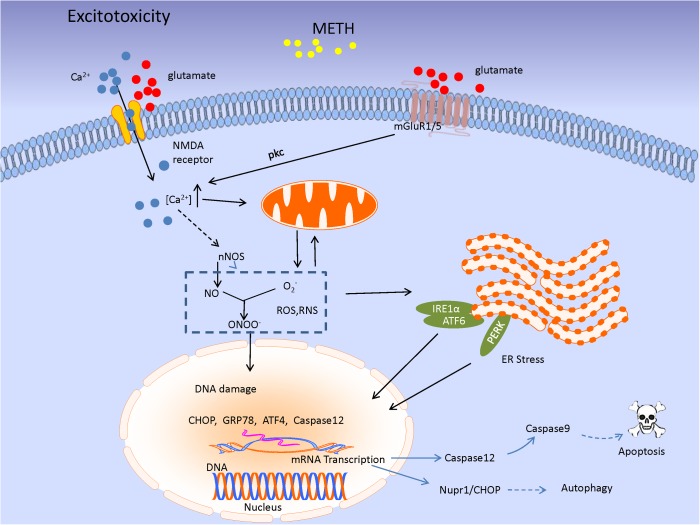
Methamphetamine (METH) is a popular new-type psychostimulant drug with complicated neurotoxicity. In spite of mounting evidence on METH-induced damage of neural cell, the accurate mechanism of toxic effect of the drug on central nervous system (CNS) has not yet been completely deciphered. Besides, effective treatment strategies toward METH neurotoxicity remain scarce and more efficacious drugs are to be developed. In this review, we summarize cellular and molecular bases that might contribute to METH-elicited neurotoxicity, which mainly include oxidative stress, excitotoxicity, and neuroinflammation. We also discuss some drugs that protect neural cells suffering from METH-induced neurotoxic consequences. We hope more in-depth investigations of exact details that how METH produces toxicity in CNS could be carried out in future and the development of new drugs as natural compounds and immunotherapies, including clinic trials, are expected.
甲基苯丙胺(METH)是一种广受欢迎的新型精神刺激药物,具有复杂的神经毒性。尽管有越来越多的证据表明METH会对神经细胞造成损伤,但该药物对中枢神经系统(CNS)产生毒性作用的确切机制尚未完全阐明。此外,针对METH神经毒性的有效治疗策略仍然匮乏,有待开发更有效的药物。在本综述中,我们总结了可能导致METH诱发神经毒性的细胞和分子基础,主要包括氧化应激、兴奋性毒性和神经炎症。我们还讨论了一些保护遭受METH诱导神经毒性后果的神经细胞的药物。我们希望未来能够对METH如何在CNS中产生毒性的具体细节进行更深入的研究,并期待开发新的药物,如天然化合物和免疫疗法,包括临床试验。