Barbot Mattia, Ceccato Filippo, Scaroni Carla
Endocrinology Unit, Department of Medicine DIMED, University of Padua, Padua, Italy.
Front Endocrinol (Lausanne). 2018 Jun 5;9:284. doi: 10.3389/fendo.2018.00284. eCollection 2018.
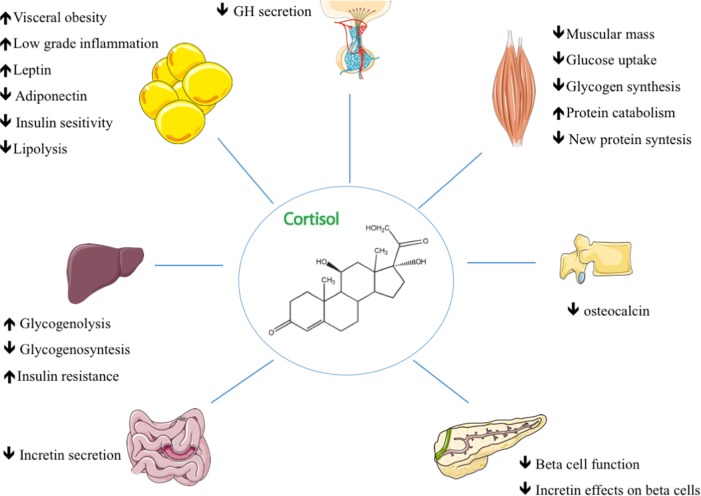
Associated with important comorbidities that significantly reduce patients' overall wellbeing and life expectancy, Cushing's disease (CD) is the most common cause of endogenous hypercortisolism. Glucocorticoid excess can lead to diabetes, and although its prevalence is probably underestimated, up to 50% of patients with CD have varying degrees of altered glucose metabolism. Fasting glycemia may nevertheless be normal in some patients in whom glucocorticoid excess leads primarily to higher postprandial glucose levels. An oral glucose tolerance test should thus be performed in all CD patients to identify glucose metabolism abnormalities. Since diabetes mellitus (DM) is a consequence of cortisol excess, treating CD also serves to alleviate impaired glucose metabolism. Although transsphenoidal pituitary surgery remains the first-line treatment for CD, it is not always effective and other treatment strategies may be necessary. This work examines the main features of DM secondary to CD and focuses on antidiabetic drugs and how cortisol-lowering medication affects glucose metabolism.
库欣病(CD)与严重降低患者整体健康状况和预期寿命的重要合并症相关,是内源性皮质醇增多症最常见的病因。糖皮质激素过量可导致糖尿病,尽管其患病率可能被低估,但高达50%的CD患者有不同程度的糖代谢改变。然而,在一些糖皮质激素过量主要导致餐后血糖水平升高的患者中,空腹血糖可能正常。因此,所有CD患者均应进行口服葡萄糖耐量试验,以识别糖代谢异常。由于糖尿病(DM)是皮质醇过量的结果,治疗CD也有助于缓解糖代谢受损。尽管经蝶窦垂体手术仍然是CD的一线治疗方法,但它并不总是有效,可能需要其他治疗策略。这项工作研究了继发于CD的DM的主要特征,并重点关注抗糖尿病药物以及降低皮质醇的药物如何影响糖代谢。