Chicheportiche Alexandre, Artoul Faozi, Schwartz Arnon, Grozinsky-Glasberg Simona, Meirovitz Amichay, Gross David J, Godefroy Jeremy
Department of Nuclear Medicine and Biophysics, Hadassah-Hebrew University Medical Center, 91120, Jerusalem, Israel.
Neuroendocrine Tumor Unit, Endocrinology and Metabolism Department, Hadassah-Hebrew University Medical Center, 91120, Jerusalem, Israel.
EJNMMI Phys. 2018 Jun 19;5(1):10. doi: 10.1186/s40658-018-0211-1.
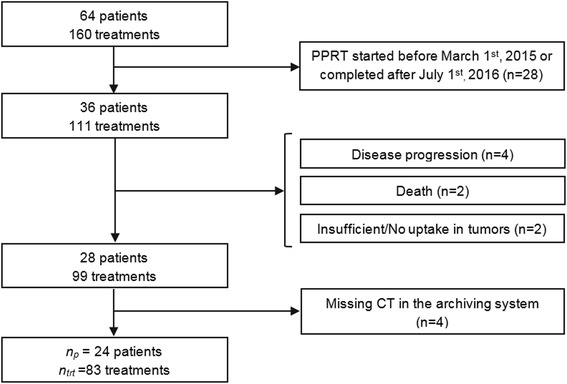
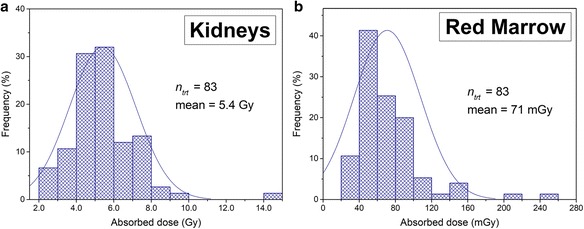
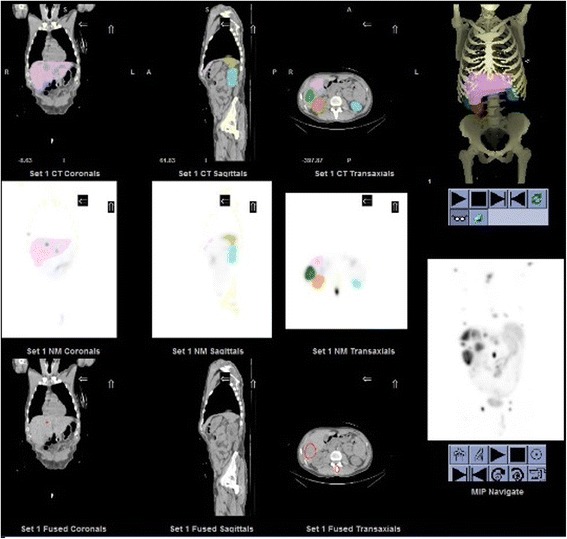
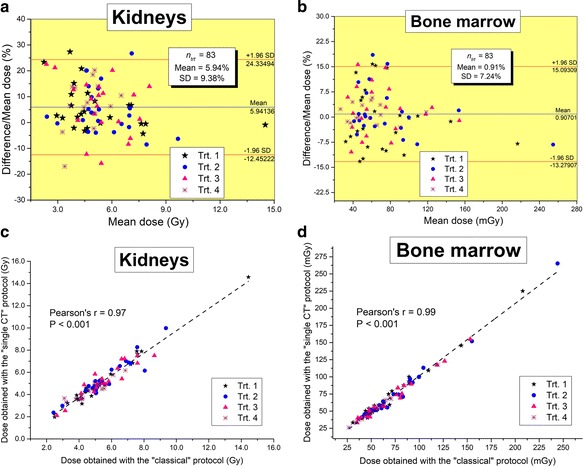
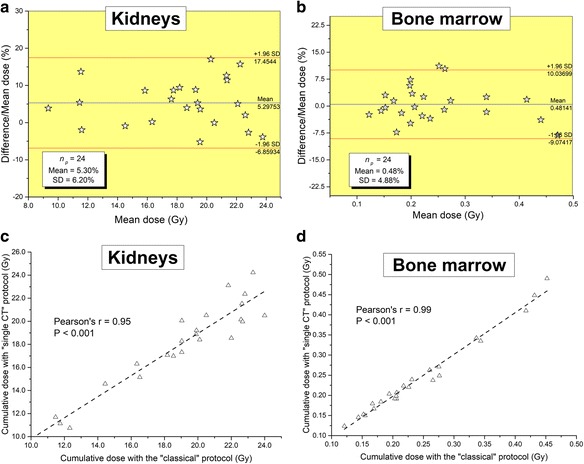
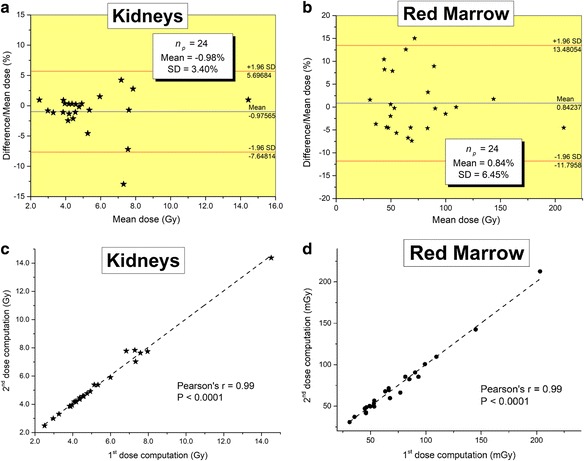
Peptide receptor radionuclide therapy (PRRT) with [Lu]-DOTA-TATE is an effective treatment of neuroendocrine tumors (NETs). After each cycle of treatment, patient dosimetry evaluates the radiation dose to the risk organs, kidneys, and bone marrow, the most radiosensitive tissues. Absorbed doses are calculated from the radioactivity in the blood and from single photon emission computed tomography (SPECT) images corrected by computed tomography (CT) acquired after each course of treatment. The aim of this work is to assess whether the dosimetry along all treatment cycles can be calculated using a single CT. We hypothesize that the absorbed doses to the risk organs calculated with a single CT will be accurate enough to correctly manage the patients, i.e., whether or not to continue PRRT. Twenty-four patients diagnosed with metastatic NETs undergoing PRRT with [Lu]-DOTA-TATE were retrospectively included in this study. We compared radiation doses to the kidneys and bone marrow using two protocols. In the "classical" one, dosimetry is calculated based on a SPECT and a CT after each treatment cycle. In the new protocol, dosimetry is calculated based on a SPECT study after each cycle but with the first acquired CT for all cycles.
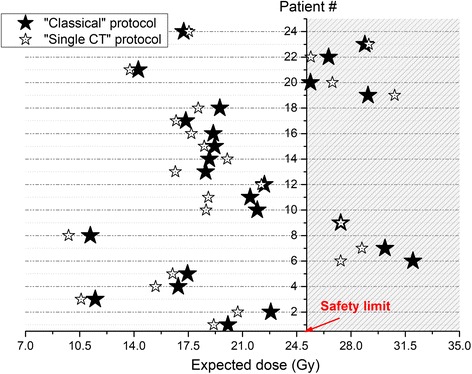
The decision whether or not to stop PRRT because of unsafe absorbed dose to the risk organs would have been the same had the classical or the new protocol been used. The agreement between the cumulative doses to the kidneys and bone marrow obtained from the two protocols was excellent with Pearson's correlation coefficients r = 0.95 and r = 0.99 (P < 0.0001) and mean relative differences of 5.30 ± 6.20% and 0.48 ± 4.88%, respectively.
Dosimetry calculations for a given patient can be done using a single CT registered to serial SPECTs. This new protocol reduces the need for a hybrid camera in the follow-up of patients receiving [Lu]-DOTA-TATE.
使用[镥]-多胺基多羧基大环配体-奥曲肽进行肽受体放射性核素治疗(PRRT)是治疗神经内分泌肿瘤(NETs)的一种有效方法。在每个治疗周期后,患者剂量测定评估对风险器官、肾脏和骨髓(最具放射敏感性的组织)的辐射剂量。吸收剂量根据血液中的放射性以及每个疗程后通过计算机断层扫描(CT)校正的单光子发射计算机断层扫描(SPECT)图像来计算。本研究的目的是评估是否可以使用单次CT计算整个治疗周期的剂量测定。我们假设用单次CT计算的对风险器官的吸收剂量将足够准确,以正确管理患者,即是否继续PRRT。本研究回顾性纳入了24例接受[镥]-多胺基多羧基大环配体-奥曲肽PRRT治疗的转移性NETs患者。我们使用两种方案比较了对肾脏和骨髓的辐射剂量。在“经典”方案中,剂量测定基于每个治疗周期后的SPECT和CT来计算。在新方案中,剂量测定基于每个周期后的SPECT研究,但所有周期均使用首次获取的CT。
无论使用经典方案还是新方案,因对风险器官的吸收剂量不安全而决定是否停止PRRT的结果都是相同的。两种方案获得的肾脏和骨髓累积剂量之间的一致性非常好,Pearson相关系数r分别为0.95和0.99(P<0.0001),平均相对差异分别为5.30±6.20%和0.48±4.88%。
对于给定患者的剂量测定计算可以使用与系列SPECT配准的单次CT来完成。这种新方案减少了接受[镥]-多胺基多羧基大环配体-奥曲肽治疗患者随访中对混合型相机的需求。