Division of Neonatal Medicine, Loma Linda University Children's Hospital, Loma Linda, California.
Pediatric Infectious Diseases, Children's Medical Center, NYU Winthrop, Mineola, New York.
Am J Perinatol. 2018 Dec;35(14):1433-1442. doi: 10.1055/s-0038-1660466. Epub 2018 Jun 19.
The objective of this study was to compare risk for respiratory syncytial virus (RSV) hospitalizations (RSVH) for preterm infants 29 to 34 weeks gestational age (wGA) versus term infants before and after 2014 guidance changes for immunoprophylaxis (IP), using data from the 2012 to 2016 RSV seasons.
Using commercial and Medicaid claims databases, infants born between July 1, 2011 and June 30, 2016 were categorized as preterm or term. RSVH during the RSV season (November-March) were identified for infants aged <6 months and rate ratios (RRs) for hospitalization comparing preterm and term infants were calculated. Difference-in-difference models were fit to evaluate the changes in hospitalization risks in preterm versus term infants from 2012 to 2014 seasons to 2014 to 2016 seasons.
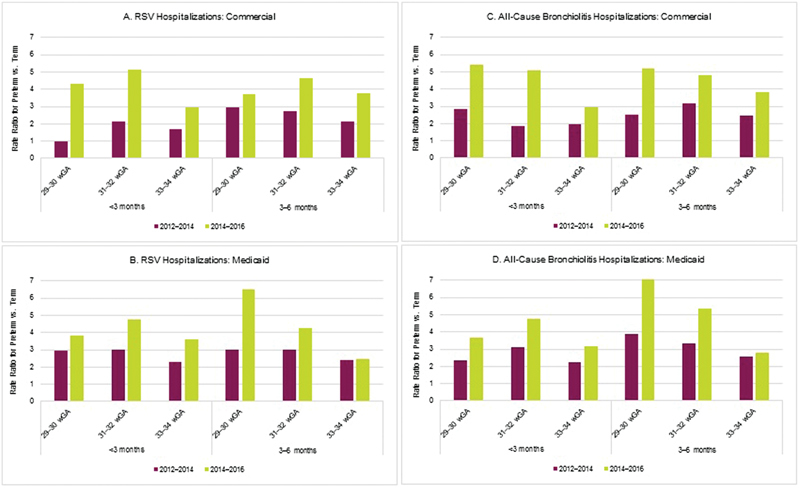
In all seasons, preterm infants had higher RSVH rates than term infants. Seasonal RRs prior to the guidance change for preterm wGA categories versus term infants ranged from 1.6 to 3.4. After the guidance change, the seasonal RRs ranged from 2.6 to 5.6. In 2014 to 2016, the risk associated with prematurity of 29 to 34 wGA versus term was significantly higher than in 2012 to 2014 (<0.0001 for commercial and Medicaid samples).
In infants aged <6 months, the risk for RSVH for infants 29 to 34 wGA compared with term infants increased significantly after the RSV IP recommendations became more restrictive.
本研究旨在比较 29 至 34 孕周(GA)早产儿与足月儿在免疫预防(IP)指南改变前后,2012 至 2016 年 RSV 季节呼吸道合胞病毒(RSV)住院(RSVH)的风险。
利用商业和医疗补助数据库,将 2011 年 7 月 1 日至 2016 年 6 月 30 日出生的婴儿分为早产儿或足月儿。确定 <6 月龄婴儿在 RSV 季节(11 月至 3 月)的 RSVH,并计算比较早产儿和足月儿住院率的比值比(RR)。采用差异中的差异模型,评估 2012 至 2014 季节与 2014 至 2016 季节早产儿与足月儿住院风险的变化。
所有季节,早产儿 RSVH 发生率均高于足月儿。指南改变前,早产儿各 GA 类别与足月儿相比,各季节 RR 值范围为 1.6 至 3.4。指南改变后,RR 值范围为 2.6 至 5.6。2014 至 2016 年,29 至 34 GA 早产儿与足月儿相比,早产相关风险明显高于 2012 至 2014 年(商业和医疗补助样本均<0.0001)。
在 <6 月龄婴儿中,与足月儿相比,29 至 34 GA 早产儿 RSVH 的风险在 RSV IP 建议变得更严格后显著增加。