Lynch Brenda, Fitzgerald Anthony P, Corcoran Paul, Healy Orla, Buckley Claire, Foley Conor, Browne John
University College Cork, School of Public Health, 4th Floor, Western Gateway Building, Western Road, Cork City, Ireland.
Health Service Executive, South/South West Hospital Group, Ernville, Western Road, Cork, Ireland.
BMC Health Serv Res. 2018 Jun 19;18(1):474. doi: 10.1186/s12913-018-3260-1.
In the past decade, the Republic of Ireland has undertaken significant reconfiguration programmes to improve emergency services. During this time the public healthcare system experienced a large real decrease in resources. This study assesses national and regional population outcomes over the period 2002-2014, and whether changes coincide with system reconfiguration and the financial restrictions imposed by the 2008 recession.
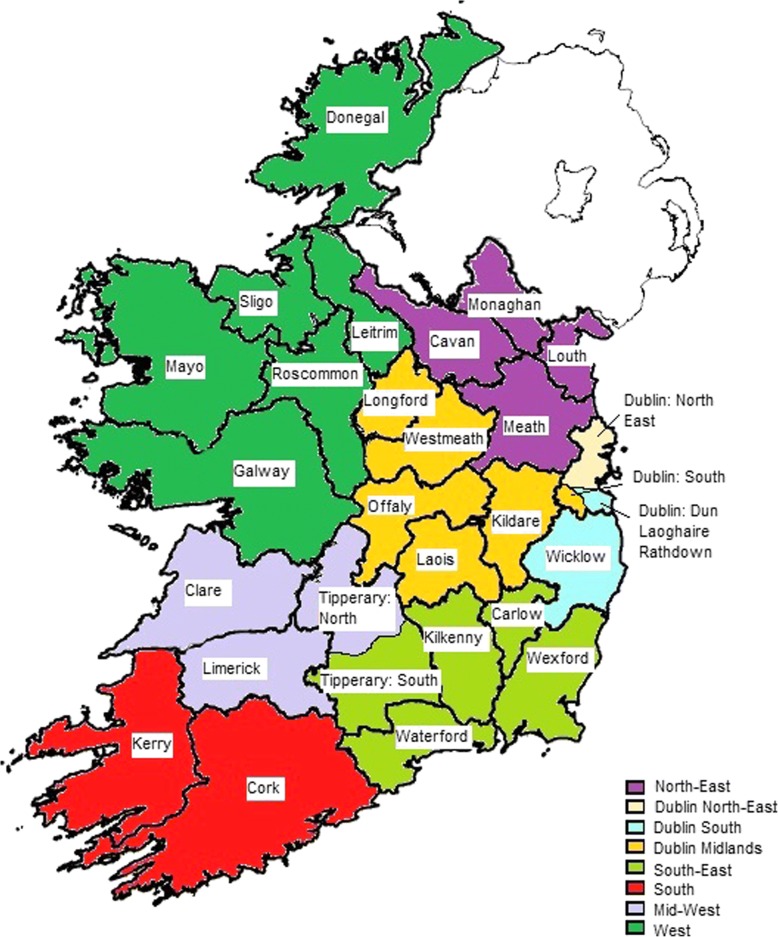
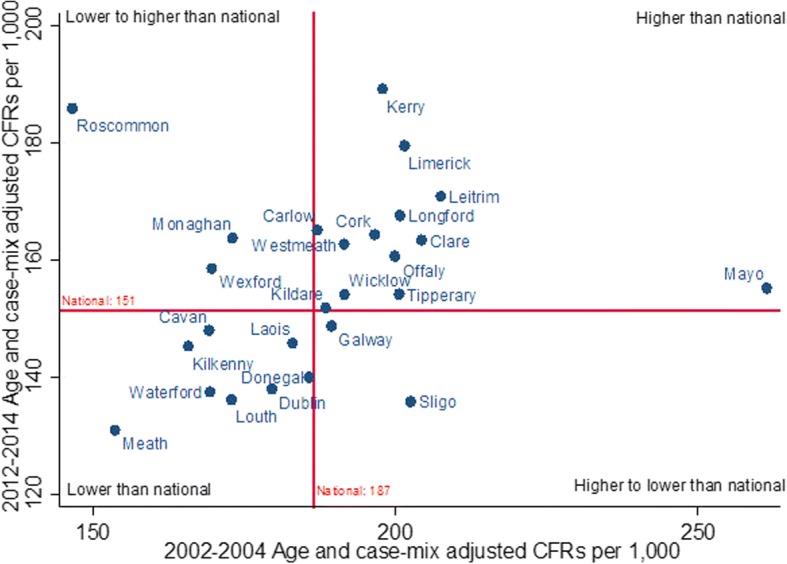
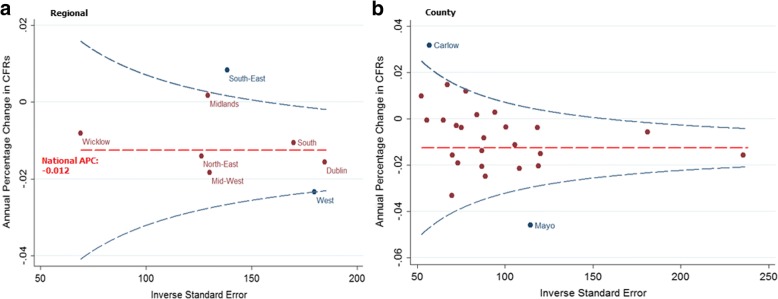
Case fatality ratios (CFRs) were constructed for emergency conditions for 2002-2014. Total emergency conditions and individual condition trends were analysed nationally using joinpoint analysis. National results informed the investigation of trends at a regional and county level using an inverse standard error weighted generalised linear model with a log link to construct funnel plots. County-level CFRs were compared for the first and last 3 years of the period to further investigate the changes to county results over the 13 year period, specifically in comparison to the national-level CFR.
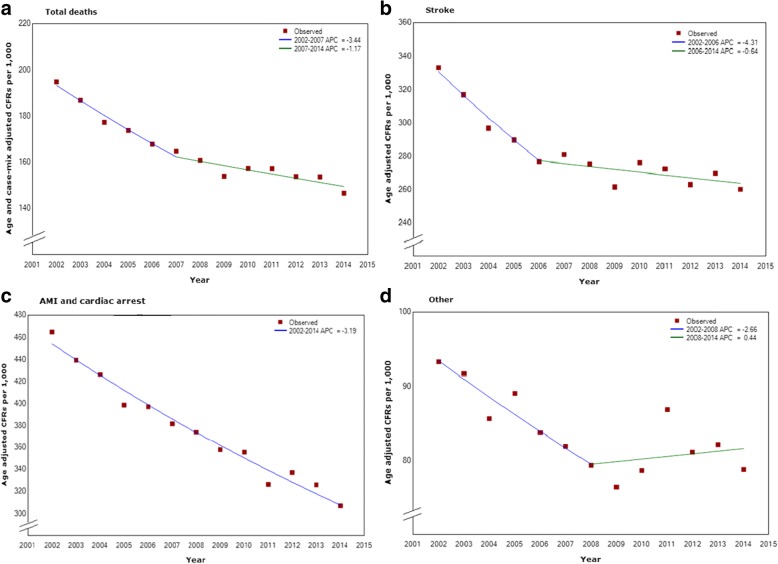
Nationally, there was an annual fall in CFRs (2.1%). The decline was faster from 2002 to 2007 (annual percentage change = - 3.4; 95% CI-4.4, - 2.4), compared to 2007-2014 (annual percentage change = - 1.2; 95% CI -1.9, - 0.5). The South-East had a lower rate of decrease and the West had a higher rate. Cross sectional analysis of two periods (2002-2004 and 2012-2014) showed high consistency in the counties performance relative to the national CFR in both periods.
Change in the national trend coincided with the onset of economic stress on the public health system. Attributing the decline in CFR improvement to economic factors is weakened by the uneven nature of the trend change. No distinct pattern of change was identified among regions which underwent substantial reconfiguration of emergency services.
在过去十年中,爱尔兰共和国开展了重大的重新配置计划以改善紧急服务。在此期间,公共医疗系统的资源实际大幅减少。本研究评估了2002年至2014年期间全国和地区的人口结果,以及这些变化是否与系统重新配置和2008年经济衰退所带来的财政限制相吻合。
构建了2002年至2014年紧急情况的病死率(CFR)。使用连接点分析对全国范围内的总紧急情况和个体情况趋势进行了分析。利用具有对数链接的逆标准误差加权广义线性模型构建漏斗图,根据全国结果对地区和县级的趋势进行调查。比较了该时期前三年和后三年的县级CFR,以进一步研究13年期间县级结果的变化,特别是与国家级CFR进行比较。
在全国范围内,CFR呈年度下降趋势(2.1%)。与2007年至2014年(年度百分比变化=-1.2;95%可信区间-1.9,-0.5)相比,2002年至2007年下降速度更快(年度百分比变化=-3.4;95%可信区间-4.4,-2.4)。东南部的下降速度较低,而西部的下降速度较高。对两个时期(2002年至2004年和2012年至2014年)的横断面分析表明,两个时期各县相对于国家CFR的表现具有高度一致性。
全国趋势的变化与公共卫生系统经济压力的出现相吻合。趋势变化的不均衡性质削弱了将CFR改善下降归因于经济因素的说法。在经历了紧急服务重大重新配置的地区中,未发现明显的变化模式。