Ferreira E, Porter R M
Departments of Internal Medicine and Orthopaedic Surgery, University of Arkansas for Medical Sciences, Little Rock, Arkansas, USA.
Bone Joint Res. 2018 May 5;7(4):263-273. doi: 10.1302/2046-3758.74.BJR-2018-0006. eCollection 2018 Apr.
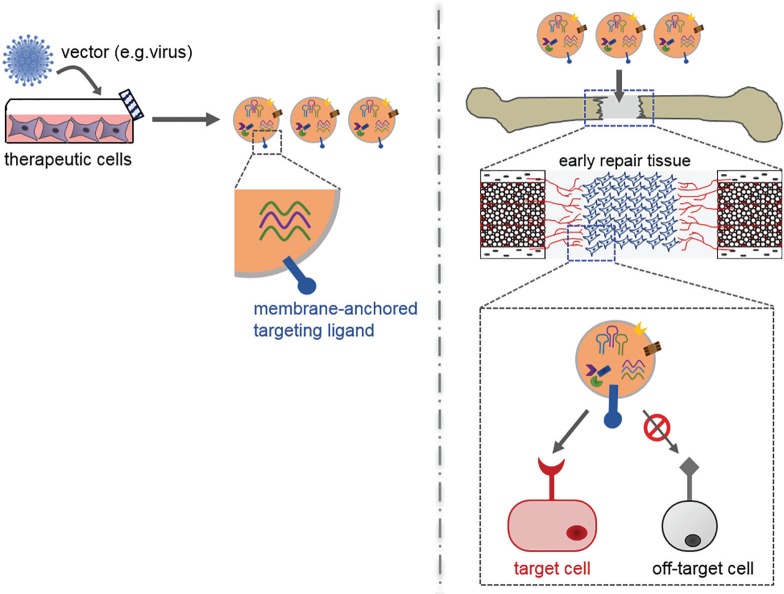
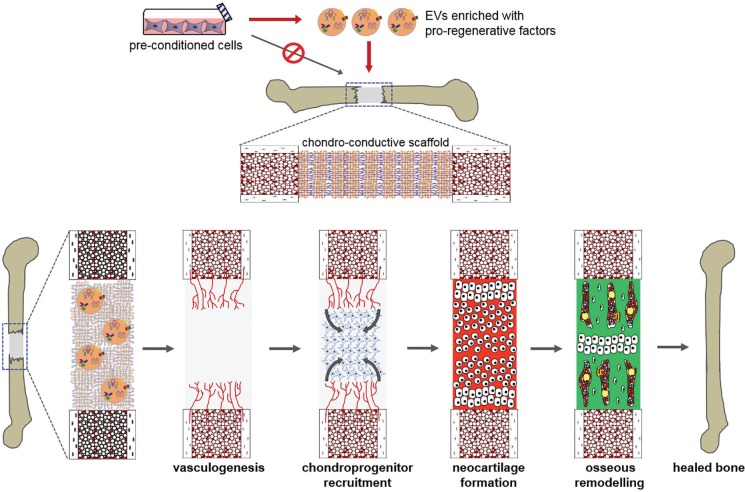
Large bone defects remain a tremendous clinical challenge. There is growing evidence in support of treatment strategies that direct defect repair through an endochondral route, involving a cartilage intermediate. While culture-expanded stem/progenitor cells are being evaluated for this purpose, these cells would compete with endogenous repair cells for limited oxygen and nutrients within ischaemic defects. Alternatively, it may be possible to employ extracellular vesicles (EVs) secreted by culture-expanded cells for overcoming key bottlenecks to endochondral repair, such as defect vascularization, chondrogenesis, and osseous remodelling. While mesenchymal stromal/stem cells are a promising source of therapeutic EVs, other donor cells should also be considered. The efficacy of an EV-based therapeutic will likely depend on the design of companion scaffolds for controlled delivery to specific target cells. Ultimately, the knowledge gained from studies of EVs could one day inform the long-term development of synthetic, engineered nanovesicles. In the meantime, EVs harnessed from cell culture have near-term promise for use in bone regenerative medicine. This narrative review presents a rationale for using EVs to improve the repair of large bone defects, highlights promising cell sources and likely therapeutic targets for directing repair through an endochondral pathway, and discusses current barriers to clinical translation. : E. Ferreira, R. M. Porter. Harnessing extracellular vesicles to direct endochondral repair of large bone defects. 2018;7:263-273. DOI: 10.1302/2046-3758.74.BJR-2018-0006.
大的骨缺损仍然是一个巨大的临床挑战。越来越多的证据支持通过软骨内途径引导缺损修复的治疗策略,该途径涉及软骨中间体。虽然正在评估用于此目的的培养扩增的干/祖细胞,但这些细胞会与内源性修复细胞在缺血性缺损内争夺有限的氧气和营养物质。或者,有可能利用培养扩增细胞分泌的细胞外囊泡(EVs)来克服软骨内修复的关键瓶颈,如缺损血管化、软骨形成和骨重塑。虽然间充质基质/干细胞是治疗性EVs的一个有前景的来源,但也应考虑其他供体细胞。基于EVs的治疗效果可能取决于用于将其可控递送至特定靶细胞的配套支架的设计。最终,从EVs研究中获得的知识有朝一日可能为合成工程纳米囊泡的长期发展提供信息。与此同时,从细胞培养中获取的EVs在骨再生医学中有近期应用前景。这篇叙述性综述提出了使用EVs改善大骨缺损修复的理论依据,强调了有前景的细胞来源和通过软骨内途径引导修复的可能治疗靶点,并讨论了当前临床转化的障碍。作者:E. 费雷拉、R. M. 波特。利用细胞外囊泡引导大骨缺损的软骨内修复。2018年;7卷:263 - 273页。DOI: 10.1302/2046 - 3758.74.BJR - 2018 - 0006 。