Centre for Conservation Research, Calgary Zoological Society, 1300 Zoo Road, NE, Calgary, Alberta T2E 7V6, Canada.
International Union for Conservation of Nature, Species Survival Commission Reintroduction Specialist Group, Gland, Switzerland.
Conserv Biol. 2019 Feb;33(1):33-39. doi: 10.1111/cobi.13160. Epub 2018 Sep 7.
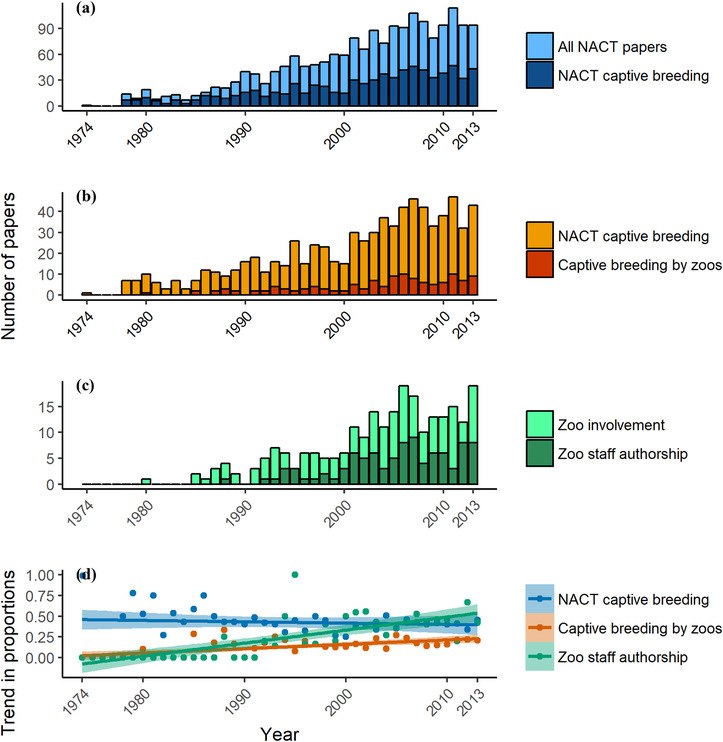
With the loss of biodiversity accelerating, conservation translocations such as reintroductions are becoming an increasingly common conservation tool. Conservation translocations must source individuals for release from either wild or captive-bred populations. We asked what proportion of North American conservation translocations rely on captive breeding and to what extent zoos and aquaria (hereafter zoos) fulfill captive breeding needs. We searched for mention of captive breeding and zoo involvement in all 1863 articles included in the North American Conservation Translocations database, which comprises journal articles and grey literature published before 2014 on conservation translocations in Canada, the United States, Mexico, the Caribbean, and Central America before 2014 as identified by a comprehensive literature review. Conservation translocations involved captive breeding for 162 (58%) of the 279 animal species translocated. Fifty-four zoos contributed animals for release. The 40 species of animals bred for release by zoos represented only 14% of all animal species for which conservation translocations were published and only 25% of all animal species that were bred for releases occurring in North America. Zoo contributions varied by taxon, ranging from zoo-bred animals released in 42% of amphibian conservation translocations to zero contributions for marine invertebrates. Proportional involvement of zoos in captive-breeding programs for release has increased from 1974 to 2014 (r = 0.325, p = 0.0313) as has the proportion of translocation-focused scientific papers coauthored by zoo professionals (from 0% in 1974 to 42% in 2013). Although zoos also contribute to conservation translocations through education, funding, and professional expertise, increasing the contribution of animals for release in responsible conservation translocation programs presents a future conservation need and opportunity. We especially encourage increased dialogue and planning between the zoo community, academic institutions, and governments to optimize the direct contribution zoos can make to wildlife conservation through conservation translocations.
随着生物多样性的丧失加速,保护转移(如再引入)正成为一种越来越常见的保护工具。保护转移必须从野生或圈养繁殖种群中为释放寻找个体。我们询问了有多少北美保护转移依赖于圈养繁殖,以及动物园和水族馆(以下简称动物园)在多大程度上满足了圈养繁殖的需求。我们在北美保护转移数据库中搜索了 1863 篇文章中的所有文章,这些文章包括在加拿大、美国、墨西哥、加勒比海和中美洲进行的保护转移的期刊文章和灰色文献,这些文章是通过全面的文献综述确定的,发表时间在 2014 年之前。279 种被转移的动物中有 162 种(58%)涉及圈养繁殖。54 家动物园提供了用于释放的动物。动物园为释放而繁殖的 40 个物种仅占所有公布的用于保护转移的动物物种的 14%,仅占在北美进行的释放的所有动物物种的 25%。动物园的贡献因分类群而异,从两栖动物保护转移中释放的动物园繁殖动物占 42%到无海洋无脊椎动物的零贡献。动物园参与圈养繁殖计划的比例从 1974 年到 2014 年有所增加(r = 0.325,p = 0.0313),动物园专业人员合著的以转移为重点的科学论文的比例也从 1974 年的 0%增加到 2013 年的 42%。尽管动物园还通过教育、资金和专业知识为保护转移做出贡献,但增加负责任的保护转移计划中用于释放的动物数量是未来的保护需求和机会。我们特别鼓励动物园社区、学术机构和政府之间加强对话和规划,以优化动物园通过保护转移对野生动物保护的直接贡献。