Biomechanics and Movement Science Program, University of Delaware, Newark, Delaware.
Department of Physical Therapy, University of Delaware, Newark, Delaware.
Sports Health. 2018 Sep/Oct;10(5):441-452. doi: 10.1177/1941738118779023. Epub 2018 Jun 20.
The Anterior Cruciate Ligament-Specialized Post-Operative Return to Sports (ACL-SPORTS) randomized controlled trial was designed to address deficits in functional and patient-reported outcomes. The trial examined the effects of a secondary ACL prevention program that included progressive strengthening, agility training, plyometrics (SAP), and other components of current primary prevention protocols, with perturbation training (SAP + PERT group) and without PERT (SAP group). A secondary purpose of this study was to examine whether study outcomes differed between men and women.
(1) Athletes in both the SAP and SAP + PERT groups will have improved knee function and patient-reported outcome measures from pre- to posttraining, (2) the SAP + PERT group would have higher outcome scores than the SAP group, and (3) outcomes will differ by sex.
Randomized controlled trial (NCT01773317).
Level 2.
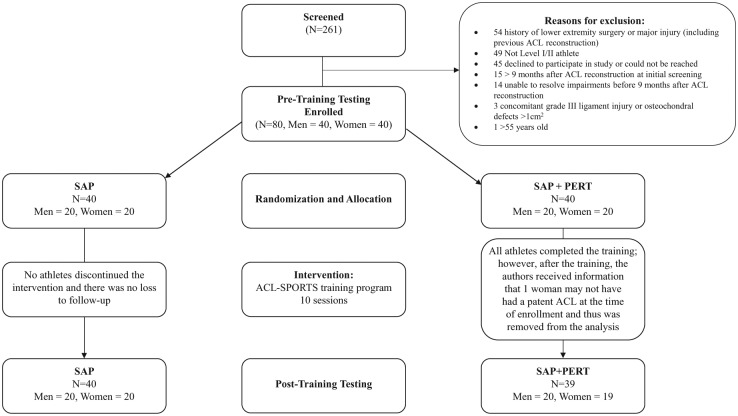
A total of 79 athletes (39 women) were randomized into the SAP and SAP + PERT groups. All athletes had undergone primary ACL reconstruction and achieved 80% quadriceps strength limb symmetry (QI), full range of motion, had minimal effusion, and had no pain. Additionally, all had begun running again. Prior to and after the training program, athletes' QI, hopping, and patient-reported outcomes were assessed. Repeated-measures analyses of variance were used to determine whether there were differences between groups. Subsequently, the SAP and SAP + PERT groups were collapsed to analyze differences between sexes.
There were significant increases for all variables, with the exception of QI. There were no differences between the SAP and SAP + PERT groups. Both men and women made significant improvements in all knee function and patient-reported outcome measures except QI. Men made significant improvements in QI, whereas women did not.
The common elements of the training program that all athletes received (10 sessions of progressive strengthening, agility training, plyometrics, and secondary prevention) may be a beneficial addition to the return-to-sport phase of ACL reconstruction rehabilitation. The results suggest that women may require further quadriceps strengthening to maintain and improve QI, an important focus given the relationship between QI and risk for reinjury.
During the return-to-sport phase of ACL reconstruction rehabilitation, clinicians tend to shift their focus away from strengthening toward more advanced sports-related tasks. These results indicate that women in particular need continued focus on quadriceps strengthening.
前交叉韧带专业术后重返运动(ACL-SPORTS)随机对照试验旨在解决功能和患者报告结果方面的缺陷。该试验研究了二次 ACL 预防计划的效果,该计划包括渐进式强化、敏捷训练、增强式训练(SAP)和当前初级预防方案的其他组成部分,包括扰动训练(SAP + PERT 组)和无 PERT(SAP 组)。本研究的次要目的是检查研究结果是否因性别而异。
(1)SAP 和 SAP + PERT 组的运动员在训练前后的膝关节功能和患者报告的结果测量都将得到改善,(2)SAP + PERT 组的结果评分将高于 SAP 组,(3)结果将因性别而异。
随机对照试验(NCT01773317)。
2 级。
共有 79 名运动员(39 名女性)被随机分配到 SAP 和 SAP + PERT 组。所有运动员均接受了初次 ACL 重建,并达到了 80%的股四头肌力量(QI)、全运动范围、最小量的积液且无疼痛。此外,所有运动员均已开始重新跑步。在训练计划之前和之后,评估运动员的 QI、跳跃和患者报告的结果。使用重复测量方差分析来确定组间是否存在差异。随后,将 SAP 和 SAP + PERT 组合并以分析性别间的差异。
除 QI 外,所有变量均有显著增加。SAP 和 SAP + PERT 组之间没有差异。男女运动员的所有膝关节功能和患者报告的结果测量均有显著改善,除 QI 外。男性的 QI 有显著改善,而女性没有。
所有运动员接受的训练计划的共同要素(10 次渐进式强化、敏捷训练、增强式训练和二级预防)可能是 ACL 重建康复重返运动阶段的有益补充。结果表明,女性可能需要进一步加强股四头肌力量,以维持和提高 QI,鉴于 QI 与再受伤风险之间的关系,这是一个重要的关注点。
在 ACL 重建康复的重返运动阶段,临床医生往往会将注意力从强化转移到更高级的与运动相关的任务上。这些结果表明,特别是女性需要继续关注股四头肌的强化。