National Oceanic and Atmospheric Administration, Center for Coastal Fisheries and Habitat Research, Beaufort, North Carolina, United States of America.
Institut Louis Malardé (ILM)-UMR 241 EIO, Laboratory of Toxic-Microalgae, Papeete, Tahiti, French Polynesia.
PLoS One. 2018 Jun 20;13(6):e0198358. doi: 10.1371/journal.pone.0198358. eCollection 2018.
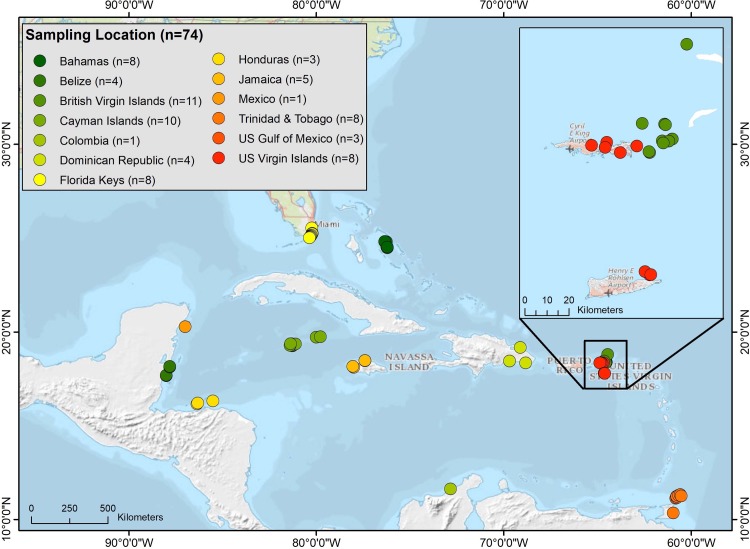
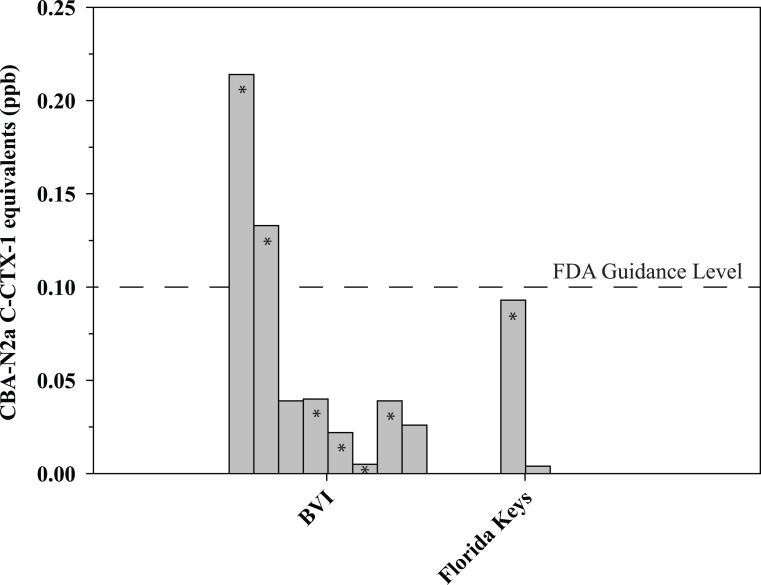
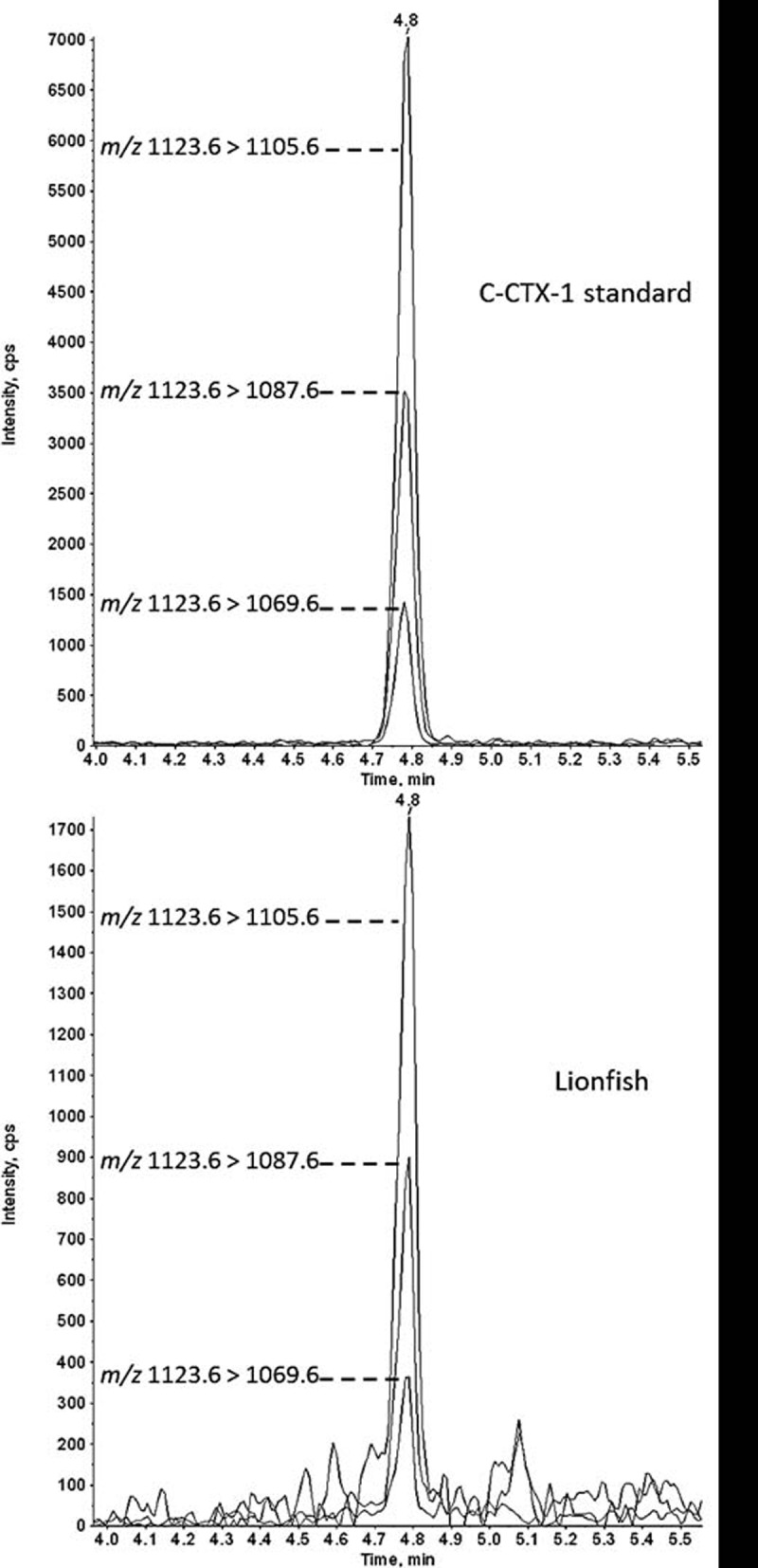
Lionfish, native to reef ecosystems of the tropical and sub-tropical Indo-Pacific, were introduced to Florida waters in the 1980s, and have spread rapidly throughout the northwestern Atlantic, Caribbean Sea and the Gulf of Mexico. These invasive, carnivorous fish significantly reduce other fish and benthic invertebrate biomass, fish recruitment, and species richness in reef ecosystems. Fisheries resource managers have proposed the establishment of a commercial fishery to reduce lionfish populations and mitigate adverse effects on reef communities. The potential for a commercial fishery for lionfish is the primary reason to identify locations where lionfish accumulate sufficient amounts of ciguatoxin (CTX) to cause ciguatera fish poisoning (CFP), the leading cause of non-bacterial seafood poisoning associated with fish consumption. To address this issue, an initial geographic assessment of CTX toxicity in lionfish from the Caribbean and Gulf of Mexico was conducted. Lionfish samples (n = 293) were collected by spearfishing from 13 locations (74 sampling sites) around the Caribbean and Gulf of Mexico between 2012 and 2015. The highest frequencies of lionfish containing measurable CTX occurred in areas known to be high-risk regions for CFP in the central to eastern Caribbean (e.g., 53% British Virgin Islands and 5% Florida Keys). Though measurable CTX was found in some locations, the majority of the samples (99.3%) contained CTX concentrations below the United States Food and Drug Administration guidance level of 0.1 ppb Caribbean ciguatoxin-1 (C-CTX-1) equivalents (eq.). Only 0.7% of lionfish tested contained more than 0.1 ppb C-CTX-1 eq. As of 2018, there has been one suspected case of CFP from eating lionfish. Given this finding, current risk reduction techniques used to manage CTX accumulating fish are discussed.
狮子鱼原产于热带和亚热带印度洋-太平洋的珊瑚礁生态系统,于 20 世纪 80 年代被引入佛罗里达州水域,现已迅速扩散至整个北大西洋、加勒比海和墨西哥湾。这些入侵的肉食性鱼类会显著降低珊瑚礁生态系统中其他鱼类和底栖无脊椎动物的生物量、鱼类的补充数量和物种丰富度。渔业资源管理者曾提议建立商业捕鱼业,以减少狮子鱼的数量并减轻其对珊瑚礁群落的不利影响。商业捕鱼业对狮子鱼的潜在需求是确定狮子鱼积累足够数量的雪卡毒素(CTX)以引发雪卡鱼中毒(CFP)的位置的主要原因,CFP 是与鱼类消费相关的非细菌性海产品中毒的主要原因。为了解决这个问题,对来自加勒比海和墨西哥湾的狮子鱼中的 CTX 毒性进行了初步的地理评估。2012 年至 2015 年期间,通过潜水捕鱼在加勒比海和墨西哥湾周围的 13 个地点(74 个采样点)采集了 293 个狮子鱼样本。在已知为中东部加勒比海 CFP 高风险地区的区域(例如,53%的英属维尔京群岛和 5%的佛罗里达群岛),发现了含有可测量 CTX 的狮子鱼的最高频率。尽管在一些地点发现了可测量的 CTX,但大多数样本(99.3%)的 CTX 浓度低于美国食品和药物管理局指导水平的 0.1 ppb 加勒比雪卡毒素-1(C-CTX-1)当量(eq.)。只有 0.7%的狮子鱼测试样本的 CTX 浓度超过 0.1 ppb C-CTX-1 eq.截至 2018 年,有一例疑似因食用狮子鱼而引发 CFP 的病例。鉴于这一发现,讨论了用于管理积累 CTX 的鱼类的当前风险降低技术。