Jang Soojin, Ryu Se Min, Lee Jooyeon, Lee Hanbyeol, Hong Seok Ho, Ha Kwon Soo, Park Won Sun, Han Eun Taek, Yang Se Ran
Department of Thoracic and Cardiovascular Surgery, Kangwon National University School of Medicine, Chuncheon, Korea.
Department of Internal Medicine, Kangwon National University School of Medicine, Chuncheon, Korea.
Tuberc Respir Dis (Seoul). 2019 Apr;82(2):133-142. doi: 10.4046/trd.2017.0124. Epub 2018 Jun 19.
Idiopathic pulmonary fibrosis involves irreversible alveolar destruction. Although alveolar epithelial type II cells are key functional participants within the lung parenchyma, how epithelial cells are affected upon bleomycin (BLM) exposure remains unknown. In this study, we determined whether BLM could induce cell cycle arrest via regulation of Schlafen (SLFN) family genes, a group of cell cycle regulators known to mediate growth-inhibitory responses and apoptosis in alveolar epithelial type II cells.
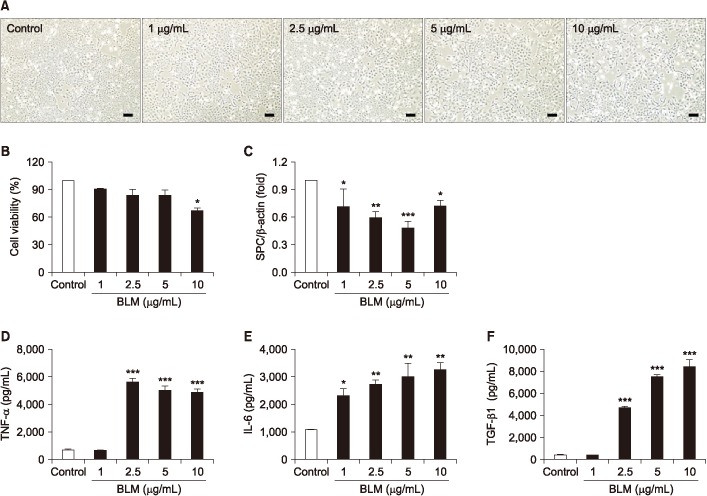
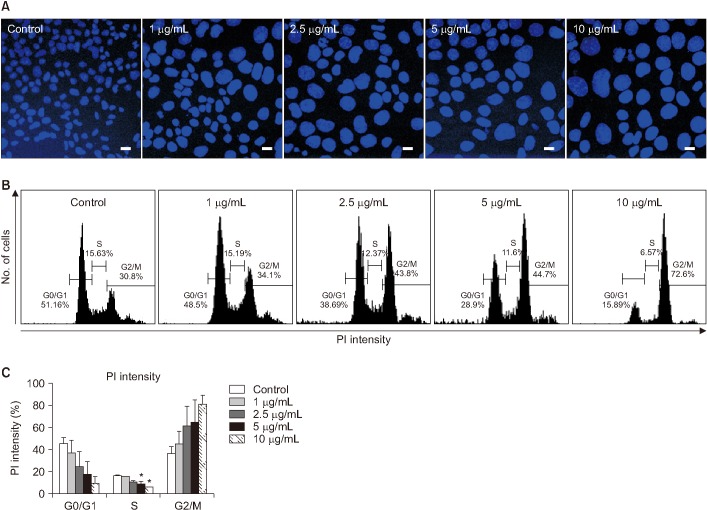
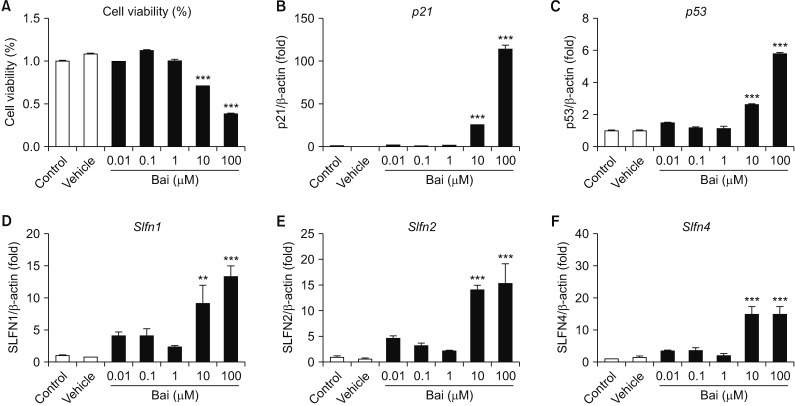
Mouse AE II cell line MLE-12 were exposed to 1-10 μg/mL BLM and 0.01-100 μM baicalein (Bai), a G1/G2 cell cycle inhibitor, for 24 hours. Cell viability and levels of pro-inflammatory cytokines were analyzed by MTT and enzyme-linked immunosorbent assay, respectively. Apoptosis-related gene expression was evaluated by quantitative real-time reverse transcription-polymerase chain reaction (qRT-PCR). Cellular morphology was determined after DAPI and Hoechst 33258 staining. To verify cell cycle arrest, propidium iodide (PI) staining was performed for MLE-12 after exposure to BLM.
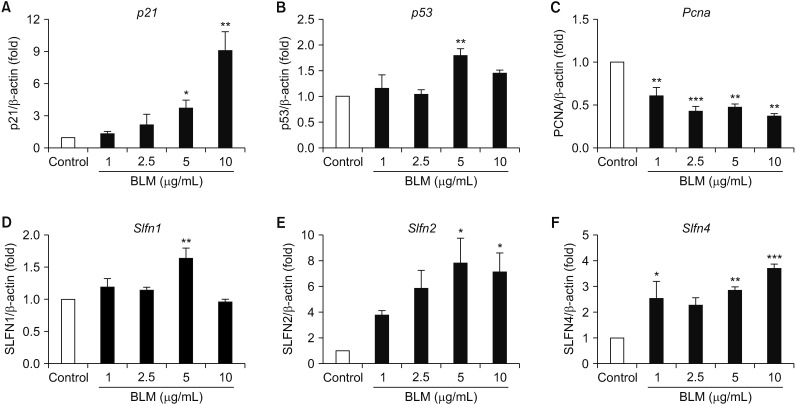
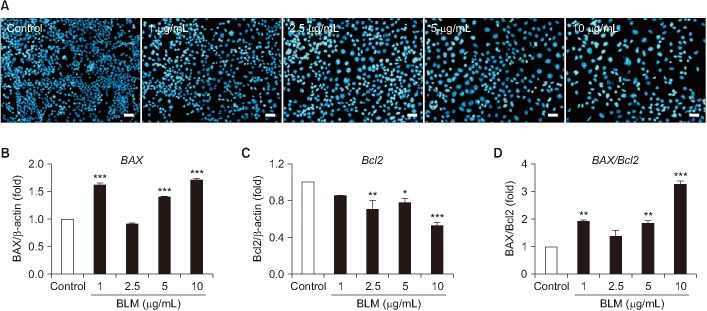
BLM decreased the proliferation of MLE-12 cells. However, it significantly increased expression levels of interleukin 6, tumor necrosis factor α, and transforming growth factor β1. Based on Hoechst 33258 staining, BLM induced condensation of nuclear and fragmentation. Based on DAPI and PI staining, BLM significantly increased the size of nuclei and induced G2/M phase cell cycle arrest. Results of qRT-PCR analysis revealed that BLM increased mRNA levels of BAX but decreased those of Bcl2. In addition, BLM/Bai increased mRNA levels of p53, p21, SLFN1, 2, 4 of Schlafen family.
BLM exposure affects pulmonary epithelial type II cells, resulting in decreased proliferation possibly through apoptotic and cell cycle arrest associated signaling.
特发性肺纤维化涉及不可逆的肺泡破坏。虽然II型肺泡上皮细胞是肺实质内关键的功能参与者,但博来霉素(BLM)暴露后上皮细胞如何受到影响仍不清楚。在本研究中,我们确定BLM是否可通过调节Schlafen(SLFN)家族基因诱导细胞周期停滞,这是一组已知可介导II型肺泡上皮细胞生长抑制反应和凋亡的细胞周期调节因子。
将小鼠II型肺泡上皮细胞系MLE-12暴露于1-10μg/mL的BLM和0.01-100μM的黄芩素(Bai,一种G1/G2细胞周期抑制剂)中24小时。分别通过MTT和酶联免疫吸附测定法分析细胞活力和促炎细胞因子水平。通过定量实时逆转录-聚合酶链反应(qRT-PCR)评估凋亡相关基因表达。在进行DAPI和Hoechst 33258染色后确定细胞形态。为验证细胞周期停滞,在暴露于BLM后对MLE-12进行碘化丙啶(PI)染色。
BLM降低了MLE-12细胞的增殖。然而,它显著增加了白细胞介素6、肿瘤坏死因子α和转化生长因子β1的表达水平。基于Hoechst 33258染色,BLM诱导了核浓缩和碎片化。基于DAPI和PI染色,BLM显著增加了细胞核大小并诱导了G2/M期细胞周期停滞。qRT-PCR分析结果显示,BLM增加了BAX的mRNA水平,但降低了Bcl2的mRNA水平。此外,BLM/Bai增加了Schlafen家族中p53、p21、SLFN1、2、4的mRNA水平。
BLM暴露影响II型肺上皮细胞,可能通过凋亡和细胞周期停滞相关信号传导导致增殖减少。