SUS Collaborating Centre for Technology Assessment & Excellence in Health, Faculdade de Farmácia, Universidade Federal de Minas Gerais, Belo Horizonte, Minas Gerais, Brazil.
Programa de Pós-Graduação em Medicamentos e Assistência Farmacêutica, Faculdade de Farmácia, Universidade Federal de Minas Gerais, Belo Horizonte, Minas Gerais, Brazil.
PLoS One. 2018 Jun 21;13(6):e0199446. doi: 10.1371/journal.pone.0199446. eCollection 2018.
Multiple Sclerosis (MS) is a disease that appreciably impacts on the quality of life of patients and is associated with high expenditure. MS is a chronic multifactorial disease, characterized by inflammation, demyelination and axonal loss. The Brazilian public health system provides pharmacological treatment as well as hospital and outpatient care for patients with relapsing-remitting and secondary progressive multiple sclerosis. However, we are not aware of any previous publications assessing total direct medical costs in patients with a long follow-up within the Brazilian healthcare system. Consequently, the objective is to analyze public spending on patients with MS to guide stakeholders in future investment and disinvestment decisions.
We retrospectively analyzed public Brazilian spending on patients with MS between 2000 and 2015 using the patient-centered registry of all patients in the public health system (SUS) obtained through deterministic-probabilistic record linkage of the Outpatient Information System, Hospital Information System and Mortality Information Systems in Brazil. Descriptive data analysis and a multiple linear regression model was performed to evaluate the associations between the mean annual cost per patient and the clinical and demographic variables. The suitability of the model was verified from a residue analysis and the level of significance adopted was 5%.
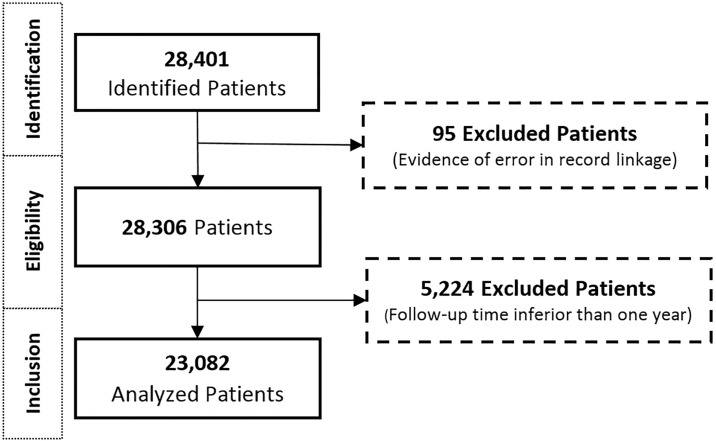
28,401 patients were identified and subsequently 23,082 patients were analyzed. The majority of the patients were female (73.3%), lived in the southeast region (58.9%), had a mean age of 36.8 (± 12.2) years and started treatment using one of the interferons beta (78.9%). The total direct medical cost spending in the sixteen years of the follow-up was US $ 2,308,393,465.60, and the mean annual expenditure per patient was US $ 13,544.40 (± 4,607.05). In the best fit model (p <0.001), approximately 40% of the variability of the mean annual cost per patient was explained by the region of residence; medication used (intention to treat); if the patient was a non-exclusive user of medicines, i.e., used SUS for other procedures other than high-cost medicines; year of treatment start; and presence of events (death; Relapse; change of treatment and/or comorbidity).
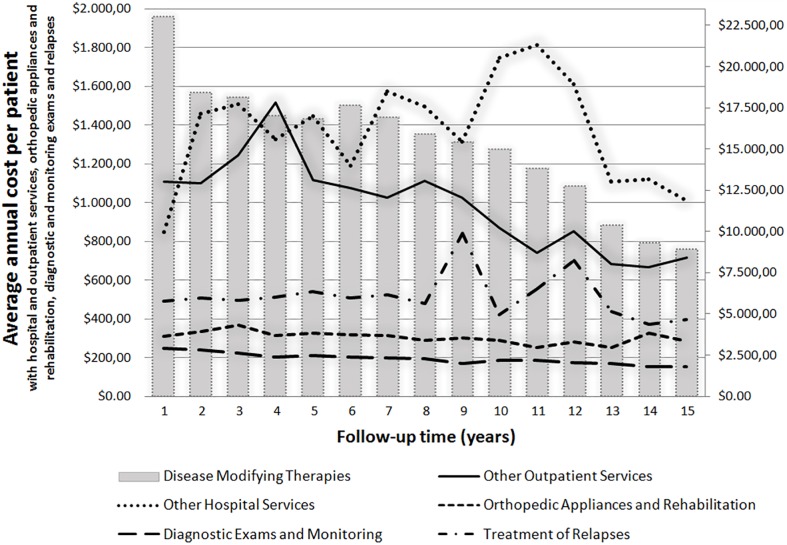
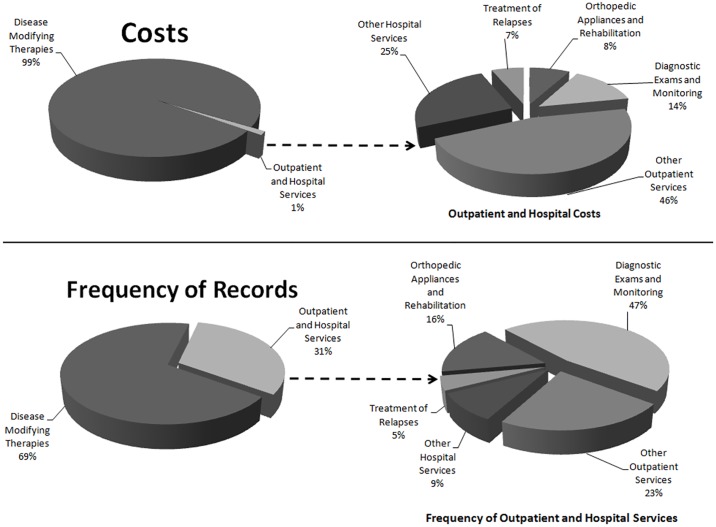
In the public health system of Brazil, disease modifying therapies currently represent almost all of the total direct costs of multiple sclerosis treatment. Around the world, new and emerging health technologies to treat of MS impose a challenge to health budgets, highlighting the need for cost-effectiveness studies comparing these technologies to those already available. Our regression model may help in this process, and calls attention to the need to access the real world performance of new therapies available in SUS, with the potential for disinvestment and/ or price reductions if needed.
多发性硬化症(MS)是一种严重影响患者生活质量的疾病,且医疗支出较高。MS 是一种慢性多因素疾病,其特征是炎症、脱髓鞘和轴索丢失。巴西公共卫生系统为缓解-复发和继发进展性多发性硬化症患者提供药物治疗以及医院和门诊护理。然而,我们没有发现任何以前的出版物评估过巴西医疗保健系统中具有长期随访的患者的总直接医疗费用。因此,本研究旨在分析多发性硬化症患者的公共支出,以指导利益相关者做出未来的投资和撤资决策。
我们使用通过巴西门诊信息系统、医院信息系统和死亡率信息系统的确定性概率记录链接获得的公共卫生系统中所有患者的以患者为中心的登记处,对 2000 年至 2015 年巴西多发性硬化症患者的公共支出进行了回顾性分析。采用描述性数据分析和多元线性回归模型评估了每位患者的平均年度费用与临床和人口统计学变量之间的关联。通过残差分析验证了模型的适用性,采用的显著性水平为 5%。
共确定了 28401 名患者,随后对其中的 23082 名患者进行了分析。大多数患者为女性(73.3%),居住在东南部(58.9%),平均年龄为 36.8(±12.2)岁,最初使用一种干扰素β(78.9%)治疗。在 16 年的随访中,直接医疗总支出为 2308393465.60 美元,每位患者的平均年支出为 13544.40 美元(±4607.05)。在最佳拟合模型中(p<0.001),患者居住地、药物使用(治疗意向)、是否为药物非专用使用者(即除了高成本药物外,还使用了 SUS 进行其他程序)、治疗开始年份以及是否发生过事件(死亡、复发、治疗改变和/或合并症)约解释了每位患者平均年度费用的 40%的可变性。
在巴西公共卫生系统中,疾病修正疗法目前几乎占多发性硬化症治疗总成本的全部。在世界各地,用于治疗 MS 的新出现的健康技术对卫生预算构成了挑战,这凸显了对这些技术与现有技术进行成本效益比较的必要性。我们的回归模型可以在这个过程中提供帮助,并提请注意需要获得巴西医疗系统中新疗法的真实世界疗效,如有必要,可考虑撤资和/或降低价格。