Chen Dongmiao, Zhang Yajie, Xu Yinjuan, Shen Tingting, Cheng Guorui, Huang Bingkang, Ruan Xiandong, Wang Congrong
Department of Laboratory Medicine, Nanfang Hospital, Southern Medical University, Guangzhou 510515, Guangdong, China.
Department of Laboratory, Xintang Hospital, Southern Medical University, Zengcheng, Guangzhou 511340, Guangdong, China.
Ther Clin Risk Manag. 2018 Jun 11;14:1091-1097. doi: 10.2147/TCRM.S159227. eCollection 2018.
This study aimed to compare the performance of chemiluminescence immunoassay (CLIA), enzyme-linked immunosorbent assay (ELISA), and passive agglutination (PA) method in detecting (MP) infection.
This study enrolled a total of 280 patients who were consecutively seen at the Nanfang Hospital of the Southern Medical University in Guangdong Province, China, between August and December 2016. Serum was collected and examined by CLIA, ELISA, and PA, respectively.
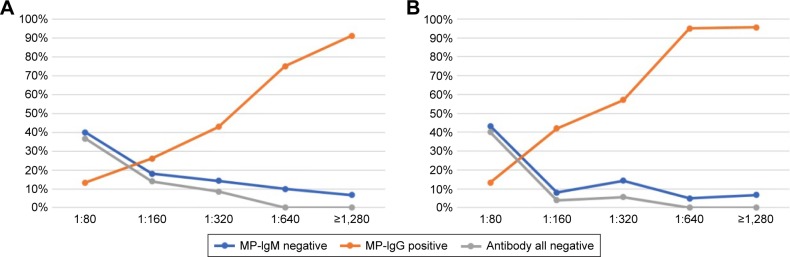
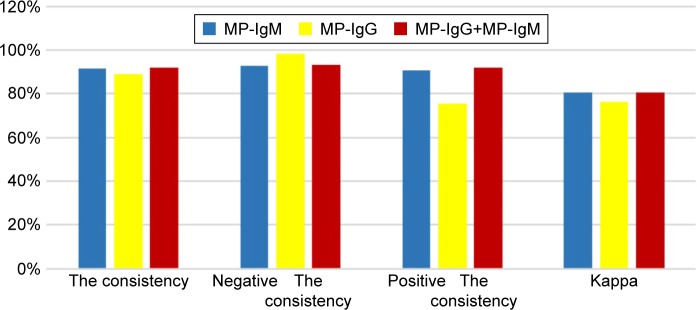
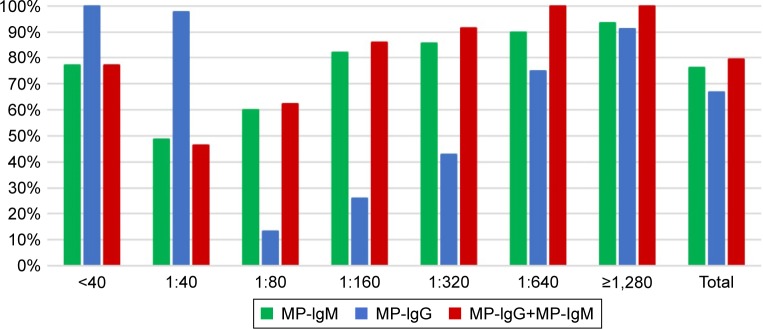
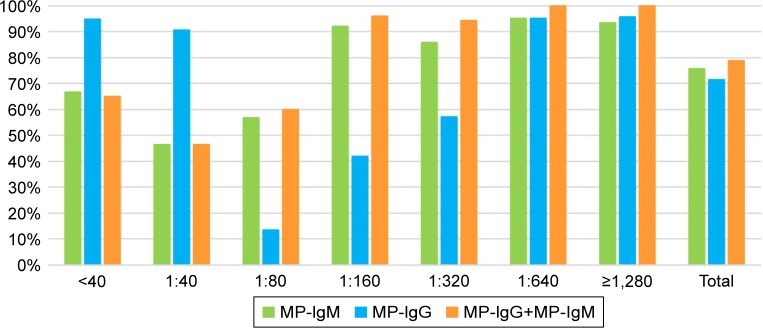
There were 180 positive (64.3%) and 100 negative cases (35.7%) by PA, 184 positive (65.7%) and 96 negative cases (34.3%) by CLIA MP-immunoglobulin (Ig) M, 89 positive (31.8%) and 191 negative cases (68.2%) by CLIA MP-IgG, 196 positive (70%) and 84 negative cases (30%) by ELISA MP-IgM, and 114 positive (40.7%) and 166 negative cases (59.3%) by ELISA MP-IgG. Patients were allocated to two groups based on PA results. In PA-negative group (≤1:40), the positive rates of MP-IgM by CLIA were 22.8% and 51.2% and by ELISA were 33.3% and 53.5%, respectively. In the PA-positive group (1:80 to ≥1:1,280), MP-IgM negative cases showed a decreasing trend: 40%, 18%, 14.3%, 10%, and 6.7% (CLIA), and 43.3%, 8%, 14.3%, 5%, and 6.7% (ELISA). The consistency between CLIA/ELISA MP-IgM, -IgG, and -IgG+MP-IgM was >92% for negative cases and >75% for positive cases, resulting in an overall consistency rate >88%. The kappa coefficients were 0.804, 0.763, and 0.806, respectively.
CLIA and ELISA have a higher sensitivity compared with PA. CLIA has a high concordance with ELISA. Moreover, CLIA has a higher specificity and sensitivity for the detection of IgM and IgG and should be used for the clinical diagnosis of MP infection.
本研究旨在比较化学发光免疫分析法(CLIA)、酶联免疫吸附测定法(ELISA)和被动凝集法(PA)检测支原体(MP)感染的性能。
本研究共纳入280例患者,这些患者于2016年8月至12月期间在中国广东省南方医科大学南方医院连续就诊。分别采集血清并采用CLIA、ELISA和PA进行检测。
PA检测有180例阳性(64.3%)和100例阴性(35.7%);CLIA检测MP免疫球蛋白(Ig)M有184例阳性(65.7%)和96例阴性(34.3%),CLIA检测MP-IgG有89例阳性(31.8%)和191例阴性(68.2%),ELISA检测MP-IgM有196例阳性(70%)和84例阴性(30%),ELISA检测MP-IgG有114例阳性(40.7%)和166例阴性(59.3%)。根据PA结果将患者分为两组。在PA阴性组(≤1:40)中,CLIA检测MP-IgM的阳性率分别为22.8%和51.2%,ELISA检测的阳性率分别为33.3%和53.5%。在PA阳性组(1:80至≥1:1280)中,MP-IgM阴性病例呈下降趋势:CLIA检测分别为40%、18%、14.3%、10%和6.7%,ELISA检测分别为43.3%、8%、14.3%、5%和6.7%。CLIA/ELISA检测MP-IgM、-IgG和-IgG + MP-IgM的阴性病例一致性>92%,阳性病例一致性>75%,总体一致性率>88%。kappa系数分别为0.804、0.763和0.806。
与PA相比,CLIA和ELISA具有更高的灵敏度。CLIA与ELISA具有高度一致性。此外,CLIA检测IgM和IgG具有更高的特异性和灵敏度,应用于MP感染的临床诊断。