a Department of Biochemistry and Cell Biology, Max F. Perutz Laboratories (MFPL), Vienna Biocenter (VBC) , University of Vienna , Vienna , Austria.
b Structural and Computational Biology Unit , European Molecular Biology Laboratory , Heidelberg , Germany.
Autophagy. 2018;14(7):1280-1282. doi: 10.1080/15548627.2018.1462079. Epub 2018 Jul 20.
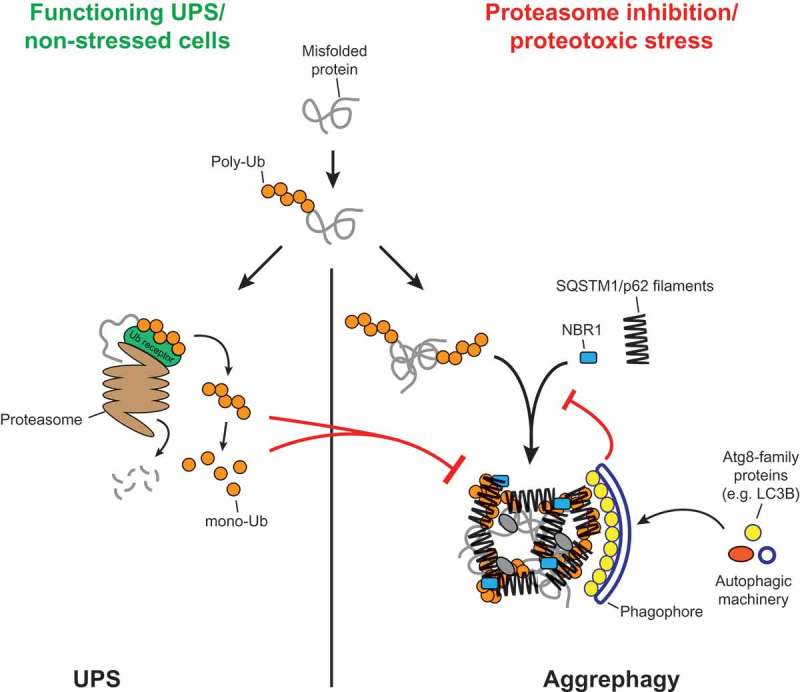
The degradation of misfolded, ubiquitinated proteins is essential for cellular homeostasis. These proteins are primarily degraded by the ubiquitin-proteasome system (UPS) and macroautophagy/autophagy serves as a backup mechanism when the UPS is overloaded. How autophagy and the UPS are coordinated is not fully understood. During the autophagy of misfolded, ubiquitinated proteins, referred to as aggrephagy, substrate proteins are clustered into larger structures in a SQSTM1/p62-dependent manner before they are sequestered by phagophores, the precursors to autophagosomes. We have recently shown that SQSTM1/p62 and ubiquitinated proteins spontaneously phase separate into micrometer-sized clusters in vitro. This enabled us to characterize the properties of the ubiquitin-positive substrates that are necessary for the SQSTM1/p62-mediated cluster formation. Our results suggest that aggrephagy is triggered by the accumulation of substrates with multiple ubiquitin chains and that the process can be inhibited by active proteasomes.
错误折叠的泛素化蛋白质的降解对于细胞内稳态至关重要。这些蛋白质主要通过泛素-蛋白酶体系统(UPS)降解,而当 UPS 过载时,巨自噬/自噬则作为备用机制。自噬和 UPS 如何协调还不完全清楚。在错误折叠的、泛素化的蛋白质的自噬中,即聚集体自噬,底物蛋白以 SQSTM1/p62 依赖性方式聚集到更大的结构中,然后被吞噬体(自噬体的前体)隔离。我们最近表明,SQSTM1/p62 和泛素化蛋白质在体外自发地相分离成微米大小的聚集体。这使我们能够描述 SQSTM1/p62 介导的聚集体形成所必需的、具有多个泛素链的底物的特性。我们的结果表明,聚集体自噬是由具有多个泛素链的底物积累触发的,并且该过程可以被活性蛋白酶体抑制。