Department of Biochemistry and Cell Biology, Max F. Perutz Laboratories, University of Vienna, Vienna BioCenter, Dr. Bohr-Gasse 9, 1030 Vienna, Austria.
Department of Biochemistry and Cell Biology, Max F. Perutz Laboratories, University of Vienna, Vienna BioCenter, Dr. Bohr-Gasse 9, 1030 Vienna, Austria
J Cell Sci. 2018 Oct 4;131(19):jcs214304. doi: 10.1242/jcs.214304.
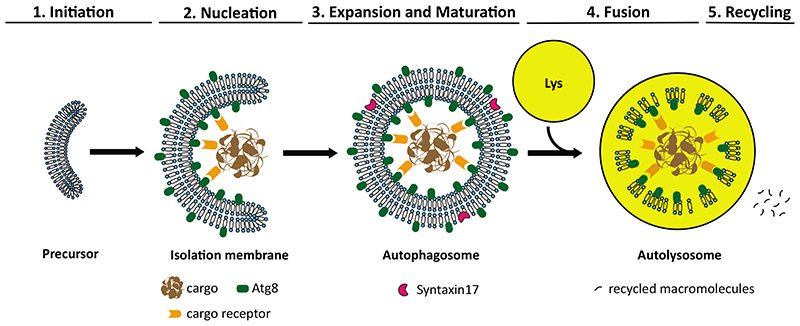
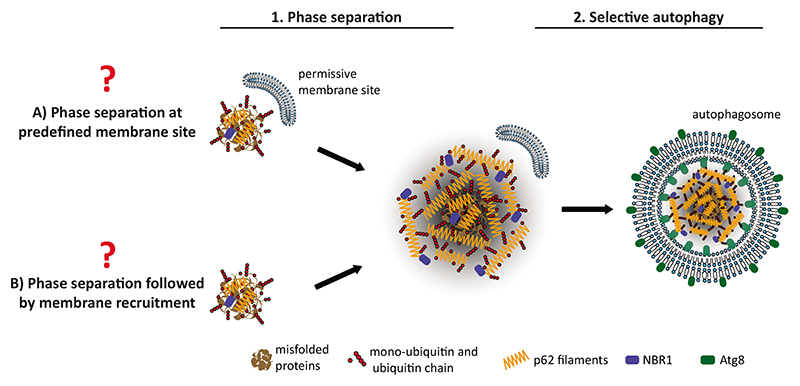
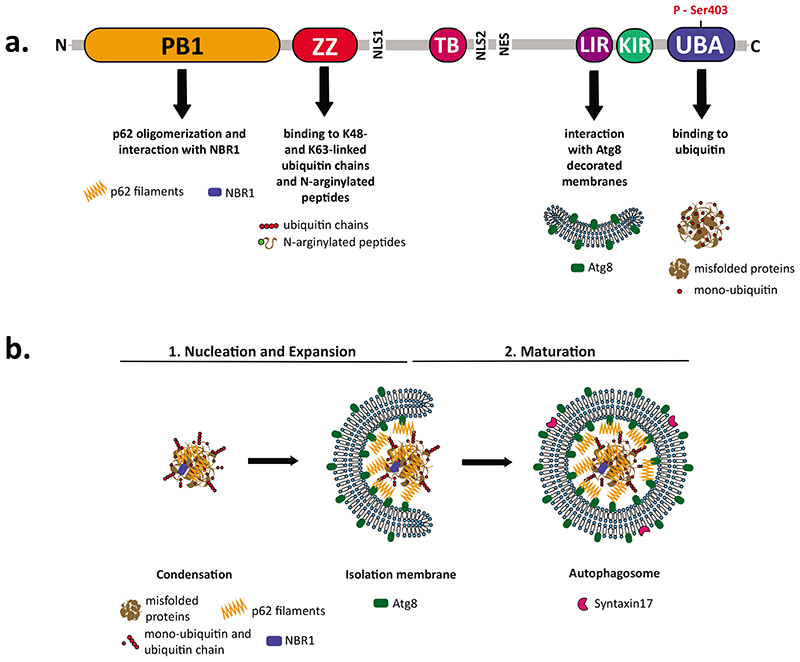
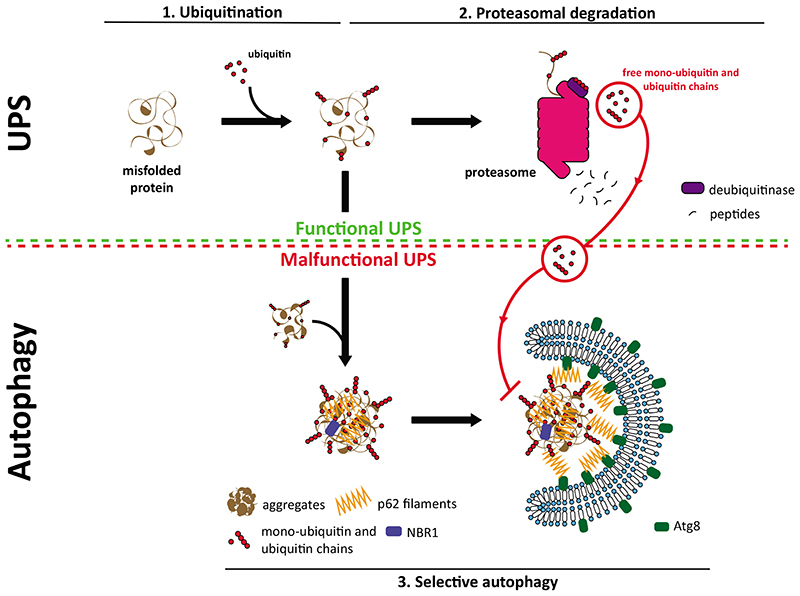
The degradation of misfolded proteins is essential for cellular homeostasis. Misfolded proteins are normally degraded by the ubiquitin-proteasome system (UPS), and selective autophagy serves as a backup mechanism when the UPS is overloaded. Selective autophagy mediates the degradation of harmful material by its sequestration within double-membrane organelles called autophagosomes. The selectivity of autophagic processes is mediated by cargo receptors, which link the cargo to the autophagosomal membrane. The p62 cargo receptor (SQSTM1) has a main function during the degradation of misfolded, ubiquitylated proteins by selective autophagy; here it functions to phase separate these proteins into larger condensates and tether them to the autophagosomal membrane. Recent work has given us crucial insights into the mechanism of action of the p62 cargo receptor during selective autophagy and how its activity can be integrated with the UPS. We will discuss these recent insights in the context of protein quality control and the emerging concept of cellular organization mediated by phase transitions.
蛋白质错误折叠的降解对于细胞内稳态至关重要。错误折叠的蛋白质通常被泛素蛋白酶体系统(UPS)降解,当 UPS 过载时,选择性自噬作为一种备用机制。选择性自噬通过将有害物质隔离在称为自噬体的双层膜细胞器中来介导其降解。自噬过程的选择性由货物受体介导,货物受体将货物与自噬体膜连接。p62 货物受体(SQSTM1)在通过选择性自噬降解错误折叠的泛素化蛋白质中具有主要功能;在这里,它将这些蛋白质相分离成更大的凝聚物,并将它们连接到自噬体膜上。最近的工作为我们深入了解 p62 货物受体在选择性自噬中的作用机制以及如何将其活性与 UPS 整合提供了关键见解。我们将在蛋白质质量控制的背景下讨论这些最新的见解,以及由相变介导的细胞组织的新兴概念。