School of Public Health, Shandong University, Jinan, 250012, China.
Key Lab of Health Economics and Policy Research, Shandong University, 44 Wen-hua-xi Road, Jinan, 250012, Shandong, China.
Int J Equity Health. 2018 Jun 22;17(1):87. doi: 10.1186/s12939-018-0802-4.
Compared with the Expanded Program on Immunization (EPI) vaccines, the coverage rate of the non-EPI vaccines is still low. The aim of this study is to explore the rural-urban disparity in category II vaccine and its determinants among children under 5 years old in China.
A cross-sectional study was conducted in 17 cities in Shandong province from August to October, 2013. A total of 1638 children were included in the analysis. Unadjusted and adjusted regression model were used to identify the rural-urban difference in vaccination of category II vaccine. Multivariate logistic regression models were employed to analyze the determinants associated with vaccination of category II vaccine in rural and urban areas respectively.
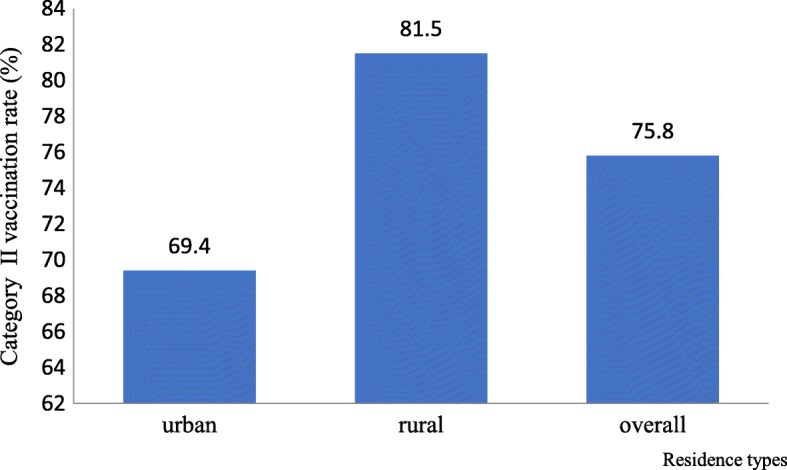
The coverage rates of category II vaccine in rural and urban children were 81.5 and 69.4% respectively. Factors including age and satisfaction with vaccination services were associated with category II vaccination both in rural and urban children (Ρ < 0.05). It was also found that the households with four or less members are more likely to vaccinate category II vaccine in rural children.
There was a big difference between rural and urban children in the use of category II vaccine. The government should strengthen financial support and regulation for the category II vaccine. The identified at-risk factors, including age, satisfaction with the vaccination services, and family size should be taken into account when designing targeted vaccination policies for rural and urban children.
与扩大免疫规划(EPI)疫苗相比,二类疫苗的接种率仍然较低。本研究旨在探讨中国 5 岁以下儿童二类疫苗的城乡差异及其决定因素。
2013 年 8 月至 10 月,在山东省 17 个城市进行了一项横断面研究。共纳入 1638 名儿童进行分析。采用未调整和调整后的回归模型来确定二类疫苗接种的城乡差异。采用多变量 logistic 回归模型分别分析农村和城市地区与二类疫苗接种相关的决定因素。
农村和城市儿童二类疫苗的接种率分别为 81.5%和 69.4%。年龄和对疫苗接种服务的满意度等因素与城乡儿童的二类疫苗接种均相关(P<0.05)。还发现,农村儿童中,家庭人口数为 4 人及以下的更有可能接种二类疫苗。
农村和城市儿童在二类疫苗的使用上存在较大差异。政府应加强对二类疫苗的财政支持和监管。在为农村和城市儿童设计有针对性的疫苗接种政策时,应考虑到年龄、对疫苗接种服务的满意度和家庭规模等确定的风险因素。