Heart and Stroke Foundation Canadian Partnership for Stroke Recovery, Toronto, ON, Canada.
Hurvitz Brain Sciences Research Program, Sunnybrook Research Institute, Toronto, ON, Canada.
Sci Rep. 2018 Jun 21;8(1):9480. doi: 10.1038/s41598-018-27541-8.
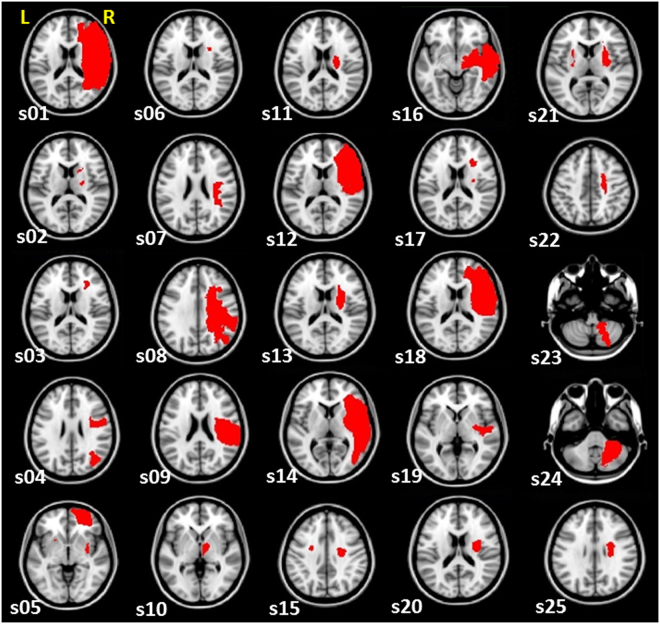
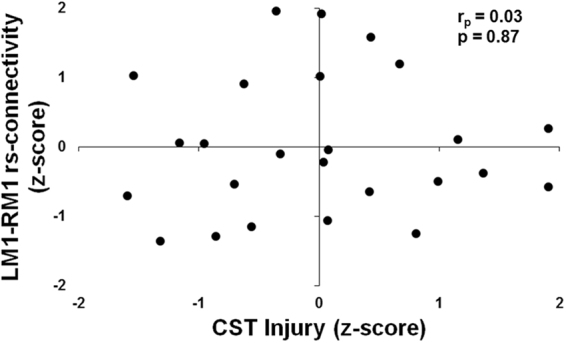
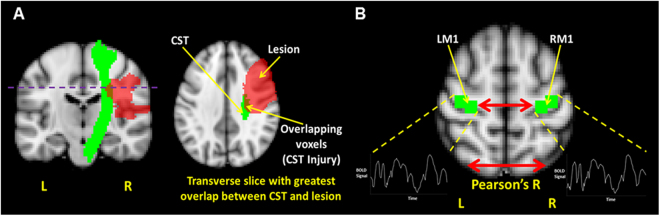
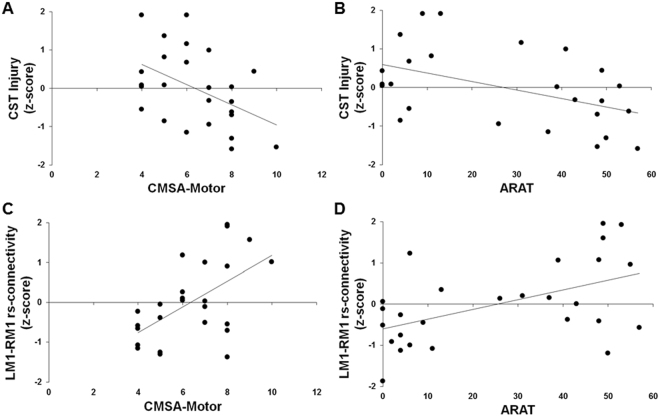
Biomarkers that represent the structural and functional integrity of the motor system enable us to better assess motor outcome post-stroke. The degree of overlap between the stroke lesion and corticospinal tract (CST Injury) is a measure of the structural integrity of the motor system, whereas the left-to-right motor cortex resting state connectivity (LM1-RM1 rs-connectivity) is a measure of its functional integrity. CST Injury and LM1-RM1 rs-connectivity each individually correlate with motor outcome post-stroke, but less is understood about the relationship between these biomarkers. Thus, this study investigates the relationship between CST Injury and LM1-RM1 rs-connectivity, individually and together, with motor outcome. Twenty-seven participants with upper limb motor deficits post-stroke completed motor assessments and underwent MRI at one time point. CST Injury and LM1-RM1 rs-connectivity were derived from T1-weighted and resting state functional MRI scans, respectively. We performed hierarchical multiple regression analyses to determine the contribution of each biomarker in explaining motor outcome. The interaction between CST Injury and LM1-RM1 rs-connectivity does not significantly contribute to the variability in motor outcome. However, inclusion of both CST Injury and LM1-RM1 rs-connectivity explains more variability in motor outcome, than either alone. We suggest both biomarkers provide distinct information about an individual's motor outcome.
生物标志物代表运动系统的结构和功能完整性,使我们能够更好地评估中风后的运动预后。中风病灶与皮质脊髓束(CST 损伤)之间的重叠程度是运动系统结构完整性的衡量标准,而大脑左半球到右半球运动皮层静息态连接(LM1-RM1 rs 连接)是运动系统功能完整性的衡量标准。CST 损伤和 LM1-RM1 rs 连接各自与中风后的运动预后相关,但人们对这些生物标志物之间的关系了解较少。因此,本研究调查了 CST 损伤和 LM1-RM1 rs 连接之间的关系,分别以及共同与运动预后的关系。27 名上肢运动功能障碍的中风患者在一个时间点完成运动评估并接受 MRI 检查。CST 损伤和 LM1-RM1 rs 连接分别来自 T1 加权和静息状态功能 MRI 扫描。我们进行了层次多重回归分析,以确定每个生物标志物在解释运动预后方面的贡献。CST 损伤和 LM1-RM1 rs 连接之间的相互作用对运动预后的变异性没有显著贡献。然而,CST 损伤和 LM1-RM1 rs 连接的同时纳入解释了更多的运动预后变异性,而不是单独纳入。我们认为这两个生物标志物都提供了关于个体运动预后的独特信息。