Sainburg Robert L, Maenza Candice, Winstein Carolee, Good David
Department of Kinesiology, The Pennsylvania State University, 29 Rec Building, Biomechanics Laboratory, University Park, Pennsylvania, 16802, USA.
Department of Neurology, Penn State Milton S. Hershey College of Medicine, Hershey, Pennsylvania, USA.
Adv Exp Med Biol. 2016;957:257-272. doi: 10.1007/978-3-319-47313-0_14.
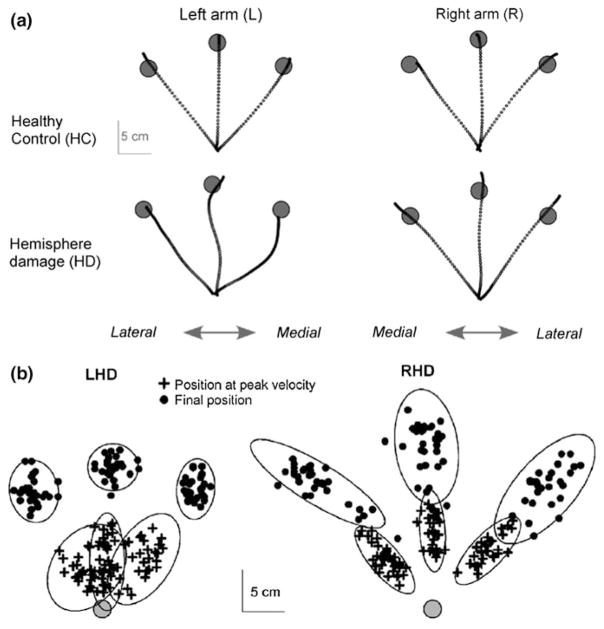
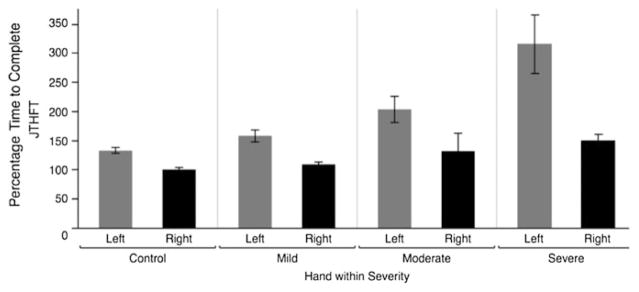
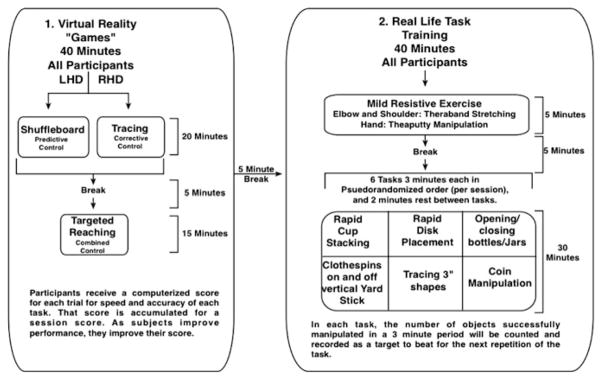
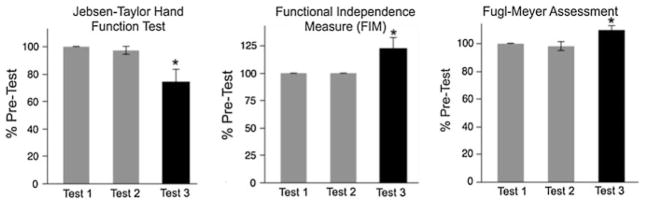
Brain lateralization is a ubiquitous feature of neural organization across the vertebrate spectrum. We have developed a model of motor lateralization that attributes different motor control processes to each cerebral hemisphere. This bilateral hemispheric model of motor control has successfully predicted hemisphere-specific motor control and motor learning deficits in the ipsilesional, or non-paretic, arm of patients with unilateral stroke. We now show across large number and range of stroke patients that these motor performance deficits in the non-paretic arm of stroke patients vary with both the side of the lesion, as well as with the severity of contralesional impairment. This last point can be functionally devastating for patients with severe contralesional paresis because for these individuals, performance of upper extremity activities of daily living depends primarily and often exclusively on ipsilesional arm function. We present a pilot study focused on improving the speed and coordination of ipsilesional arm function in a convenience sample of three stroke patients with severe contralesional impairment. Over a three-week period, patients received a total of nine 1.5 h sessions of training that included intense practice of virtual reality and real-life tasks. Our results indicated substantial improvements in ipsilesional arm movement kinematics, functional performance, and that these improvements carried over to improve functional independence. In addition, the contralesional arm improved in our measure of contralesional impairment, which was likely due to improved participation in activities of daily living. We discuss of our findings for physical rehabilitation.
大脑偏侧化是整个脊椎动物谱系中神经组织普遍存在的特征。我们开发了一种运动偏侧化模型,该模型将不同的运动控制过程归因于每个大脑半球。这种双侧半球运动控制模型已成功预测了单侧中风患者患侧(即非瘫痪侧)手臂的半球特异性运动控制和运动学习缺陷。我们现在在大量不同类型的中风患者中发现,中风患者非瘫痪侧手臂的这些运动表现缺陷会因病变部位以及对侧损伤的严重程度而有所不同。最后这一点对于患有严重对侧轻瘫的患者在功能上可能是毁灭性的,因为对于这些个体来说,上肢日常生活活动的执行主要且往往完全依赖于患侧手臂的功能。我们进行了一项初步研究,重点是改善三名患有严重对侧损伤的中风患者的便利样本中患侧手臂功能的速度和协调性。在为期三周的时间里,患者总共接受了九次每次1.5小时的训练课程,其中包括对虚拟现实和现实生活任务进行强化练习。我们的结果表明,患侧手臂的运动运动学和功能表现有了显著改善,并且这些改善还延伸至提高功能独立性。此外,在我们对侧损伤的测量中,对侧手臂也有所改善,这可能是由于参与日常生活活动的情况有所改善。我们讨论了这些发现对物理康复的意义。