Santos Jessica C, Pyter Leah M
Department of Basic and Applied Immunology, School of Medicine of Ribeirao Preto, University of Sao Paulo, Sao Paulo, Brazil.
Departments of Psychiatry and Behavioral Health and Neuroscience, The Institute for Behavioral Medicine Research, Ohio State University Wexner Medical Center, Columbus, OH, United States.
Front Immunol. 2018 Jun 7;9:1195. doi: 10.3389/fimmu.2018.01195. eCollection 2018.
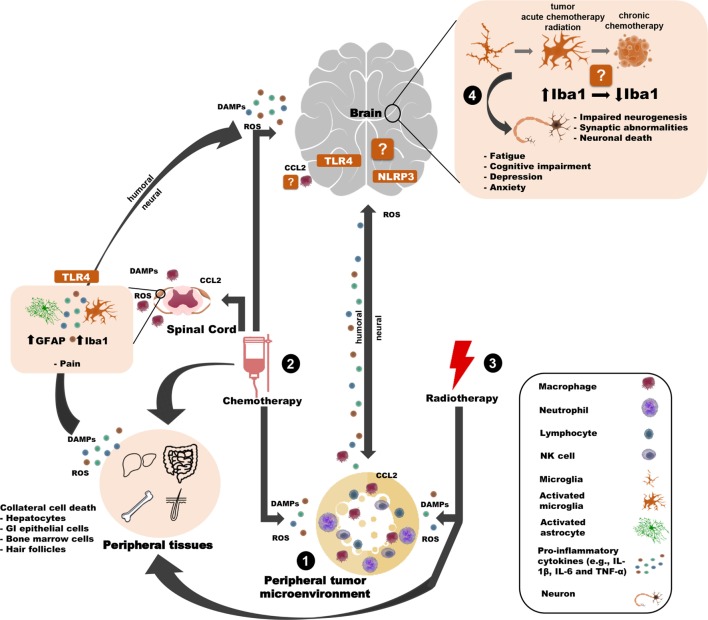
Behavioral comorbidities (depression, anxiety, fatigue, cognitive disturbances, and neuropathic pain) are prevalent in cancer patients and survivors. These mental and neurological health issues reduce quality-of-life, which is a significant societal concern given the increasing rates of long-term survival after various cancers. Hypothesized causes of behavioral comorbidities with cancer include tumor biology, stress associated with the cancer experience, and cancer treatments. A relatively recent leading mechanism by which these causes contribute to changes in neurobiology that underlie behavior is inflammation. Indeed, both basic and clinical research indicates that peripheral inflammation leads to central inflammation and behavioral changes in other illness contexts. Given the limitations of assessing neuroimmunology in clinical populations, this review primarily synthesizes evidence of neuroimmune and neuroinflammatory changes due to two components of cancer (tumor biology and cancer treatments) that are associated with altered affective-like or cognitive behaviors in rodents. Specifically, alterations in microglia, neuroinflammation, and immune trafficking to the brain are compiled in models of tumors, chemotherapy, and/or radiation. Evidence-based neuronal mechanisms by which these neuroimmune changes may lead to changes in behavior are proposed. Finally, converging evidence in clinical cancer populations is discussed.
行为共病(抑郁、焦虑、疲劳、认知障碍和神经性疼痛)在癌症患者及其幸存者中很常见。这些心理和神经健康问题会降低生活质量,鉴于各种癌症后长期生存率不断上升,这是一个重大的社会问题。癌症行为共病的假定原因包括肿瘤生物学、与癌症经历相关的压力以及癌症治疗。这些原因导致神经生物学变化进而引发行为改变的一个相对较新的主要机制是炎症。事实上,基础研究和临床研究均表明,在其他疾病背景下,外周炎症会导致中枢炎症和行为改变。鉴于在临床人群中评估神经免疫学存在局限性,本综述主要综合了癌症的两个组成部分(肿瘤生物学和癌症治疗)导致神经免疫和神经炎症变化的证据,这些变化与啮齿动物情感样或认知行为改变有关。具体而言,在肿瘤、化疗和/或放疗模型中汇总了小胶质细胞、神经炎症和免疫向脑内转运的改变。提出了这些神经免疫变化可能导致行为改变的循证神经元机制。最后,讨论了临床癌症人群中的趋同证据。