de Jesus-Silva Seleno Glauber, de Oliveira João Pedro, Brianezi Matheus Henrique Colepicolo, Silva Melissa Andreia de Moraes, Krupa Arturo Eduardo, Cardoso Rodolfo Souza
Faculdade de Medicina de Itajubá - FMIt, Itajubá, MG, Brasil.
J Vasc Bras. 2017 Jan-Mar;16(1):16-22. doi: 10.1590/1677-5449.008916.
Whether they are defined as minor or major, lower limb amputations constitute a severe health problem, causing high rates of morbidity and mortality and considerable social impact. Different patient clinical characteristics appear to be related to different types of amputations.
To analyze risk factors present in patients who underwent lower limb amputations at a tertiary hospital.
This was a retrospective, cross-sectional study of 109 patients who underwent lower limb amputations over a period of 31 months, analyzing gender, age, 15 clinical data and five laboratory parameters present at the time of admission. Data were treated with descriptive statistics and compared using Student’s test for unpaired samples (for numerical variables), the Mann-Whitney test, or Fisher’s exact tests (for categorical variables).
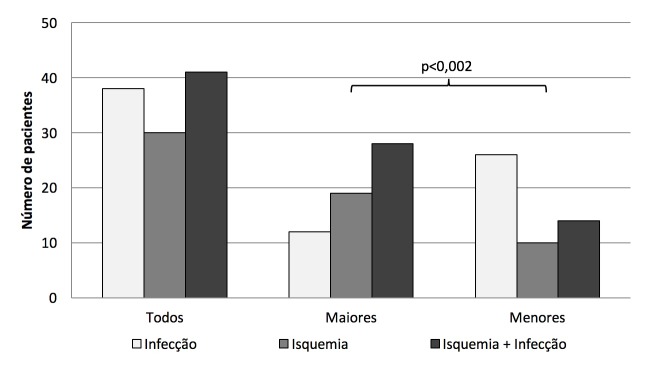
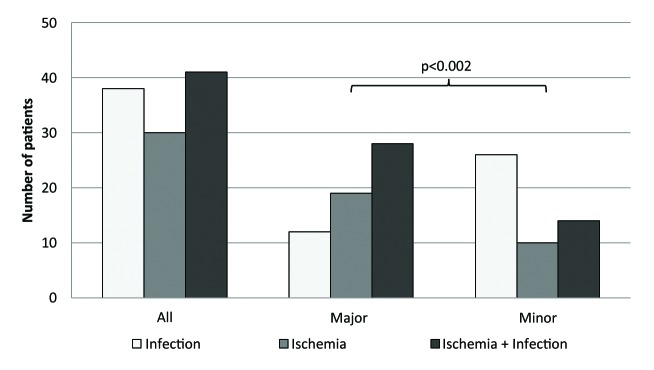
There were 59 major and 50 minor amputations out of a total of 109 performed. The majority of patients were male (65%) and mean age was 65 years (range 39 to 93). Risk factors that were statistically (p < 0.05) more related to major amputations were advanced age, stroke, ischemia, sepsis, and low hemoglobin and hematocrit levels. Diabetes mellitus, neuropathy, and palpable distal pulses were factors more strongly associated with minor amputations.
Lower limb amputations at different levels are related to different risk factors. Ischemia of greater severity and morbidity was associated with major amputations, while neuropathy and preserved perfusion were more often related to minor amputations.
无论被定义为大截肢还是小截肢,下肢截肢都构成严重的健康问题,导致高发病率、高死亡率以及相当大的社会影响。不同患者的临床特征似乎与不同类型的截肢相关。
分析在一家三级医院接受下肢截肢手术的患者存在的风险因素。
这是一项回顾性横断面研究,对109例在31个月内接受下肢截肢手术的患者进行分析,包括性别、年龄、入院时的15项临床数据和5项实验室参数。数据采用描述性统计处理,并使用非配对样本的学生检验(用于数值变量)、曼-惠特尼检验或费舍尔精确检验(用于分类变量)进行比较。
在总共109例截肢手术中,有59例大截肢和50例小截肢。大多数患者为男性(65%),平均年龄为65岁(范围39至93岁)。在统计学上(p < 0.05)与大截肢更相关的风险因素是高龄、中风、缺血、败血症以及低血红蛋白和血细胞比容水平。糖尿病、神经病变和可触及的远端脉搏是与小截肢关联更强的因素。
不同水平的下肢截肢与不同的风险因素相关。更严重的缺血及更高的发病率与大截肢相关,而神经病变和保留的灌注更常与小截肢相关。