da Silva Luiz Arthur Barbosa, de Medeiros Ana Miryam Costa, de Oliveira Patrícia Teixeira, da Silveira Éricka Janine Dantas, Miguel Márcia Cristina da Costa
Universidade Federal do Rio Grande do Norte - UFRN, Programa de Pós-graduação em Patologia Oral, Natal, RN, Brasil.
J Vasc Bras. 2017 Jan-Mar;16(1):68-72. doi: 10.1590/1677-5449.000417.
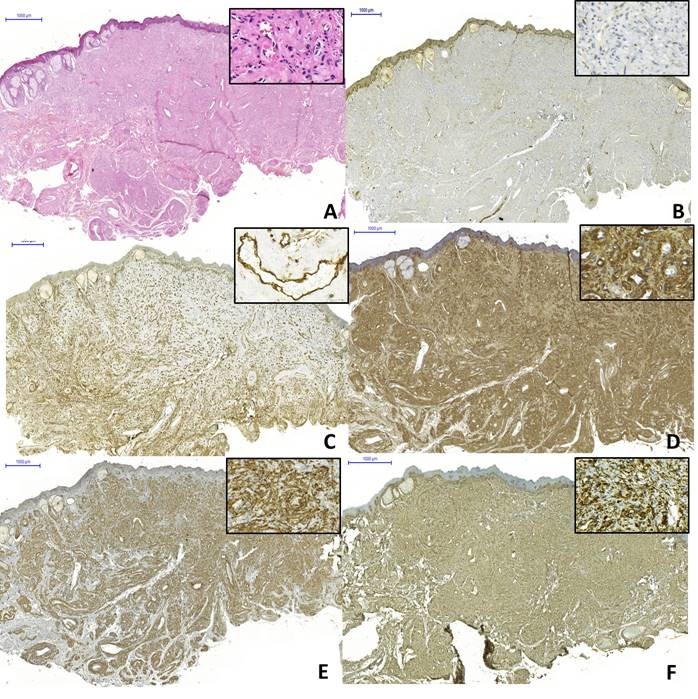
Angioleiomyoma is a benign neoplasm that was considered a tumor of smooth-muscle origin until the most recent (2013) WHO classification of soft tissue tumors, in which it was reclassified as a tumor of perivascular origin. Angioleiomyomas rarely occur in the oral cavity. These lesions are treated surgically with good prognosis. This article presents a review of reports of oral angioleiomyoma in the literature from the last 5 years and describes the case of a 44-year-old man who presented with an asymptomatic nodule in the upper lip that had developed over a 6-month period. Diagnostic hypotheses of pleomorphic adenoma or canalicular adenoma were raised. Biopsy of the lesion, histopathological and immunohistochemical analysis (S100, CD34, H-caldesmon, and desmin) confirmed a diagnosis of angioleiomyoma. It is noteworthy that immunohistochemistry is an important auxiliary method for differential diagnosis of angioleiomyoma from other tumors, particularly myopericytoma.
血管平滑肌瘤是一种良性肿瘤,在2013年世界卫生组织最新的软组织肿瘤分类之前,一直被认为是平滑肌起源的肿瘤,在该分类中它被重新归类为血管周围起源的肿瘤。血管平滑肌瘤很少发生于口腔。这些病变通过手术治疗,预后良好。本文回顾了过去5年文献中关于口腔血管平滑肌瘤的报道,并描述了一例44岁男性病例,该患者上唇出现一个无症状结节,在6个月内逐渐增大。曾提出多形性腺瘤或管状腺瘤的诊断假设。对病变进行活检、组织病理学和免疫组织化学分析(S100、CD34、H-钙调蛋白和结蛋白)确诊为血管平滑肌瘤。值得注意的是,免疫组织化学是血管平滑肌瘤与其他肿瘤,特别是肌周细胞瘤进行鉴别诊断的重要辅助方法。