Universität Hamburg, Hamburg, Germany.
PLoS One. 2018 Jun 22;13(6):e0199161. doi: 10.1371/journal.pone.0199161. eCollection 2018.
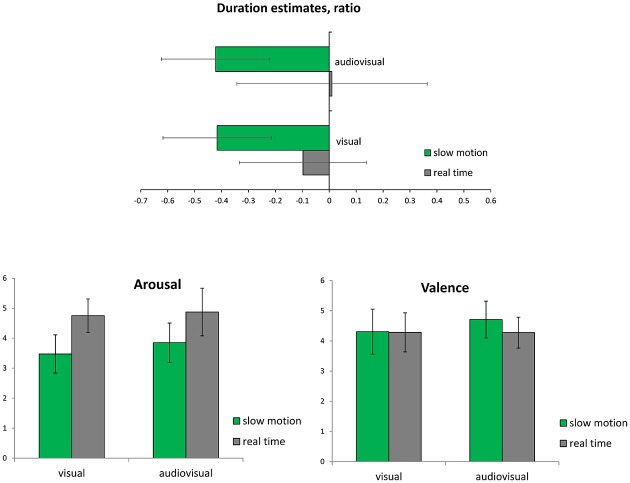
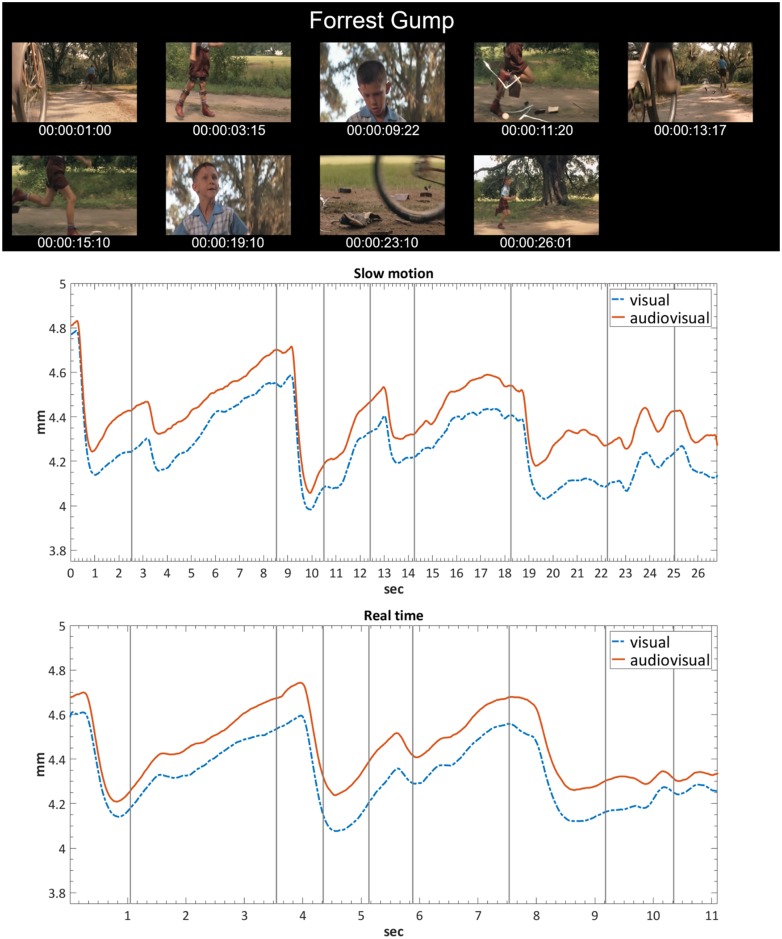
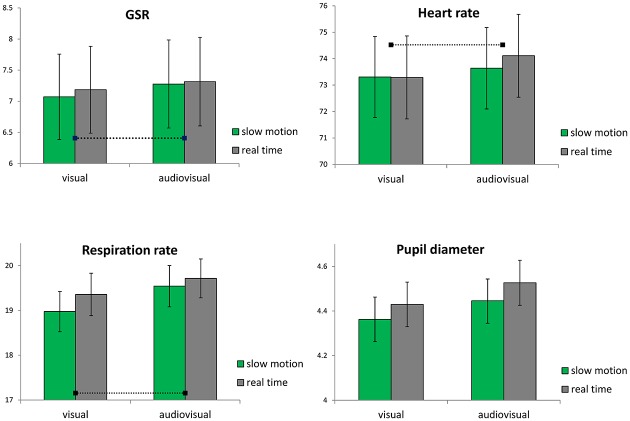
Slow motion scenes are ubiquitous in screen-based audiovisual media and are typically accompanied by emotional music. The strong effects of slow motion on observers are hypothetically related to heightened emotional states in which time seems to pass more slowly. These states are simulated in films and video clips, and seem to resemble such experiences in daily life. The current study investigated time perception and emotional response to media clips containing decelerated human motion, with or without music using psychometric and psychophysiological testing methods. Participants were presented with slow-motion scenes taken from commercial films, ballet and sports footage, as well as the same scenes converted to real-time. Results reveal that slow-motion scenes, compared to adapted real-time scenes, led to systematic underestimations of duration, lower perceived arousal but higher valence, lower respiration rates and smaller pupillary diameters. The presence of music compared to visual-only presentations strongly affected results in terms of higher accuracy in duration estimates, higher perceived arousal and valence, higher physiological activation and larger pupillary diameters, indicating higher arousal. Video genre affected responses in addition. These findings suggest that perceiving slow motion is not related to states of high arousal, but rather affects cognitive dimensions of perceived time and valence. Music influences these experiences profoundly, thus strengthening the impact of stretched time in audiovisual media.
慢动作场景在基于屏幕的视听媒体中无处不在,通常伴随着情绪化的音乐。慢动作对观察者的强烈影响假设与情绪状态有关,在这种状态下,时间似乎过得更慢。这些状态在电影和视频剪辑中被模拟出来,似乎类似于日常生活中的这些体验。本研究使用心理计量和心理生理学测试方法,调查了对包含减速人体运动的媒体剪辑的时间感知和情绪反应,这些剪辑有音乐和没有音乐。参与者观看了来自商业电影、芭蕾舞和体育镜头的慢动作场景,以及转换为实时的相同场景。结果表明,与适应的实时场景相比,慢动作场景导致持续时间的系统低估、感知唤醒度降低但愉悦度升高、呼吸率降低和瞳孔直径减小。与仅视觉呈现相比,音乐的存在强烈影响了持续时间估计的准确性、感知唤醒度和愉悦度、更高的生理激活和更大的瞳孔直径,这表明更高的唤醒度。视频类型除了影响反应。这些发现表明,感知慢动作与高唤醒状态无关,而是影响感知时间和愉悦度的认知维度。音乐深刻地影响了这些体验,从而增强了视听媒体中拉伸时间的影响。