Aoe Jo, Watabe Tadashi, Shimosegawa Eku, Kato Hiroki, Kanai Yasukazu, Naka Sadahiro, Matsunaga Keiko, Isohashi Kayako, Tatsumi Mitsuaki, Hatazawa Jun
Department of Nuclear Medicine and Tracer Kinetics, Osaka University Graduate School of Medicine, 2-2 Yamadaoka, Suita, Osaka, 565-0871, Japan.
Department of Molecular Imaging in Medicine, Osaka University Graduate School of Medicine, 2-2 Yamadaoka, Suita, Osaka, 565-0871, Japan.
Ann Nucl Med. 2018 Aug;32(7):485-491. doi: 10.1007/s12149-018-1272-x. Epub 2018 Jun 22.
Resting-state functional MRI (rs-fMRI) has revealed the existence of a default-mode network (DMN) based on spontaneous oscillations of the blood oxygenation level-dependent (BOLD) signal. The BOLD signal reflects the deoxyhemoglobin concentration, which depends on the relationship between the regional cerebral blood flow (CBF) and the cerebral metabolic rate of oxygen (CMRO). However, these two factors cannot be separated in BOLD rs-fMRI. In this study, we attempted to estimate the functional correlations in the DMN by means of quantitative O-labeled gases and water PET, and to compare the contribution of the CBF and CMRO to the DMN.
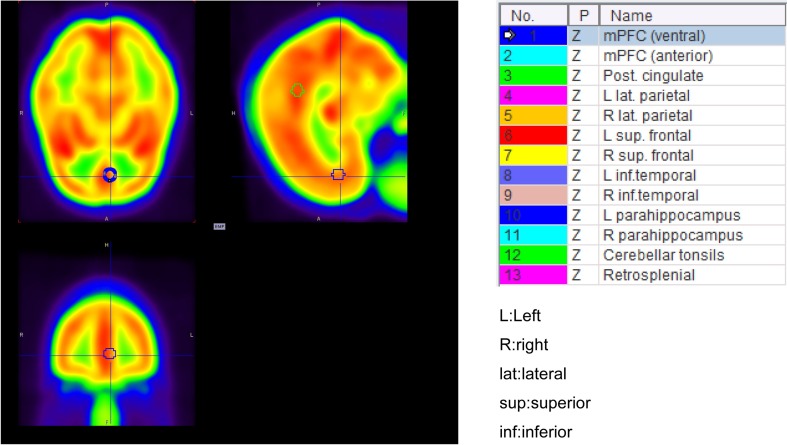
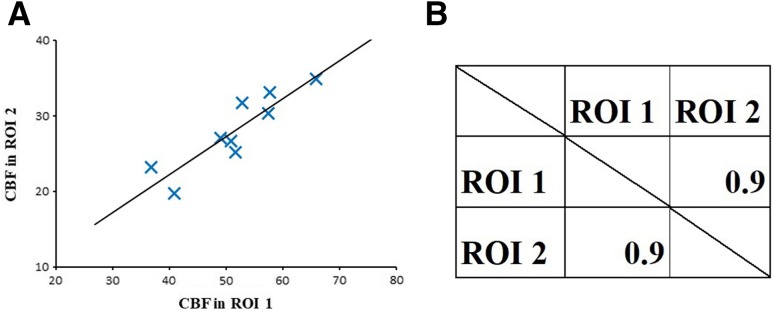
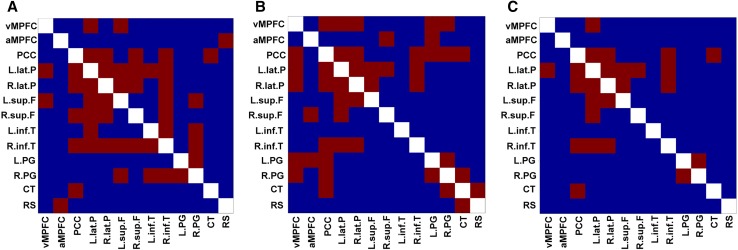
Nine healthy volunteers (5 men and 4 women; mean age, 47.0 ± 1.2 years) were studied by means of O-O, O-CO gases and O-water PET. Quantitative CBF and CMRO images were generated by an autoradiographic method and transformed into MNI standardized brain template. Regions of interest were placed on normalized PET images according to the previous rs-fMRI study. For the functional correlation analysis, the intersubject Pearson's correlation coefficients (r) were calculated for all pairs in the brain regions and correlation matrices were obtained for CBF and CMRO, respectively. We defined r > 0.7 as a significant positive correlation and compared the correlation matrices of CBF and CMRO.
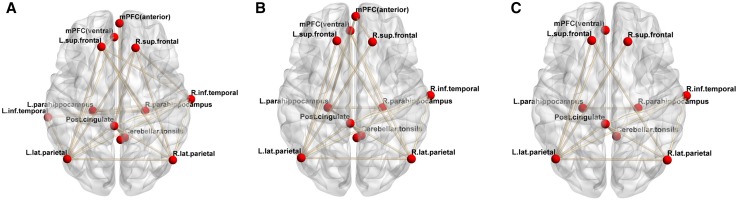
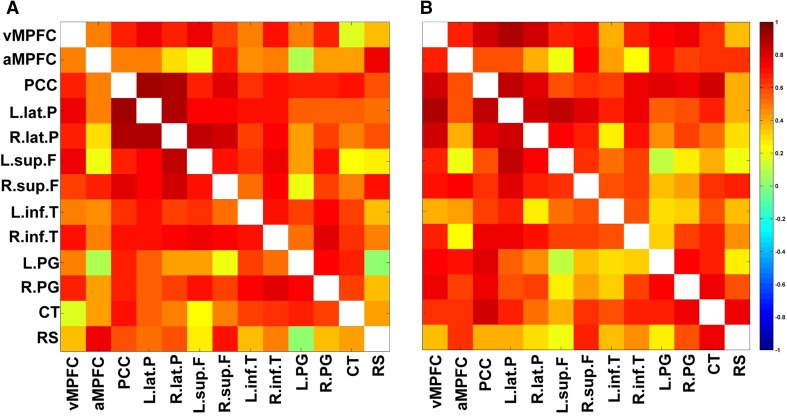
Significant positive correlations (r > 0.7) were observed in 24 pairs of brain regions for the CBF and 22 pairs of brain regions for the CMRO. Among them, 12 overlapping networks were observed between CBF and CMRO. Correlation analysis of CBF led to the detection of more brain networks as compared to that of CMRO, indicating that the CBF can capture the state of the spontaneous activity with a higher sensitivity.
We estimated the functional correlations in the DMN by means of quantitative PET using O-labeled gases and water. The correlation matrix derived from the CBF revealed a larger number of brain networks as compared to that derived from the CMRO, indicating that contribution to the functional correlation in the DMN is higher in the blood flow more than the oxygen consumption.
静息态功能磁共振成像(rs-fMRI)已揭示基于血氧水平依赖(BOLD)信号的自发振荡存在默认模式网络(DMN)。BOLD信号反映脱氧血红蛋白浓度,其取决于局部脑血流量(CBF)与脑氧代谢率(CMRO)之间的关系。然而,在BOLD rs-fMRI中这两个因素无法分离。在本研究中,我们试图通过定量O标记气体和水PET来估计DMN中的功能相关性,并比较CBF和CMRO对DMN的贡献。
对9名健康志愿者(5名男性和4名女性;平均年龄47.0±1.2岁)进行O-O、O-CO气体和O-水PET研究。通过放射自显影法生成定量CBF和CMRO图像,并将其转换为MNI标准化脑模板。根据先前的rs-fMRI研究,在标准化PET图像上放置感兴趣区域。对于功能相关性分析,计算脑区所有配对之间的受试者间Pearson相关系数(r),并分别获得CBF和CMRO的相关矩阵。我们将r>0.7定义为显著正相关,并比较CBF和CMRO的相关矩阵。
CBF在24对脑区中观察到显著正相关(r>0.7),CMRO在22对脑区中观察到显著正相关。其中,CBF和CMRO之间观察到12个重叠网络。与CMRO相比,CBF的相关性分析检测到更多的脑网络,表明CBF能够以更高的灵敏度捕捉自发活动状态。
我们通过使用O标记气体和水的定量PET估计了DMN中的功能相关性。与CMRO得出的相关矩阵相比,CBF得出的相关矩阵揭示了更多的脑网络,表明血流对DMN功能相关性的贡献高于氧消耗。