Unit of Polar Genomics, Korea Polar Research Institute, Incheon 21990, Korea.
Department of Systems Biology, College of Life Science and Biotechnology, Yonsei University, Seoul 03722, Korea.
BMB Rep. 2018 Nov;51(11):578-583. doi: 10.5483/BMBRep.2018.51.11.122.
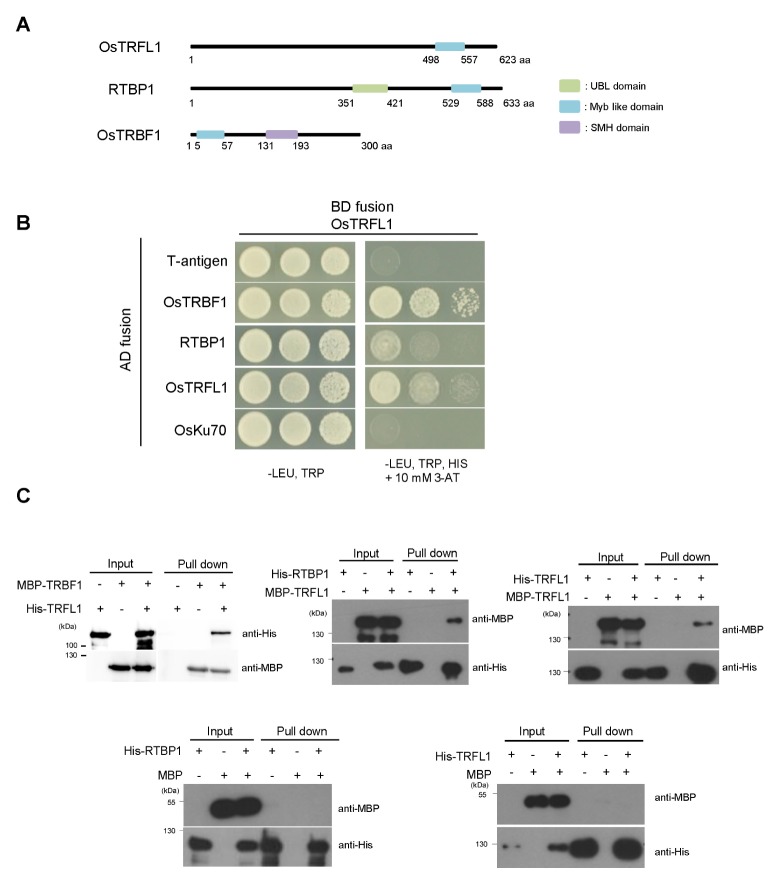
Telomeres are specialized nucleoprotein complexes that function to protect eukaryotic chromosomes from recombination and erosion. Several telomere binding proteins (TBPs) have been characterized in higher plants, but their detailed in vivo functions at the plant level are largely unknown. In this study, we identified and characterized OsTRFL1 (Oryza sativa Telomere Repeat-binding Factor Like 1) in rice, a monocot model crop. Although OsTRFL1 did not directly bind to telomere repeats (TTTAGGG)4 in vitro, it was associated with telomeric sequences in planta. OsTRFL1 interacted with rice TBPs, such as OsTRBF1 and RTBP1, in yeast and plant cells as well as in vitro. Thus, it seems likely that the association of OsTRFL1 with other TBPs enables OsTRFL1 to bind to telomeres indirectly. T-DNA inserted OsTRFL1 knock-out mutant rice plants displayed significantly longer telomeres (6-25 kb) than those (5-12 kb) in wild-type plants, indicating that OsTRFL1 is a negative factor for telomere lengthening. The reduced levels of OsTRFL1 caused serious developmental defects in both vegetative and reproductive organs of rice plants. These results suggest that OsTRFL1 is an essential factor for the proper maintenance of telomeres and normal development of rice. [BMB Reports 2018; 51(11): 578-583].
端粒是一种特殊的核蛋白复合物,其功能是保护真核染色体免受重组和侵蚀。已经在高等植物中鉴定出几种端粒结合蛋白(TBPs),但其在植物水平上的详细体内功能在很大程度上尚不清楚。在这项研究中,我们在水稻中鉴定并表征了 OsTRFL1(Oryza sativa Telomere Repeat-binding Factor Like 1),水稻是单子叶模式作物。尽管 OsTRFL1 不能在体外直接结合端粒重复序列(TTTAGGG)4,但它与植物体内的端粒序列有关。OsTRFL1 在酵母和植物细胞以及体外与水稻 TBPs(如 OsTRBF1 和 RTBP1)相互作用。因此,似乎 OsTRFL1 与其他 TBPs 的结合使 OsTRFL1 能够间接地与端粒结合。与野生型植物(5-12 kb)相比,T-DNA 插入 OsTRFL1 敲除突变体水稻植物的端粒显着更长(6-25 kb),表明 OsTRFL1 是端粒延长的负因子。OsTRFL1 水平的降低导致水稻营养和生殖器官的严重发育缺陷。这些结果表明 OsTRFL1 是维持端粒正常和水稻正常发育的必需因素。[BMB 报告 2018;51(11): 578-583]。