Wellcome Centre for Integrative Neuroimaging, Centre for Functional MRI of the Brain (FMRIB), Nuffield Department of Clinical Neurosciences, John Radcliffe Hospital, University of Oxford, Oxford, United Kingdom.
Wellcome Centre for Integrative Neuroimaging, Department of Experimental Psychology, University of Oxford, Oxford, United Kingdom.
Cortex. 2019 Sep;118:107-115. doi: 10.1016/j.cortex.2018.05.005. Epub 2018 May 12.
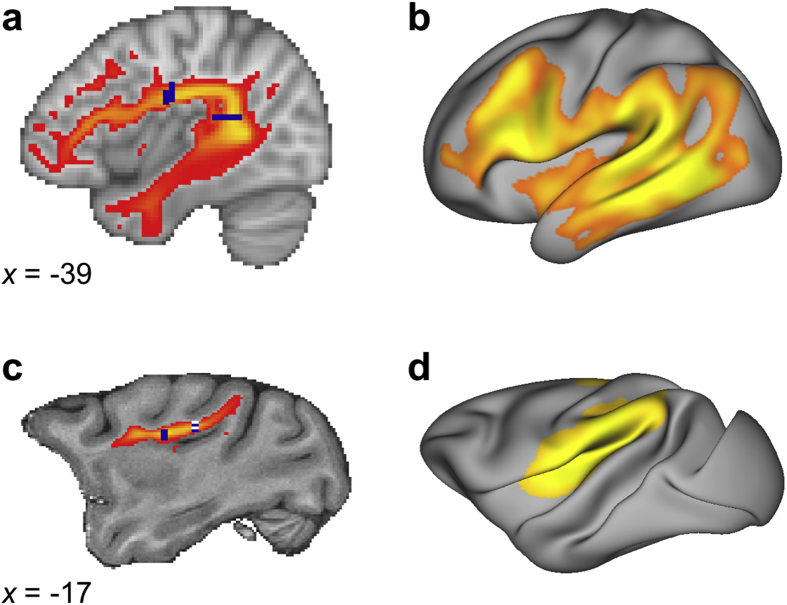
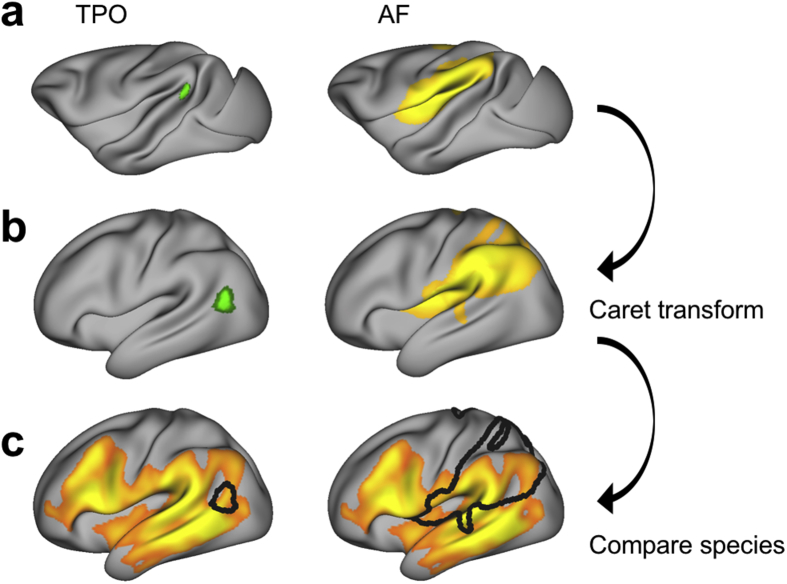
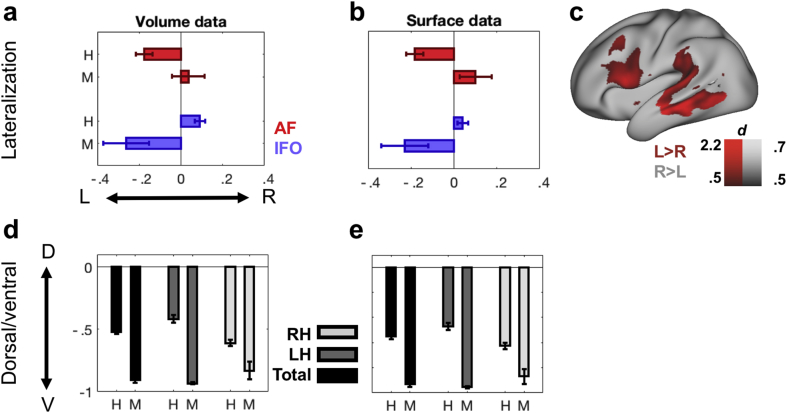
Evolutionary adaptations of the human brain are the basis for our unique abilities such as language. An expansion of the arcuate fasciculus (AF), the dorsal language tract, in the human lineage involving left lateralization is considered canonical, but this hypothesis has not been tested in relation to other architectural adaptations in the human brain. Using diffusion-weighted MRI, we examined AF in the human and macaque and quantified species differences in white matter architecture and surface representations. To compare surface results in the two species, we transformed macaque representations to human space using a landmark-based monkey-to-human cortical expansion model. We found that the human dorsal AF, but not the ventral inferior fronto-occipital fasciculus (IFO), is left-lateralized. In the monkey AF is not lateralized. Moreover, compared to the macaque, human AF is relatively increased with respect to IFO. A comparison of human and transformed macaque surface representations suggests that cortical expansion alone cannot account for the species differences in the surface representation of AF. Our results show that the human AF has undergone critical anatomical modifications in comparison with the macaque AF. More generally, this work demonstrates that studies on the human brain specializations underlying the language connectome can benefit from current methodological advances in comparative neuroanatomy.
人类大脑的进化适应是我们独特能力的基础,例如语言。人类谱系中弓状束(AF)的扩展,即背侧语言束,涉及左侧化,被认为是典型的,但这一假设尚未在与人类大脑其他结构适应相关的方面得到检验。我们使用弥散加权 MRI 检查了人类和猕猴的 AF,并量化了白质结构和表面表示的物种差异。为了比较两种物种的表面结果,我们使用基于地标点的猴到人皮质扩展模型将猕猴的表示转换到人类空间。我们发现,人类的背侧 AF,但不是腹侧下额枕束(IFO),是左侧化的。在猕猴中,AF 没有侧化。此外,与猕猴相比,人类的 AF 相对于 IFO 相对增加。人类和转化后的猕猴表面表示的比较表明,仅皮层扩展不能解释 AF 表面表示的物种差异。我们的结果表明,与猕猴的 AF 相比,人类的 AF 经历了关键的解剖学修改。更普遍地说,这项工作表明,对人类大脑语言连接组基础上的专业化的研究可以从比较神经解剖学的当前方法学进展中受益。