Ma Wei-Wei, Ding Bing-Jie, Yuan Lin-Hong, Zhao Lei, Yu Huan-Ling, Xi Yuan-di, Xiao Rong
School of Public Health, Beijing Key Laboratory of Enviromental Toxicology, Capital Medical University, Beijing 100069, China.
Department of Clinical Nutrition Beijing Friendship Hospital, Capital Medical University.
Afr Health Sci. 2017 Dec;17(4):1211-1221. doi: 10.4314/ahs.v17i4.32.
Aberrant protein expression within the hippocampus has recently been implicated in the pathogenesis of obesity-induced memory impairment.
The objective of the current study was to search for specific memory-related factors in the hippocampus in obese rats.
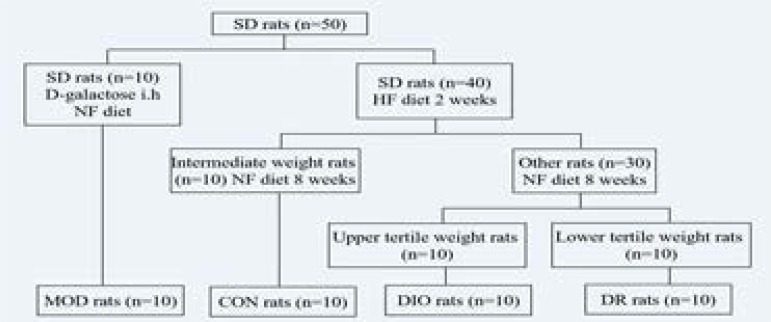
Sprague-Dawley (SD) rats were fed either a high-fat (HF) diet or normal-fat (NF) diet for 10 weeks to obtain the control (CON), diet-induced obese rats (DIO) and diet-resistant (DR) rats. D-galactose was injected subcutaneously for 10 weeks to establish model (MOD) rats with learning and memory impairment. After the hippocampus of the rats sampling, the proteome analysis was conducted using two-dimensional get electrophoresis (2-DE) combined with peptide mass fingerprinting (PMF).
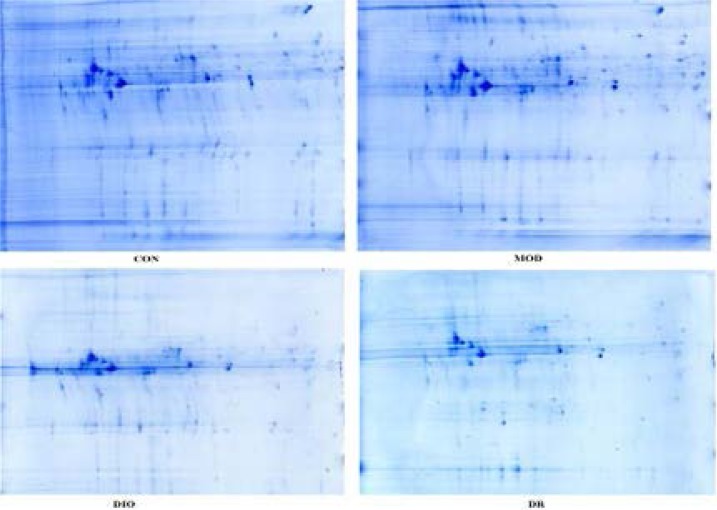
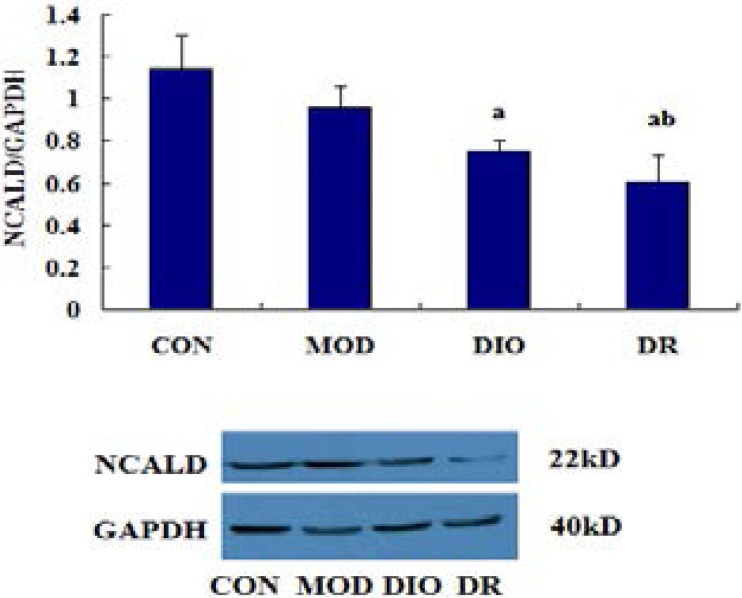
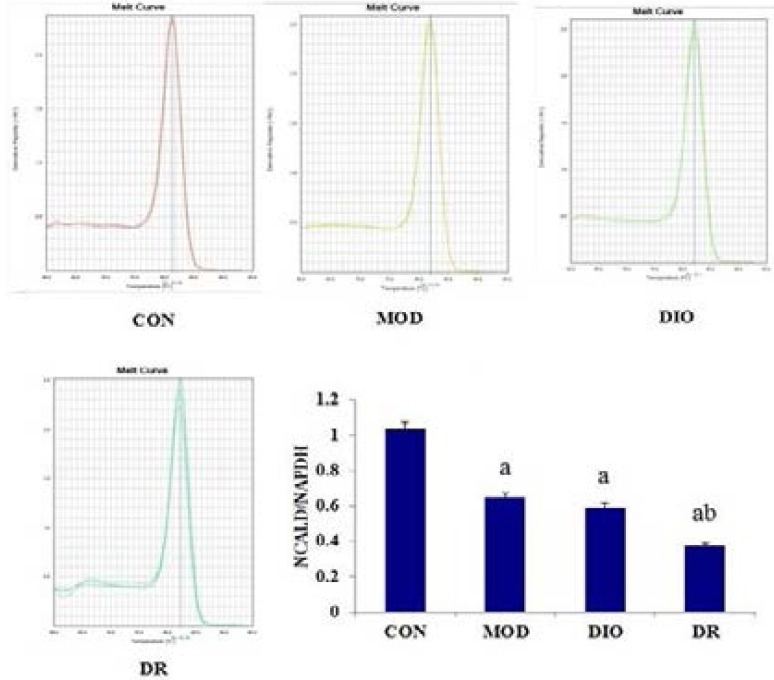
We found 15 differential proteins that expressed in the hippocampus in rats induced by HF diet from the 2-DE map. In addition, Neurocalcin-delta (NCALD) was nearly down-regulated in the DR rats compared with CON rats and MOD rats, which was further confirmed by Western blot, real-time PCR and ELISA results.
Our data demonstrates that the differential memory-related proteins were a reflection of the HF diet, but not potential factors in obesity proneness or obesity resistance. Furthermore, NCALD is proved to be a potential hippocampus-memory related factor related to obesity.
海马体内异常的蛋白质表达最近被认为与肥胖诱导的记忆障碍的发病机制有关。
本研究的目的是在肥胖大鼠的海马体中寻找特定的记忆相关因子。
将Sprague-Dawley(SD)大鼠分别喂食高脂(HF)饮食或正常脂肪(NF)饮食10周,以获得对照组(CON)、饮食诱导肥胖大鼠(DIO)和饮食抵抗(DR)大鼠。皮下注射D-半乳糖10周以建立具有学习和记忆障碍的模型(MOD)大鼠。在对大鼠的海马体进行取样后,使用二维凝胶电泳(2-DE)结合肽质量指纹图谱(PMF)进行蛋白质组分析。
我们从2-DE图谱中发现了15种在高脂饮食诱导的大鼠海马体中表达的差异蛋白。此外,与CON大鼠和MOD大鼠相比,DR大鼠中的神经钙蛋白δ(NCALD)几乎下调,蛋白质免疫印迹、实时PCR和酶联免疫吸附测定结果进一步证实了这一点。
我们的数据表明,差异记忆相关蛋白是高脂饮食的反映,而不是肥胖倾向或肥胖抵抗的潜在因素。此外,NCALD被证明是与肥胖相关的潜在海马体-记忆相关因子。