Hasim Mohamed S, Nessim Carolyn, Villeneuve Patrick J, Vanderhyden Barbara C, Dimitroulakos Jim
Cancer Therapeutics Program at the Ottawa Hospital Research Institute, Ottawa, Ontario, Canada; Department of Biochemistry at the University of Ottawa, Ottawa, Ontario, Canada.
Department of General Surgery, The Ottawa Hospital, Ottawa, Ontario, Canada.
Transl Oncol. 2018 Aug;11(4):988-998. doi: 10.1016/j.tranon.2018.06.001. Epub 2018 Jun 22.
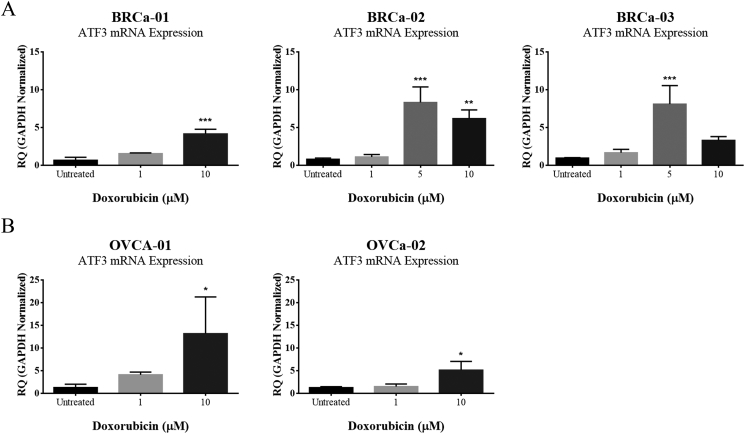
Anthracyclines, such as doxorubicin, are used as first-line chemotherapeutics, usually in combination therapies, for the treatment of advanced breast cancer. While these drugs have been successful therapeutic options, their use is limited due to serious drug related toxicities and acquired tumor resistance. Uncovering the molecular mechanisms that mediate doxorubicin's cytotoxic effect will lead to the identification of novel more efficacious combination therapies and allow for reduced doses of doxorubicin to be administered while maintaining efficacy. In our study, we demonstrate that activating transcription factor (ATF) 3 expression was upregulated by doxorubicin treatment in a representative panel of human breast cancer cell lines MCF7 and MDA-MB-231. We have also shown that doxorubicin treatment can induce ATF3 expression in ex vivo human breast and ovarian tumor samples. The upregulation of ATF3 in the cell lines was regulated by multiple cellular mechanisms including the activation of JNK and ATM signaling pathways. Importantly, loss of ATF3 expression resulted in reduced sensitivity to doxorubicin treatment in mouse embryonic fibroblasts. Through a 1200 FDA-approved compound library screen, we identified a number of agents whose cytotoxicity is dependent on ATF3 expression that also enhanced doxorubicin induced cytotoxicity. For example, the combination of the HDAC inhibitor vorinostat or the nucleoside analogue trifluridine could synergistically enhance doxorubicin cytotoxicity in the MCF7 cell line. Synergy in cell lines with the combination of ATF3 inducers and patients with elevated basal levels of ATF3 shows enhanced response to chemotherapy. Taken together, our results demonstrate a role for ATF3 in mediating doxorubicin cytotoxicity and provide rationale for the combination of ATF3-inducing agents with doxorubicin as a novel therapeutic approach.
蒽环类药物,如阿霉素,通常作为联合疗法中的一线化疗药物,用于治疗晚期乳腺癌。虽然这些药物是成功的治疗选择,但由于严重的药物相关毒性和获得性肿瘤耐药性,其应用受到限制。揭示介导阿霉素细胞毒性作用的分子机制将有助于识别更有效的新型联合疗法,并在保持疗效的同时减少阿霉素的给药剂量。在我们的研究中,我们证明在人乳腺癌细胞系MCF7和MDA-MB-231的代表性样本中,阿霉素处理可上调激活转录因子(ATF)3的表达。我们还表明,阿霉素处理可在体外人乳腺和卵巢肿瘤样本中诱导ATF3表达。细胞系中ATF3的上调受多种细胞机制调节,包括JNK和ATM信号通路的激活。重要的是,ATF3表达缺失导致小鼠胚胎成纤维细胞对阿霉素处理的敏感性降低。通过对1200种FDA批准的化合物文库进行筛选,我们鉴定出许多细胞毒性依赖于ATF3表达的药物,这些药物也增强了阿霉素诱导的细胞毒性。例如,HDAC抑制剂伏立诺他或核苷类似物曲氟尿苷的组合可协同增强MCF7细胞系中阿霉素的细胞毒性。在细胞系中,ATF3诱导剂与基础ATF3水平升高的患者联合使用时的协同作用表明对化疗的反应增强。综上所述,我们的结果证明了ATF3在介导阿霉素细胞毒性中的作用,并为将ATF3诱导剂与阿霉素联合使用作为一种新型治疗方法提供了理论依据。