Department of Population and Quantitative Health Sciences, Case Western Reserve University, 10900 Euclid Avenue, Cleveland, OH, 44106, USA.
Present address: Office of Strategic Data Use, New York City Department of Health and Mental Hygiene, 42-09 28th Street, Long Island City, NY, 11101-4132, USA.
BMC Public Health. 2018 Jun 26;18(1):798. doi: 10.1186/s12889-018-5648-6.
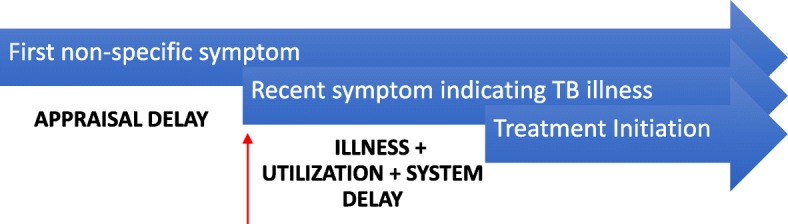
Appraisal delay is the time a patient takes to consider a symptom as not only noticeable, but a sign of illness. The study's objective was to determine the association between appraisal delay in seeking tuberculosis (TB) treatment and geographic distance measured by network travel (driving and pedestrian) time (in minutes) and distance (Euclidean and self-reported) (in kilometers) and to identify other risk factors from selected covariates and how they modify the core association between delay and distance.
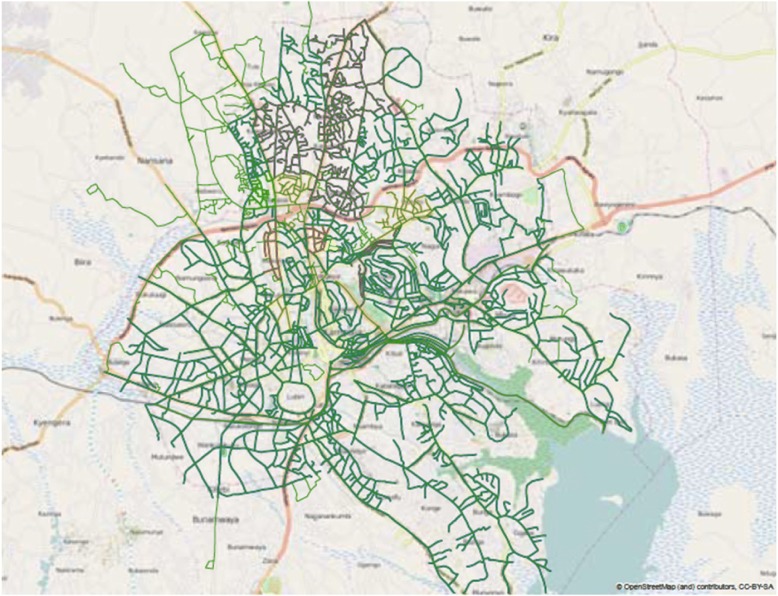
This was part of a longitudinal cohort study known as the Kawempe Community Health Study based in Kampala, Uganda. The study enrolled households from April 2002 to July 2012. Multivariable interval regression with multiplicative heteroscedasticity was used to assess the impact of time and distance on delay. The delay interval outcome was defined using a comprehensive set of 28 possible self-reported symptoms. The main independent variables were network travel time (in minutes) and Euclidean distance (in kilometers). Other covariates were organized according to the Andersen utilization conceptual framework.
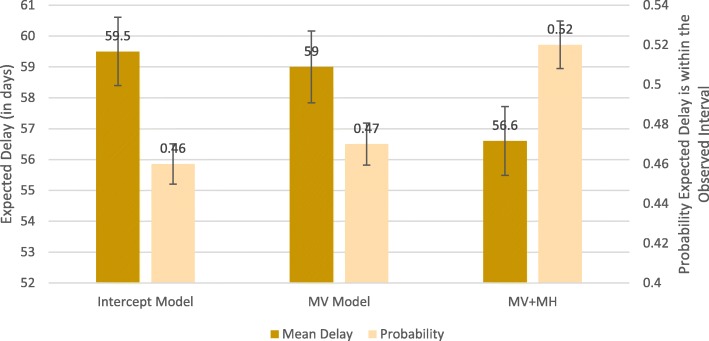
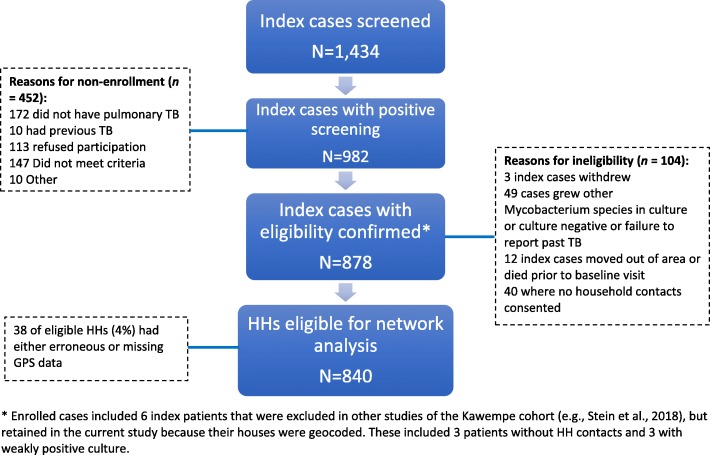
A total of 838 patients with both distance and delay data were included in the network analysis. Bivariate analyses did not reveal a significant association of any distance metric with the delay outcome. However, adjusting for patient characteristics and cavitary disease status, the multivariable model indicated that each minute of driving time to the clinic significantly (p = 0.02) and positively predicted 0.25 days' delay. At the median distance value of 47 min, this represented an additional delay of about 12 (95% CI: [3, 21]) days to the mean of 40 days (95% CI: [25, 56]). Increasing Euclidean distance significantly predicted (p = 0.02) reduced variance in the delay outcome, thereby increasing precision of the mean delay estimate. At the median Euclidean distance of 2.8 km, the variance in the delay was reduced by more than 25%.
Of the four geographic distance measures, network travel driving time was a better and more robust predictor of mean delay in this setting. Including network travel driving time with other risk factors may be important in identifying populations especially vulnerable to delay.
评估延迟是指患者将症状不仅视为明显,而且视为疾病迹象所需的时间。本研究的目的是确定寻求结核病(TB)治疗的评估延迟与通过网络出行(驾驶和步行)时间(以分为单位)和距离(以公里为单位)测量的地理距离之间的关联,并确定来自选定协变量的其他风险因素,以及它们如何改变延迟与距离之间的核心关联。
这是基于乌干达坎帕拉的 Kawempe 社区健康研究的纵向队列研究的一部分。该研究于 2002 年 4 月至 2012 年 7 月招募了家庭。使用具有异方差性的多变量间隔回归来评估时间和距离对延迟的影响。使用一套全面的 28 种可能的自述症状来定义延迟间隔结果。主要的独立变量是网络出行时间(以分为单位)和欧几里得距离(以公里为单位)。其他协变量根据安德森利用概念框架进行了组织。
共有 838 名患者同时具有距离和延迟数据,纳入网络分析。在双变量分析中,任何距离指标与延迟结果均无显著关联。然而,在调整患者特征和空洞性疾病状态后,多变量模型表明,到诊所的每驾驶一分钟都显著(p=0.02)且正向预测了 0.25 天的延迟。在距离中位数为 47 分钟的情况下,这代表了对 40 天(95%CI:[25,56])平均值的额外约 12(95%CI:[3,21])天的延迟。增加欧几里得距离显著预测(p=0.02)延迟结果的方差降低,从而提高了平均延迟估计的精度。在欧几里得距离中位数为 2.8 公里的情况下,延迟的方差降低了 25%以上。
在这一环境中,四种地理距离测量方法中,网络出行驾驶时间是平均延迟的更好且更稳健的预测指标。将网络出行驾驶时间与其他风险因素结合起来,可能对识别特别容易出现延迟的人群非常重要。