Menzies Institute for Medical Research, University of Tasmania, Private Bag 23, Hobart, TAS, 7001, Australia.
Faculty of Education, University of Tasmania, Launceston, TAS, Australia.
BMC Public Health. 2018 Jun 26;18(1):797. doi: 10.1186/s12889-018-5674-4.
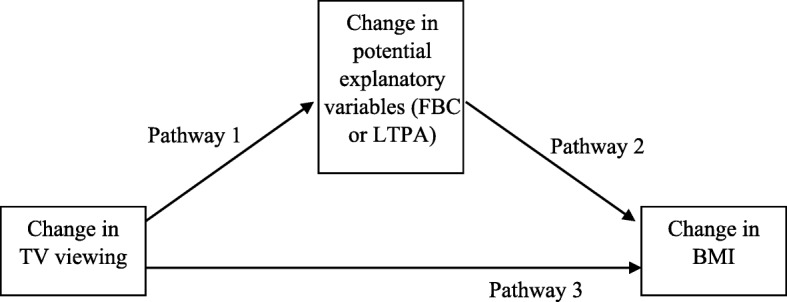
The mechanisms explaining the positive relationship between television (TV) viewing and body mass index (BMI) are unclear. 'Mindless eating' and 'physical activity displacement' theories have been suggested, but have not been tested longitudinally among young adults. This study aimed to determine whether longitudinal associations between young adults' TV viewing and BMI are explained by changes in TV-related food and beverage consumption (FBC) and/or leisure-time physical activity (LTPA) over 5 years among young adults.
A cohort of young Australian adults (n = 1068) was assessed in 2004-6 (T1) and 2009-2011 (T2), height and weight were measured (T1) or self-reported (T2), and participants self-reported TV viewing time (hours/day), weekly TV-related FBC and LTPA (mins/week). Linear regression was used to examine direct pathways between TV viewing and BMI, adjusting for TV-related FBC and LTPA to examine indirect pathways.
The association between TV viewing time and BMI (β: 0.41, 95% CI 0.03, 0.78 for > 1-h increase in TV viewing/day) was not explained by TV-related FBC (β: 0.37, 95% CI -0.18, 0.91) or LTPA (β: 0.38, 95% CI -0.17, 0.93) hypotheses. Increased TV-related FBC was associated with increased TV viewing (0.39 ± 1.54 h/day) and greater increases in BMI (0.92 ± 2.28 kg/m, p = 0.16). LTPA increases were not associated with changes in TV viewing (- 0.07 ± 1.42 h/day), and increases in BMI were smallest when LTPA increased (0.44 ± 2.25 kg/m) and greatest when LTPA decreased (0.82 ± 2.30 kg/m) (p = 0.13).
Factors other than changes in TV-related FBC or LTPA may explain the longitudinal relationship between TV viewing and increasing BMI among young adults. Findings confirm that TV viewing is a risk factor for weight gain in young adults but the underlying causal mechanisms remain unclear.
目前尚不清楚解释看电视(TV)与体重指数(BMI)之间正相关关系的机制。虽然已经提出了“无意识进食”和“体力活动替代”理论,但这些理论尚未在年轻人中进行纵向研究。本研究旨在确定年轻人看电视时间与 BMI 之间的纵向关联是否可以通过年轻人在 5 年内看电视相关的食物和饮料消费(FBC)和/或休闲时间体力活动(LTPA)的变化来解释。
一项针对年轻澳大利亚成年人(n=1068)的队列研究于 2004-2006 年(T1)和 2009-2011 年(T2)进行,在 T1 时测量了身高和体重,或在 T2 时自我报告,参与者自我报告了每天看电视的时间(小时/天)、每周看电视相关的 FBC 和 LTPA(分钟/周)。线性回归用于检验 TV 观看与 BMI 之间的直接关联,同时调整 TV 相关的 FBC 和 LTPA 以检验间接关联。
看电视时间与 BMI 之间的关联(β:0.41,95%CI 0.03,0.78,每天看电视时间增加 1 小时以上)不能用 TV 相关的 FBC(β:0.37,95%CI-0.18,0.91)或 LTPA(β:0.38,95%CI-0.17,0.93)假设来解释。看电视相关的 FBC 增加与看电视时间增加(0.39±1.54 h/天)和 BMI 增加(0.92±2.28 kg/m,p=0.16)相关。LTPA 增加与看电视时间的变化无关(-0.07±1.42 h/天),当 LTPA 增加时,BMI 的增加最小(0.44±2.25 kg/m),而当 LTPA 减少时,BMI 的增加最大(0.82±2.30 kg/m)(p=0.13)。
除了看电视相关的 FBC 或 LTPA 的变化外,其他因素可能解释了年轻人中看电视时间与 BMI 增加之间的纵向关系。研究结果证实,看电视是年轻人体重增加的一个风险因素,但潜在的因果机制仍不清楚。