Departamento de Fisiología, Facultad de Ciencias Biológicas, Pontificia Universidad Católica de Chile, Alameda #340, Santiago 8331150, Chile.
Instituto de Ciencias Biomédicas, Facultad de Ciencias de la Salud, Universidad Autónoma de Chile, El Llano Subercaseaux #2801, Santiago 8910060, Chile.
Int J Mol Sci. 2018 Jun 25;19(7):1864. doi: 10.3390/ijms19071864.
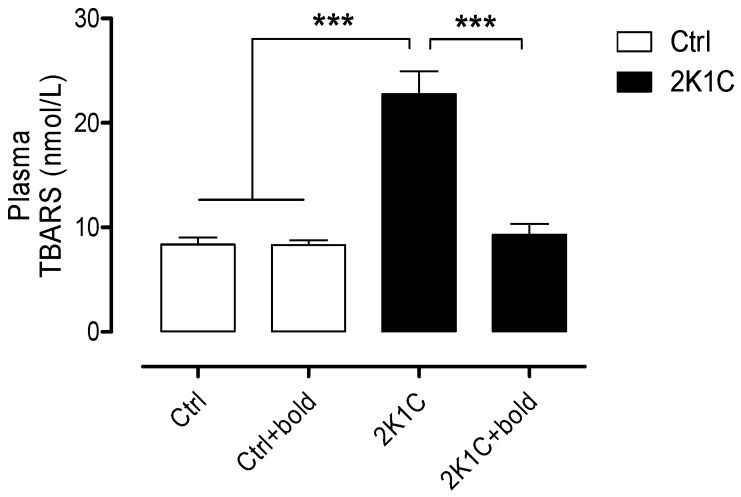
Boldine, a major aporphine alkaloid found in the Chilean boldo tree, is a potent antioxidant. Oxidative stress plays a detrimental role in the pathogenesis of kidney damage in renovascular hypertension (RVH). The activation of the renin-angiotensin system (RAS) is crucial to the development and progression of hypertensive renal damage and TGF-β is closely associated with the activation of RAS. In the present study, we assessed the effect of boldine on the progression of kidney disease using the 2K1C hypertension model and identifying mediators in the RAS, such as TGF-β, that could be modulated by this alkaloid. Toward this hypothesis, rats ( = 5/group) were treated with boldine (50 mg/kg/day, gavage) for six weeks after 2K1C surgery (pressure ≥ 180 mmHg). Kidney function was evaluated by measuring of proteinuria/creatininuria ratio (U prot/U Crea), oxidative stress (OS) by measuring thiobarbituric acid reactive substances (TBARS). The evolution of systolic blood pressure (SBP) was followed weekly. Alpha-smooth muscle actin (α-SMA) and Col III were used as markers of kidney damage; ED-1 and osteopontin (OPN) were used as markers of inflammation. We also explored the effect in RAS mediators, such as ACE-1 and TGF-β. Boldine treatment reduced the UProt/UCrea ratio, plasma TBARS, and slightly reduced SBP in 2K1C hypertensive rats, producing no effect in control animals. In 2K1C rats treated with boldine the levels of α-SMA, Col III, ED-1, and OPN were lower when compared to 2K1C rats. Boldine prevented the increase in ACE-1 and TGF-β in 2K1C rats, suggesting that boldine reduces kidney damage. These results suggest that boldine could potentially be used as a nutraceutic.
博尔定,智利产的一种阿朴菲生物碱,是一种强有力的抗氧化剂。氧化应激在肾血管性高血压(RVH)引起的肾损伤发病机制中起着有害的作用。肾素-血管紧张素系统(RAS)的激活对于高血压性肾损伤的发展和进展至关重要,而 TGF-β与 RAS 的激活密切相关。在本研究中,我们使用 2K1C 高血压模型评估了博尔定对肾脏疾病进展的影响,并鉴定了 RAS 中的介质,如 TGF-β,这些介质可以被这种生物碱调节。针对这一假设,给大鼠(每组 5 只)在 2K1C 手术后(血压 ≥ 180mmHg)用博尔定(50mg/kg/天,灌胃)治疗 6 周。通过测量蛋白尿/肌酐比值(U prot/U Crea)来评估肾功能,通过测量硫代巴比妥酸反应物质(TBARS)来评估氧化应激(OS)。每周监测收缩压(SBP)的变化。α-平滑肌肌动蛋白(α-SMA)和 Col III 被用作肾脏损伤的标志物;ED-1 和骨桥蛋白(OPN)被用作炎症的标志物。我们还研究了 RAS 介质如 ACE-1 和 TGF-β的作用。博尔定治疗降低了 2K1C 高血压大鼠的 UProt/UCrea 比值、血浆 TBARS 和 SBP,对对照组动物无影响。在 2K1C 大鼠中,与 2K1C 大鼠相比,博尔定治疗降低了 α-SMA、Col III、ED-1 和 OPN 的水平。博尔定阻止了 2K1C 大鼠中 ACE-1 和 TGF-β的增加,表明博尔定可减轻肾脏损伤。这些结果表明,博尔定可能可作为一种营养保健品。