Songthamwat Srisuda, Na Nan Chatchanawadee, Songthamwat Metha
Department of Obstetrics and Gynecology, Udonthani Hospital, Udonthani, Thailand.
Int J Womens Health. 2018 Jun 15;10:317-323. doi: 10.2147/IJWH.S159062. eCollection 2018.
Threatened preterm labor is a condition in which regular uterine contractions occur at least 1 time in 10 minutes and persist for more than 30 minutes before completion of 37 weeks of gestation without dilatation of the cervix. In preterm labor with cervical dilatation, the efficacy of tocolytics was proven for prolonging pregnancy. However, in threatened preterm labor, the efficacy of tocolytics has not yet been well studied. This study aimed to evaluate the effectiveness of nifedipine versus a placebo for inhibiting uterine contraction in threatened preterm labor.
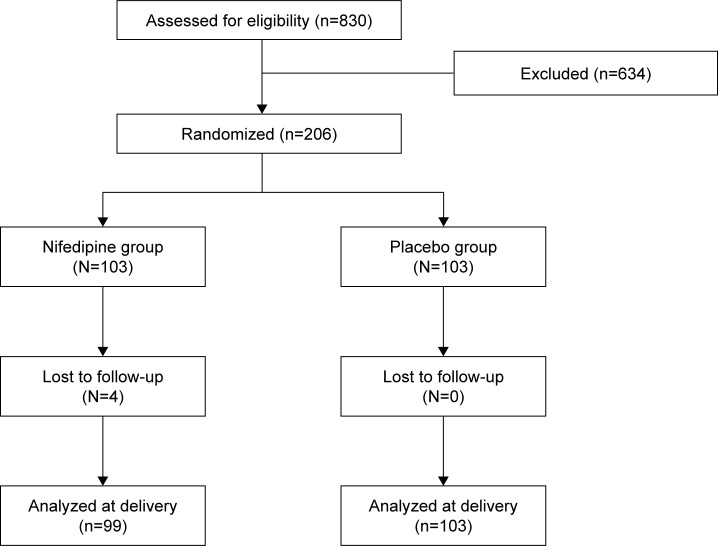
A randomized, double-blinded, placebo-controlled study with 206 threatened preterm labor patients was undertaken. The participants were randomly allocated into either nifedipine or placebo groups. The proportion of patients with successful treatment, gestational age at delivery, and neonatal outcome were compared between the 2 groups.
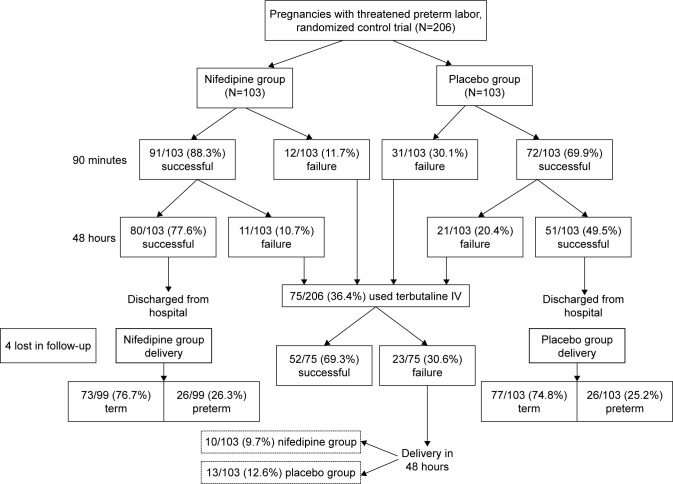
After 90 minutes of treatment, 88.3% of the nifedipine group and 69.9% of the placebo group had no uterine contraction (<0.001). Nifedipine led to successful treatment outcomes in 77.6% of the total participants compared with 49.5% in the placebo group (<0.001). The remainder of the participants from both groups needed a second-line tocolytic drug. Of these, 9.7% in the nifedipine group delivered within 48 hours compared with 12.6% in the placebo group (>0.05). Mean gestation age at delivery and neonatal complications for both groups were not significantly different.
Nifedipine had a higher success rate for inhibiting threatened preterm contractions.
先兆早产是指在妊娠37周前,子宫出现规律宫缩,至少每10分钟1次,持续超过30分钟,且宫颈未扩张。在宫颈扩张的早产中,已证实宫缩抑制剂可延长孕周。然而,在先兆早产中,宫缩抑制剂的疗效尚未得到充分研究。本研究旨在评估硝苯地平与安慰剂在抑制先兆早产宫缩方面的有效性。
对206例先兆早产患者进行了一项随机、双盲、安慰剂对照研究。参与者被随机分为硝苯地平组或安慰剂组。比较两组治疗成功的患者比例、分娩时的孕周和新生儿结局。
治疗90分钟后,硝苯地平组88.3%的患者和安慰剂组69.9%的患者无宫缩(<0.001)。硝苯地平组77.6%的总参与者治疗成功,而安慰剂组为49.5%(<0.001)。两组其余参与者需要二线宫缩抑制剂。其中,硝苯地平组9.7%的患者在48小时内分娩,安慰剂组为12.6%(>0.05)。两组的平均分娩孕周和新生儿并发症无显著差异。
硝苯地平抑制先兆早产宫缩的成功率更高。