Department of Systems and Information Engineering, School of Engineering, University of Virginia, Charlottesville, VA, United States.
Department of Public Health Sciences, School of Medicine, University of Virginia, Charlottesville, VA, United States.
Diabetes Res Clin Pract. 2018 Sep;143:24-33. doi: 10.1016/j.diabres.2018.06.016. Epub 2018 Jun 23.
To examine factors that affect cost-related medication non-adherence (CRN), defined as taking medication less than as prescribed because of cost, among adults with diabetes and to determine their relative contribution in explaining CRN.
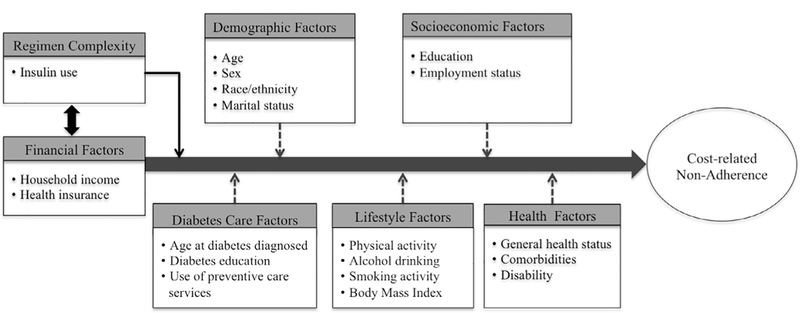
Behavioral Risk Factor Surveillance System data for 2013-2014 were used to identify individuals with diabetes and their CRN. We modeled CRN as a function of financial factors, regimen complexity, and other contextual factors including diabetes care, lifestyle, and health factors. Dominance analysis was performed to rank these factors by relative importance.
CRN among U.S. adults with diabetes was 16.5%. Respondents with annual income <$50,000 and without health insurance were more likely to report CRN, compared to those with income ≥$50,000 and those with insurance, respectively. Insulin users had 1.24 times higher risk of CRN compared to those not on insulin. Contextual factors that significantly affected CRN included diabetes care factors, lifestyle factors, and comorbid depression, arthritis, and COPD/asthma. Dominance analysis showed health insurance was the most important factor for respondents <65 and depression was the most important factor for respondents ≥65.
In addition to traditional risk factors of CRN, compliance with annual recommendations for diabetes and healthy lifestyle were associated with lower CRN. Policies and social supports that address these contextual factors may help improve CRN.
研究影响糖尿病患者药物费用相关不依从性(CRN)的因素,即由于费用原因而未按规定服用药物,并确定这些因素在解释 CRN 方面的相对贡献。
利用 2013-2014 年行为风险因素监测系统的数据,确定患有糖尿病的个体及其 CRN。我们将 CRN 建模为财务因素、治疗方案复杂性以及包括糖尿病护理、生活方式和健康因素在内的其他背景因素的函数。采用优势分析对这些因素进行相对重要性排序。
美国糖尿病成年患者的 CRN 为 16.5%。与收入≥$50,000 且有保险的患者相比,年收入<$50,000 且没有保险的患者更有可能报告 CRN。与未使用胰岛素的患者相比,使用胰岛素的患者发生 CRN 的风险高 1.24 倍。对 CRN 有显著影响的背景因素包括糖尿病护理因素、生活方式因素以及并发抑郁、关节炎和 COPD/哮喘。优势分析表明,对于 65 岁以下的患者,医疗保险是最重要的因素,而对于 65 岁及以上的患者,抑郁是最重要的因素。
除了 CRN 的传统风险因素外,遵守年度糖尿病建议和健康生活方式与较低的 CRN 相关。解决这些背景因素的政策和社会支持可能有助于改善 CRN。