Pritzker School of Medicine, The University of Chicago, 924 E 57th St, Chicago, IL, 60637, USA.
NORC at the University of Chicago, 1155 East 60th St, 2nd Floor, Chicago, IL, 60637, USA.
BMC Public Health. 2018 Jun 27;18(1):804. doi: 10.1186/s12889-018-5664-6.
Older adults receive important health benefits from more robust social capital. Yet, the mechanisms behind these associations are not fully understood. Some evidence suggests that higher levels of social capital ultimately affect health through alterations in physical activity (PA), but most of this research has relied on self-reported levels of PA. The aim of this study was to determine whether components of social capital, including social network size and composition as well as the frequency of participation in various social and community activities, were associated with accelerometry-measured PA levels in a nationally representative sample of community-dwelling older adults (≥ 62 years).
We conducted a cross-sectional analysis using data from the wrist accelerometry sub-study (n = 738) within Wave 2 of the National Social, Health, and Aging Project (NSHAP), a population-based longitudinal study that collects extensive survey data on the physical, cognitive, and social health of older adults. Participants' physical activity was measured with a wrist accelerometer worn for 72 consecutive hours. We related seven, self-reported social relationship variables (network size, network proportion friends, and frequencies of socializing with friends and family, visiting with neighbors, attending organized group meetings, attending religious services, and volunteering) to accelerometer-measured PA (mean counts-per-minute) using multivariate linear regression analysis, while adjusting for potential confounders.
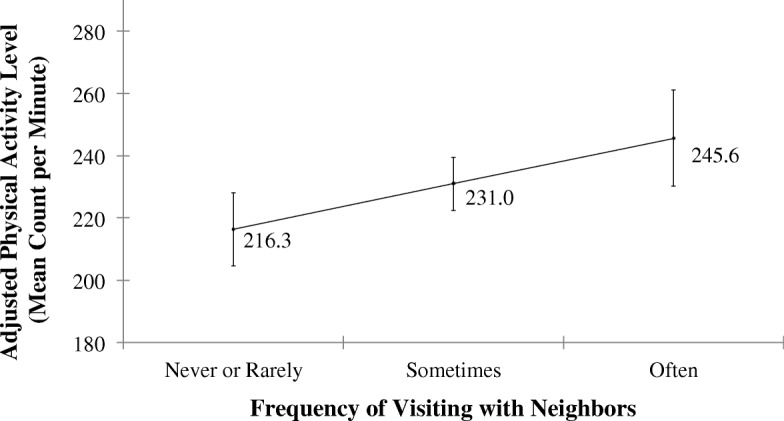
Larger social networks (p = 0.042), higher network proportion friends (p = 0.013), more frequent visiting with neighbors (p = 0.009), and more frequent attendance at organized group meetings (p = 0.035) were associated with higher PA levels after controlling for demographic and health covariates. Volunteering was significant prior to adjusting for covariates. No significant associations were found between frequencies of socializing with friends and relatives or attendance at religious services and PA.
This study suggests social capital is significantly related to objectively measured PA levels among older adults, and that friendships as well as social participation in groups and with neighbors may be particularly pertinent to PA. These findings expand our understanding of and offer a potential mechanism linking social relationships and overall health among older adults. They also have implications for how we might motivate older adults to be more physically active.
老年人从更强大的社会资本中获得重要的健康益处。然而,这些关联的背后机制尚不完全清楚。一些证据表明,较高水平的社会资本最终通过改变体力活动(PA)来影响健康,但大多数此类研究都依赖于自我报告的 PA 水平。本研究的目的是确定社会资本的组成部分(包括社交网络的规模和组成以及参与各种社交和社区活动的频率)是否与全国代表性社区居住的老年人(≥62 岁)的加速度计测量的 PA 水平相关。
我们使用来自国家社会、健康和老龄化项目(NSHAP)第 2 波手腕加速度计子研究(n=738)的数据进行了横断面分析,这是一项基于人群的纵向研究,收集了有关老年人身体、认知和社会健康的广泛调查数据。参与者的身体活动通过佩戴腕式加速度计连续 72 小时进行测量。我们使用多元线性回归分析将七个自我报告的社会关系变量(网络规模、网络中朋友的比例以及与朋友和家人社交、与邻居交往、参加有组织的团体会议、参加宗教服务和志愿服务的频率)与加速度计测量的 PA(平均每分钟计数)联系起来,同时调整了潜在的混杂因素。
在控制人口统计学和健康混杂因素后,更大的社交网络(p=0.042)、更高的网络中朋友的比例(p=0.013)、更频繁的与邻居交往(p=0.009)和更频繁地参加有组织的团体会议(p=0.035)与更高的 PA 水平相关。在调整混杂因素之前,志愿服务具有统计学意义。与朋友和亲戚交往以及参加宗教服务的频率与 PA 之间没有显著关联。
本研究表明,社会资本与老年人的客观测量 PA 水平显著相关,并且友谊以及与邻居和团体的社交参与可能与 PA 特别相关。这些发现扩展了我们对社会关系与老年人整体健康之间联系的理解,并提供了潜在的机制。它们还对我们如何激励老年人更加活跃身体有影响。