Li Ronald H L, Johnson Lynelle R, Kohen Casey, Tablin Fern
Department of Veterinary Surgical and Radiological Sciences, School of Veterinary Medicine, University of California, One Shield Avenue, Davis, California, 95161, USA.
Department of Medicine and Epidemiology, School of Veterinary Medicine, University of California, Davis, California, USA.
BMC Vet Res. 2018 Jun 27;14(1):210. doi: 10.1186/s12917-018-1523-z.
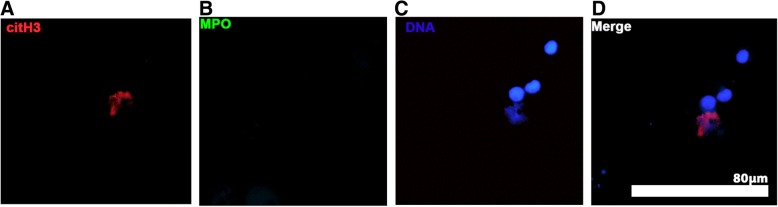
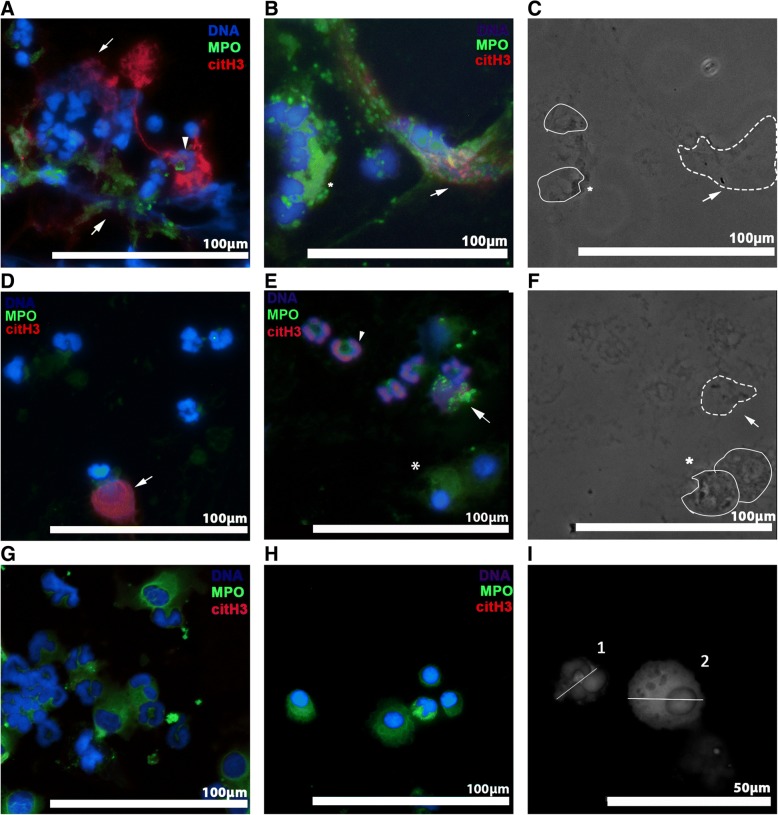
Canine neutrophils release neutrophil extracellular traps (NETs) in response to lipopolysaccharide but NETs from clinical septic dogs had not been identified. The primary aim is to describe the methodology of identifying and quantifying neutrophil extracellular traps (NETs) in cytology samples of septic foci in dogs with sepsis using immunofluorescence microscopy. Cytology samples including endotracheal tracheal wash (ETW), bronchoalveolar lavage (BAL), abdominal and pleural effusion collected from 5 dogs (3 septic, 2 non-septic) were fixed, permeabilized and stained for myeloperoxidase (MPO), citrullinated histone H3 (citH3) and cell-free DNA (cfDNA). Fluorescence microscopy was used to identify and quantify NETs in 10 random views at 40× magnification. NETs were identified based on co-localization of MPO, citH3 and cfDNA. NETs were quantified as a ratio (number of NETs: number of neutrophils). Neutrophils were identified based on cytoplasmic MPO, cellular diameter and nuclear morphology.
NETs were identified and quantified in all cytology samples collected from septic dogs. A small number of NETs was documented in one dog with sterile chronic bronchitis. No NETs were found in sterile abdominal effusion collected from one dog with congestive heart failure.
Immunofluorescence microscopy could be a useful tool for the study of NETs in dogs with clinical sepsis.
犬中性粒细胞可响应脂多糖释放中性粒细胞胞外诱捕网(NETs),但临床败血症犬的NETs尚未得到鉴定。主要目的是描述使用免疫荧光显微镜在患有败血症的犬的败血症病灶细胞学样本中鉴定和定量中性粒细胞胞外诱捕网(NETs)的方法。对从5只犬(3只败血症犬,2只非败血症犬)收集的细胞学样本,包括气管内冲洗液(ETW)、支气管肺泡灌洗液(BAL)、腹腔积液和胸腔积液进行固定、通透处理,并对髓过氧化物酶(MPO)、瓜氨酸化组蛋白H3(citH3)和游离DNA(cfDNA)进行染色。使用荧光显微镜在40倍放大倍数下的10个随机视野中鉴定和定量NETs。基于MPO、citH3和cfDNA的共定位来鉴定NETs。NETs以比率(NETs数量:中性粒细胞数量)进行定量。基于细胞质MPO、细胞直径和核形态来鉴定中性粒细胞。
在从败血症犬收集的所有细胞学样本中均鉴定并定量了NETs。在一只患有无菌性慢性支气管炎的犬中记录到少量NETs。在一只患有充血性心力衰竭的犬收集的无菌性腹腔积液中未发现NETs。
免疫荧光显微镜可能是研究临床败血症犬NETs的有用工具。