• 文献检索
  • 文档翻译
  • 深度研究
  • 学术资讯
  • Suppr Zotero 插件Zotero 插件
  • 邀请有礼
  • 套餐&价格
  • 历史记录
应用&插件
Suppr Zotero 插件Zotero 插件浏览器插件Mac 客户端Windows 客户端微信小程序
定价
高级版会员购买积分包购买API积分包
服务
文献检索文档翻译深度研究API 文档MCP 服务
关于我们
关于 Suppr公司介绍联系我们用户协议隐私条款
关注我们

Suppr 超能文献

核心技术专利:CN118964589B侵权必究
粤ICP备2023148730 号-1Suppr @ 2026

文献检索

告别复杂PubMed语法,用中文像聊天一样搜索,搜遍4000万医学文献。AI智能推荐,让科研检索更轻松。

立即免费搜索

文件翻译

保留排版,准确专业,支持PDF/Word/PPT等文件格式,支持 12+语言互译。

免费翻译文档

深度研究

AI帮你快速写综述,25分钟生成高质量综述,智能提取关键信息,辅助科研写作。

立即免费体验

用于儿童和青少年焦虑症及抑郁症的电子心理健康护理技术:报告实施结果的研究系统综述

eMental Healthcare Technologies for Anxiety and Depression in Childhood and Adolescence: Systematic Review of Studies Reporting Implementation Outcomes.

作者信息

Wozney Lori, McGrath Patrick J, Gehring Nicole D, Bennett Kathryn, Huguet Anna, Hartling Lisa, Dyson Michele P, Soleimani Amir, Newton Amanda S

机构信息

Izaak Walton Killam Centre, Centre for Research in Family Health, Halifax, NS, Canada.

Department of Psychiatry, Dalhousie University, Halifax, NS, Canada.

出版信息

JMIR Ment Health. 2018 Jun 26;5(2):e48. doi: 10.2196/mental.9655.

DOI:10.2196/mental.9655
PMID:29945858
原文链接:https://pmc.ncbi.nlm.nih.gov/articles/PMC6039769/
Abstract

BACKGROUND

Anxiety disorders and depression are frequent conditions in childhood and adolescence. eMental healthcare technologies may improve access to services, but their uptake within health systems is limited.

OBJECTIVE

The objective of this review was to examine and describe how the implementation of eMental healthcare technologies for anxiety disorders and depression in children and adolescents has been studied.

METHODS

We conducted a search of 5 electronic databases and gray literature. Eligible studies were those that assessed an eMental healthcare technology for treating or preventing anxiety or depression, included children or adolescents (<18 years), or their parents or healthcare providers and reported findings on technology implementation. The methodological quality of studies was evaluated using the Mixed Methods Appraisal Tool. Outcomes of interest were based on 8 implementation outcomes: acceptability (satisfaction with a technology), adoption (technology uptake and utilization), appropriateness ("fitness for purpose"), cost (financial impact of technology implementation), feasibility (extent to which a technology was successfully used), fidelity (implementation as intended), penetration ("spread" or "reach" of the technology), and sustainability (maintenance or integration of a technology within a healthcare service). For extracted implementation outcome data, we coded favorable ratings on measurement scales as "positive results" and unfavorable ratings on measurement scales as "negative results." Those studies that reported both positive and negative findings were coded as having "mixed results."

RESULTS

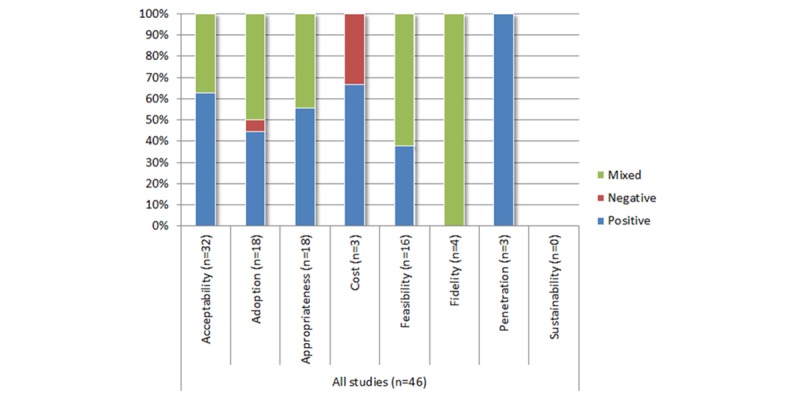
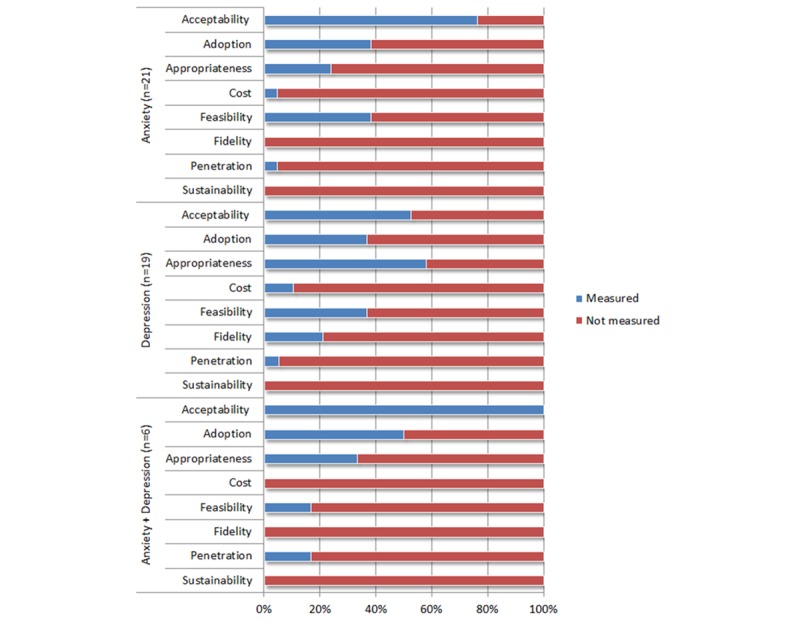
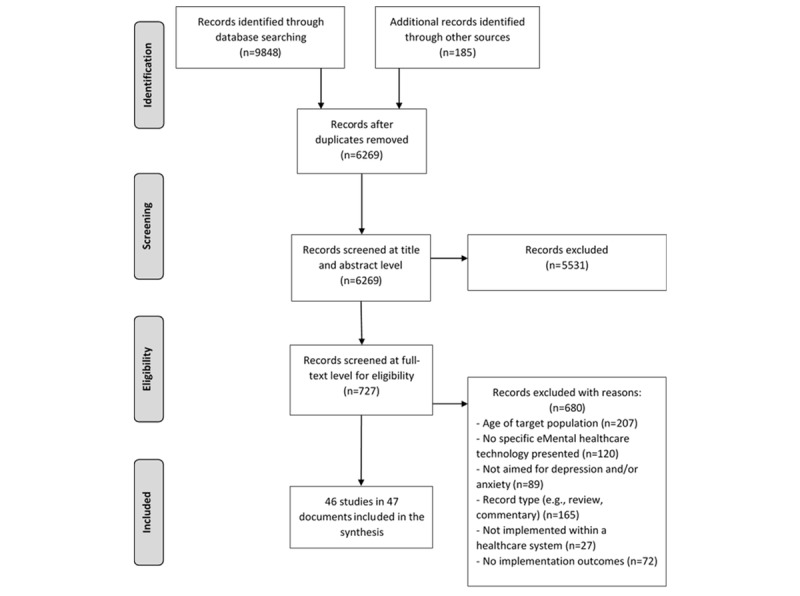
A total of 46 studies met the inclusion criteria, the majority of which were rated as very good to excellent in methodological quality. These studies investigated eMental healthcare technologies for anxiety (n=23), depression (n=18), or both anxiety and depression (n=5). Studies of technologies for anxiety evaluated the following: (1) acceptability (78%) reported high levels of satisfaction, (2) adoption (43%) commonly reported positive results, and (3) feasibility (43%) reported mixed results. Studies of technologies for depression evaluated the following: (1) appropriateness (56%) reported moderate helpfulness and (2) acceptability (50%) described a mix of both positive and negative findings. Studies of technologies designed to aid anxiety and depression commonly reported mixed experiences with acceptability and adoption and positive findings for appropriateness of the technologies for treatment. Across all studies, cost, fidelity, and penetration and sustainability were the least measured implementation outcomes.

CONCLUSIONS

Acceptability of eMental healthcare technology is high among users and is the most commonly investigated implementation outcome. Perceptions of the appropriateness and adoption of eMental healthcare technology were varied. Implementation research that identifies, evaluates, and reports on costs, sustainability, and fidelity to clinical guidelines is crucial for making high-quality eMental healthcare available to children and adolescents.

摘要

背景

焦虑症和抑郁症在儿童和青少年中很常见。电子心理健康护理技术可能会改善服务的可及性,但它们在卫生系统中的应用有限。

目的

本综述的目的是研究和描述针对儿童和青少年焦虑症和抑郁症的电子心理健康护理技术的实施情况。

方法

我们检索了5个电子数据库和灰色文献。符合条件的研究是那些评估用于治疗或预防焦虑或抑郁的电子心理健康护理技术的研究,包括儿童或青少年(<18岁)、他们的父母或医疗保健提供者,并报告了技术实施的结果。使用混合方法评估工具评估研究的方法学质量。感兴趣的结果基于8个实施结果:可接受性(对技术的满意度)、采用率(技术的采用和使用情况)、适宜性(“是否适合目的”)、成本(技术实施的财务影响)、可行性(技术成功使用的程度)、保真度(按预期实施)、渗透率(技术的“传播”或“覆盖范围”)和可持续性(技术在医疗服务中的维持或整合)。对于提取的实施结果数据,我们将量表上的有利评级编码为“阳性结果”,将量表上的不利评级编码为“阴性结果”。那些报告了阳性和阴性结果的研究被编码为“混合结果”。

结果

共有46项研究符合纳入标准,其中大多数在方法学质量上被评为非常好到优秀。这些研究调查了用于治疗焦虑症(n = 23)、抑郁症(n = 18)或焦虑症和抑郁症两者(n = 5)的电子心理健康护理技术。针对焦虑症的技术研究评估了以下方面:(1)可接受性(78%)报告了高水平的满意度,(2)采用率(43%)通常报告了阳性结果,(3)可行性(43%)报告了混合结果。针对抑郁症的技术研究评估了以下方面:(1)适宜性(56%)报告了中等帮助程度,(2)可接受性(50%)描述了阳性和阴性结果的混合。旨在帮助焦虑症和抑郁症的技术研究通常报告了在可接受性和采用率方面的混合体验以及该技术用于治疗的适宜性方面的阳性结果。在所有研究中,成本、保真度、渗透率和可持续性是最少测量的实施结果。

结论

电子心理健康护理技术在用户中的可接受性很高,并且是最常研究的实施结果。对电子心理健康护理技术的适宜性和采用率的看法各不相同。识别、评估和报告成本、可持续性以及对临床指南的保真度的实施研究对于为儿童和青少年提供高质量的电子心理健康护理至关重要。
https://cdn.ncbi.nlm.nih.gov/pmc/blobs/65a1/6039769/b81657799b4e/mental_v5i2e48_fig3.jpg
https://cdn.ncbi.nlm.nih.gov/pmc/blobs/65a1/6039769/01adcc358bf8/mental_v5i2e48_fig1.jpg
https://cdn.ncbi.nlm.nih.gov/pmc/blobs/65a1/6039769/4b7afdb14cf0/mental_v5i2e48_fig2.jpg
https://cdn.ncbi.nlm.nih.gov/pmc/blobs/65a1/6039769/b81657799b4e/mental_v5i2e48_fig3.jpg
https://cdn.ncbi.nlm.nih.gov/pmc/blobs/65a1/6039769/01adcc358bf8/mental_v5i2e48_fig1.jpg
https://cdn.ncbi.nlm.nih.gov/pmc/blobs/65a1/6039769/4b7afdb14cf0/mental_v5i2e48_fig2.jpg
https://cdn.ncbi.nlm.nih.gov/pmc/blobs/65a1/6039769/b81657799b4e/mental_v5i2e48_fig3.jpg

相似文献

1
eMental Healthcare Technologies for Anxiety and Depression in Childhood and Adolescence: Systematic Review of Studies Reporting Implementation Outcomes.用于儿童和青少年焦虑症及抑郁症的电子心理健康护理技术:报告实施结果的研究系统综述
JMIR Ment Health. 2018 Jun 26;5(2):e48. doi: 10.2196/mental.9655.
2
Pediatric eMental healthcare technologies: a systematic review of implementation foci in research studies, and government and organizational documents.儿科电子心理健康护理技术:对研究、政府及组织文件中实施重点的系统评价
Implement Sci. 2017 Jun 21;12(1):76. doi: 10.1186/s13012-017-0608-6.
3
Implementation of eMental Health care: viewpoints from key informants from organizations and agencies with eHealth mandates.电子心理健康护理的实施:来自负有电子健康任务的组织和机构关键信息提供者的观点。
BMC Med Inform Decis Mak. 2017 Jun 2;17(1):78. doi: 10.1186/s12911-017-0474-9.
4
eMental health service use among Australian youth: a cross-sectional survey framed by Andersen's model.澳大利亚青年使用电子心理健康服务:基于安德森模型的横断面调查。
Aust Health Rev. 2020 Dec;44(6):891-897. doi: 10.1071/AH19095.
5
Improving Implementation of eMental Health for Mood Disorders in Routine Practice: Systematic Review of Barriers and Facilitating Factors.改善日常实践中情绪障碍电子心理健康的实施:障碍与促进因素的系统评价
JMIR Ment Health. 2018 Mar 16;5(1):e20. doi: 10.2196/mental.9769.
6
Folic acid supplementation and malaria susceptibility and severity among people taking antifolate antimalarial drugs in endemic areas.在流行地区,服用抗叶酸抗疟药物的人群中,叶酸补充剂与疟疾易感性和严重程度的关系。
Cochrane Database Syst Rev. 2022 Feb 1;2(2022):CD014217. doi: 10.1002/14651858.CD014217.
7
Implementation of Electronic Medical Records in Mental Health Settings: Scoping Review.精神卫生环境中电子病历的实施:范围审查
JMIR Ment Health. 2021 Sep 7;8(9):e30564. doi: 10.2196/30564.
8
Implementation of e-mental health for depression and anxiety: A critical scoping review.电子心理健康在抑郁和焦虑中的应用:一项关键性的范围综述。
J Community Psychol. 2020 Apr;48(3):904-920. doi: 10.1002/jcop.22309. Epub 2020 Jan 16.
9
The future of Cochrane Neonatal.考克兰新生儿协作网的未来。
Early Hum Dev. 2020 Nov;150:105191. doi: 10.1016/j.earlhumdev.2020.105191. Epub 2020 Sep 12.
10
Mobile health interventions for HIV/STI prevention among youth in low- and middle-income countries (LMICs): a systematic review of studies reporting implementation outcomes.中低收入国家青少年预防艾滋病毒/性传播感染的移动健康干预措施:对报告实施结果的研究的系统评价
Implement Sci Commun. 2021 Nov 6;2(1):126. doi: 10.1186/s43058-021-00230-w.

引用本文的文献

1
Understanding stakeholder views of the use of digital therapeutic interventions within children and young people's mental health services.了解利益相关者对儿童和青少年心理健康服务中数字治疗干预措施使用情况的看法。
Front Psychiatry. 2025 Feb 11;16:1505345. doi: 10.3389/fpsyt.2025.1505345. eCollection 2025.
2
Engagement of adolescents with ADHD in a narrative-centered game-based behavior change environment to reduce alcohol use.让患有注意力缺陷多动障碍(ADHD)的青少年参与以叙事为中心的基于游戏的行为改变环境,以减少酒精使用。
Front Educ (Lausanne). 2023;8. doi: 10.3389/feduc.2023.1183994. Epub 2024 Jan 4.
3
The effectiveness of e-mental health interventions on stress, anxiety, and depression among healthcare professionals: a systematic review and meta-analysis.

本文引用的文献

1
A Pilot Study of Computer-Assisted Cognitive Behavioral Therapy for Childhood Anxiety in Community Mental Health Centers.社区心理健康中心儿童焦虑症计算机辅助认知行为疗法的初步研究。
J Cogn Psychother. 2013;27(3):221-234. doi: 10.1891/0889-8391.27.3.221. Epub 2013 Jan 1.
2
Prevention and early intervention of anxiety problems in young children: A pilot evaluation of Cool Little Kids Online.幼儿焦虑问题的预防与早期干预:“酷小孩在线”的初步评估
Internet Interv. 2016 May 18;4:105-112. doi: 10.1016/j.invent.2016.05.001. eCollection 2016 May.
3
The impact of non-response bias due to sampling in public health studies: A comparison of voluntary versus mandatory recruitment in a Dutch national survey on adolescent health.
电子心理健康干预措施对医护人员压力、焦虑和抑郁的有效性:系统评价和荟萃分析。
Syst Rev. 2024 May 30;13(1):144. doi: 10.1186/s13643-024-02565-6.
4
A qualitative interview study of patients' attitudes towards and intention to use digital interventions for depressive disorders on prescription.一项关于患者对处方中用于治疗抑郁症的数字干预措施的态度及使用意愿的定性访谈研究。
Front Digit Health. 2024 Feb 5;6:1275569. doi: 10.3389/fdgth.2024.1275569. eCollection 2024.
5
Implementation strategies to scale up self-administered depot medroxyprogesterone acetate subcutaneous injectable contraception: a scoping review.扩大自我管理的 depot 醋酸甲羟孕酮皮下注射避孕措施的实施策略:范围综述。
Syst Rev. 2023 Jul 4;12(1):114. doi: 10.1186/s13643-023-02216-2.
6
Supporting Adolescent Engagement with Artificial Intelligence-Driven Digital Health Behavior Change Interventions.支持青少年参与人工智能驱动的数字健康行为改变干预措施。
J Med Internet Res. 2023 May 24;25:e40306. doi: 10.2196/40306.
7
Implementation of eMental health technologies for informal caregivers: A multiple case study.为非正式照料者实施电子心理健康技术:一项多案例研究。
Front Digit Health. 2023 Mar 24;5:1130866. doi: 10.3389/fdgth.2023.1130866. eCollection 2023.
8
Determination of Markers of Successful Implementation of Mental Health Apps for Young People: Systematic Review.确定年轻人心理健康应用程序成功实施的标志物:系统评价。
J Med Internet Res. 2022 Nov 9;24(11):e40347. doi: 10.2196/40347.
9
Assessment and Prediction of Depression and Anxiety Risk Factors in Schoolchildren: Machine Learning Techniques Performance Analysis.学龄儿童抑郁和焦虑风险因素的评估与预测:机器学习技术性能分析
JMIR Form Res. 2022 Aug 31;6(8):e32736. doi: 10.2196/32736.
10
Describing implementation outcomes for a virtual community of practice: The ECHO Ontario Mental Health experience.描述实践虚拟社区的实施结果:安大略省 ECHO 心理健康经验。
Health Res Policy Syst. 2022 Feb 8;20(1):17. doi: 10.1186/s12961-022-00818-1.
公共卫生研究中抽样导致的无应答偏倚的影响:荷兰青少年健康全国性调查中自愿招募与强制招募的比较。
BMC Public Health. 2017 Mar 23;17(1):276. doi: 10.1186/s12889-017-4189-8.
4
The Emerging Application of Health Information Technology in Child and Adolescent Psychiatry.健康信息技术在儿童和青少年精神病学中的新兴应用。
Child Adolesc Psychiatr Clin N Am. 2017 Jan;26(1):xiii-xv. doi: 10.1016/j.chc.2016.08.001. Epub 2016 Oct 15.
5
Factors that influence the implementation of e-health: a systematic review of systematic reviews (an update).影响电子健康实施的因素:系统评价的系统综述(更新版)
Implement Sci. 2016 Oct 26;11(1):146. doi: 10.1186/s13012-016-0510-7.
6
Right choice, right time: Evaluation of an online decision aid for youth depression.正确的选择,正确的时机:在线青少年抑郁决策辅助工具的评估。
Health Expect. 2017 Aug;20(4):714-723. doi: 10.1111/hex.12510. Epub 2016 Oct 17.
7
Effectiveness of online versus live multi-family psychoeducation group therapy for children and adolescents with mood or anxiety disorders: a pilot study.在线与现场多家庭心理教育团体治疗对患有情绪或焦虑障碍的儿童和青少年的有效性:一项试点研究。
Int J Adolesc Med Health. 2016 Oct 14;30(4):/j/ijamh.2018.30.issue-4/ijamh-2016-0069/ijamh-2016-0069.xml. doi: 10.1515/ijamh-2016-0069.
8
"On My Own, but Not Alone" - Adolescents' Experiences of Internet-Delivered Cognitive Behavior Therapy for Obsessive-Compulsive Disorder.“独自面对,但并不孤单”——青少年接受互联网认知行为疗法治疗强迫症的体验
PLoS One. 2016 Oct 6;11(10):e0164311. doi: 10.1371/journal.pone.0164311. eCollection 2016.
9
Comprehensive Online Self-Monitoring to Support Clinicians Manage Risk of Suicide in Youth Depression.全面在线自我监测,以支持临床医生管理青少年抑郁症自杀风险。
Crisis. 2017 May;38(3):147-157. doi: 10.1027/0227-5910/a000422. Epub 2016 Sep 23.
10
Moderated online social therapy for depression relapse prevention in young people: pilot study of a 'next generation' online intervention.针对青少年预防抑郁症复发的适度在线社交疗法:一项“下一代”在线干预的试点研究
Early Interv Psychiatry. 2018 Aug;12(4):613-625. doi: 10.1111/eip.12354. Epub 2016 Jun 17.