Ross Jamie, Stevenson Fiona, Lau Rosa, Murray Elizabeth
e-Health Unit, Research Department of Primary Care and Population Health, University College London, Upper 3rd Floor, Royal Free Campus, Rowland Hill Street, London, NW3 2PF, UK.
Implement Sci. 2016 Oct 26;11(1):146. doi: 10.1186/s13012-016-0510-7.
There is a significant potential for e-health to deliver cost-effective, quality health care, and spending on e-health systems by governments and healthcare systems is increasing worldwide. However, there remains a tension between the use of e-health in this way and implementation. Furthermore, the large body of reviews in the e-health implementation field, often based on one particular technology, setting or health condition make it difficult to access a comprehensive and comprehensible summary of available evidence to help plan and undertake implementation. This review provides an update and re-analysis of a systematic review of the e-health implementation literature culminating in a set of accessible and usable recommendations for anyone involved or interested in the implementation of e-health.
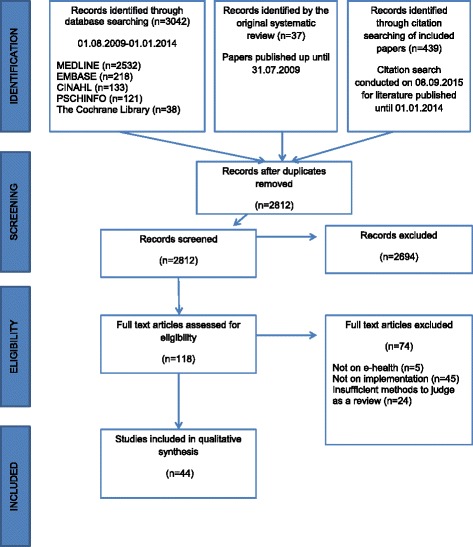
MEDLINE, EMBASE, CINAHL, PsycINFO and The Cochrane Library were searched for studies published between 2009 and 2014. Studies were included if they were systematic reviews of the implementation of e-health. Data from included studies were synthesised using the principles of meta-ethnography, and categorisation of the data was informed by the Consolidated Framework for Implementation Research (CFIR).
Forty-four reviews mainly from North America and Europe were included. A range of e-health technologies including electronic medical records and clinical decision support systems were represented. Healthcare settings included primary care, secondary care and home care. Factors important for implementation were identified at the levels of the following: the individual e-health technology, the outer setting, the inner setting and the individual health professionals as well as the process of implementation.
This systematic review of reviews provides a synthesis of the literature that both acknowledges the multi-level complexity of e-health implementation and provides an accessible and useful guide for those planning implementation. New interpretations of a large amount of data across e-health systems and healthcare settings have been generated and synthesised into a set of useable recommendations for practice. This review provides a further empirical test of the CFIR and identifies areas where additional research is necessary.
PROSPERO, CRD42015017661.
电子健康有显著潜力提供具有成本效益的优质医疗保健服务,全球范围内政府和医疗系统在电子健康系统上的支出正在增加。然而,以这种方式使用电子健康与实施之间仍存在矛盾。此外,电子健康实施领域大量的综述往往基于某一特定技术、环境或健康状况,这使得难以获取全面且易于理解的现有证据总结,以帮助规划和进行实施。本综述对电子健康实施文献的系统评价进行了更新和重新分析,最终为任何参与或关注电子健康实施的人提供了一套易于获取且实用的建议。
检索了MEDLINE、EMBASE、CINAHL、PsycINFO和考科蓝图书馆中2009年至2014年发表的研究。纳入的研究需为电子健康实施的系统评价。使用元民族志原则对纳入研究的数据进行综合,并依据实施研究综合框架(CFIR)对数据进行分类。
纳入了44篇主要来自北美和欧洲的综述。涵盖了一系列电子健康技术,包括电子病历和临床决策支持系统。医疗环境包括初级保健、二级保健和家庭护理。在以下层面确定了对实施重要的因素:单个电子健康技术、外部环境、内部环境、个体卫生专业人员以及实施过程。
对综述的这一系统评价综合了文献,既承认了电子健康实施的多层次复杂性,又为规划实施的人员提供了易于获取且实用的指南。对跨电子健康系统和医疗环境的大量数据进行了新的解读,并综合成一套实用的实践建议。本综述对CFIR进行了进一步的实证检验,并确定了需要进一步研究的领域。
PROSPERO,CRD42015017661。