Division of Cardiology, Department of Medicine, Massachusetts General Hospital, Boston, MA.
Harvard Medical School, Boston, MA.
J Am Heart Assoc. 2018 Jun 26;7(13):e009047. doi: 10.1161/JAHA.118.009047.
Venous thromboembolism (VTE) is the third leading cause of vascular disease and accounts for $10 billion in annual US healthcare costs. The nationwide burden of 30-day readmissions after such events has not been comprehensively assessed.
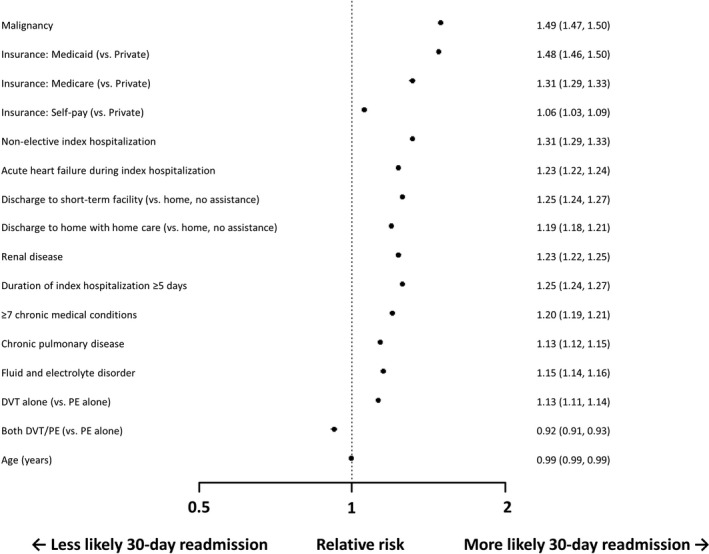
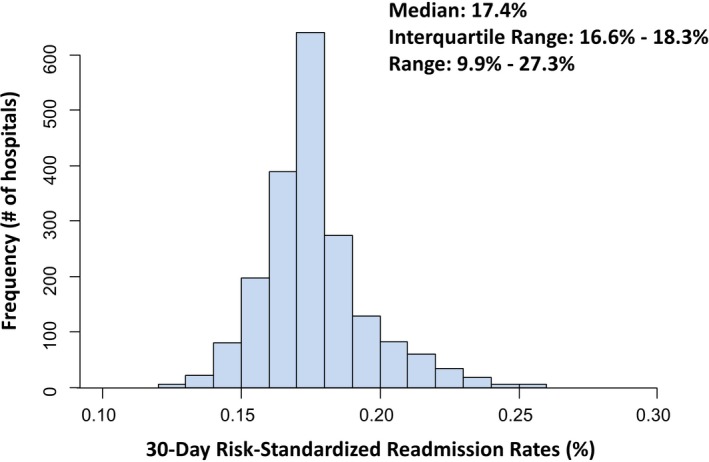
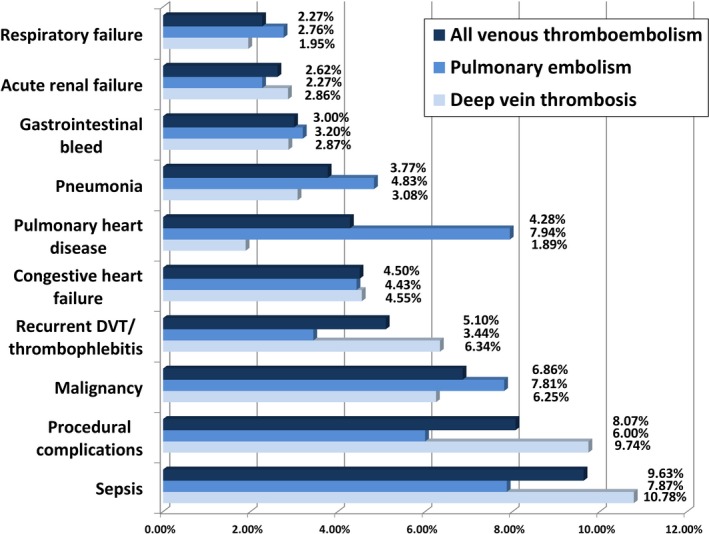
We analyzed adults ≥18 years of age with hospitalizations associated with acute VTE between January 1, 2010, and December 31, 2014, in the Nationwide Readmissions Database. () codes were used to identify hospitalizations associated with acute pulmonary embolism or deep vein thrombosis. The primary outcome was the rate of unplanned 30-day readmission. Hierarchical logistic regression was used to calculate hospital-specific 30-day risk-standardized readmission rates, a marker of healthcare quality. Among 1 176 335 hospitalizations with acute VTE, in-hospital death occurred in 6.2%. VTE was associated with malignancy in 19.7%, recent surgery in 19.3%, recent trauma in 4.6%, hypercoagulability in 3.3%, and pregnancy in 1.0%. Among survivors to discharge, the 30-day readmission rate was 17.5%, with no significant difference in rates across study years (17.4%-17.7%; =0.10 for trend). Major predictors of readmission were malignancy (relative risk, 1.49, 95% confidence interval 1.47-1.50), Medicaid insurance (relative risk, 1.48, 95% confidence interval 1.46-1.50), and nonelective index admission (relative risk, 1.31, 95% confidence interval 1.29-1.33). Top causes of readmission included sepsis (9.6%) and procedural complications (8.1%). Median rehospitalization costs were $9781.7 (interquartile range, $5430.7-$18 784.1), and 8.1% died during readmission. The interquartile range in risk-standardized readmission rates was 16.6% to 18.3%, suggesting modest interhospital heterogeneity in readmission risk.
Nearly 1 in 5 patients with acute VTE were readmitted within 30 days. Predictors and causes of readmission were primarily related to patient characteristics and complications from comorbid conditions, whereas healthcare quality had a moderate impact on readmission risk.
静脉血栓栓塞症(VTE)是导致血管疾病的第三大病因,每年耗费美国医疗保健费用 100 亿美元。目前,尚未对该疾病发生后 30 天内再入院的全国性负担进行全面评估。
我们分析了 2010 年 1 月 1 日至 2014 年 12 月 31 日期间,全美再入院数据库中与急性 VTE 相关的 18 岁及以上住院患者。使用 () 代码来识别与急性肺栓塞或深静脉血栓形成相关的住院患者。主要结局是无计划 30 天再入院率。使用分层逻辑回归计算特定医院的 30 天风险标准化再入院率,这是医疗质量的一个标志物。在 1176335 例急性 VTE 住院患者中,院内死亡发生率为 6.2%。VTE 与恶性肿瘤相关占 19.7%,近期手术占 19.3%,近期创伤占 4.6%,高凝状态占 3.3%,妊娠占 1.0%。在出院存活者中,30 天再入院率为 17.5%,各研究年度之间的再入院率无显著差异(17.4%-17.7%;趋势=0.10)。再入院的主要预测因素包括恶性肿瘤(相对风险,1.49,95%置信区间 1.47-1.50)、医疗补助保险(相对风险,1.48,95%置信区间 1.46-1.50)和非择期指数入院(相对风险,1.31,95%置信区间 1.29-1.33)。再入院的主要原因包括败血症(9.6%)和程序并发症(8.1%)。中位再住院费用为 9781.7 美元(四分位间距,5430.7-18784.1),8.1%的患者在再入院期间死亡。风险标准化再入院率的四分位间距为 16.6%-18.3%,表明医院间再入院风险存在适度异质性。
近 1/5 的急性 VTE 患者在 30 天内再次入院。再入院的预测因素和原因主要与患者特征以及合并症相关并发症有关,而医疗质量对再入院风险的影响适中。