Patel Mainak J
Department of Mathematics, College of William and Mary, Williamsburg, VA, United States.
Front Comput Neurosci. 2018 Jun 12;12:45. doi: 10.3389/fncom.2018.00045. eCollection 2018.
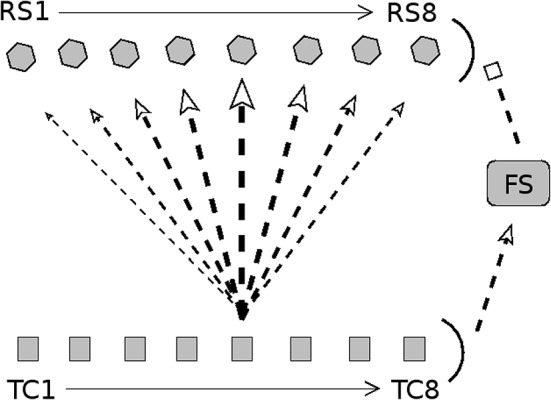
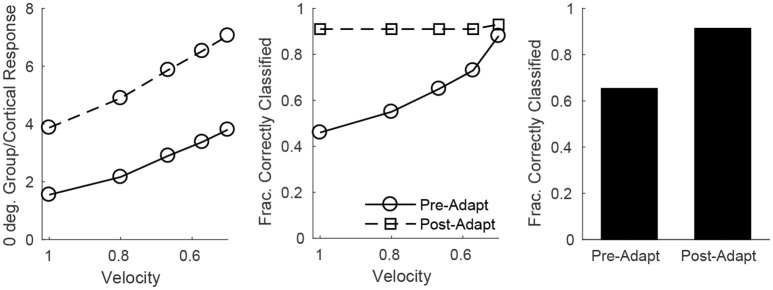
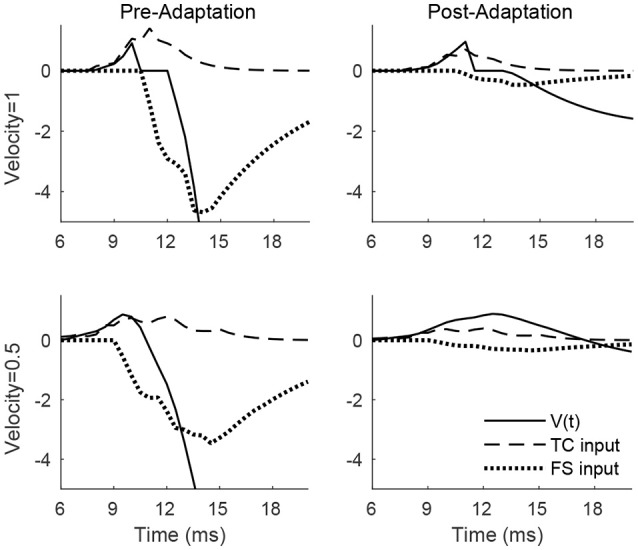
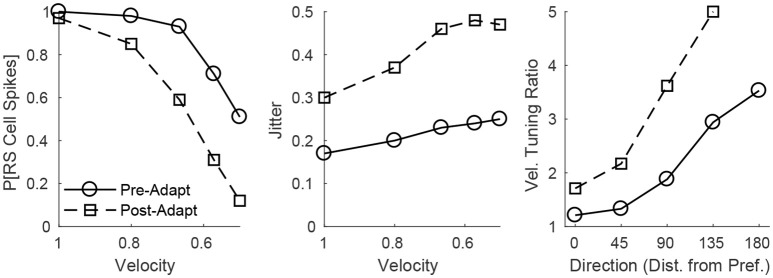
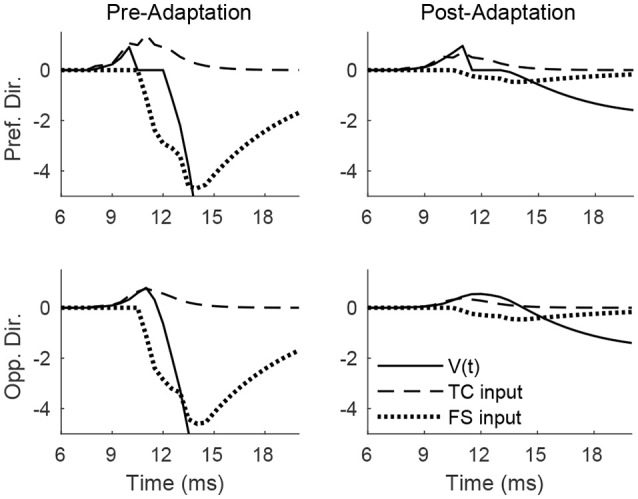
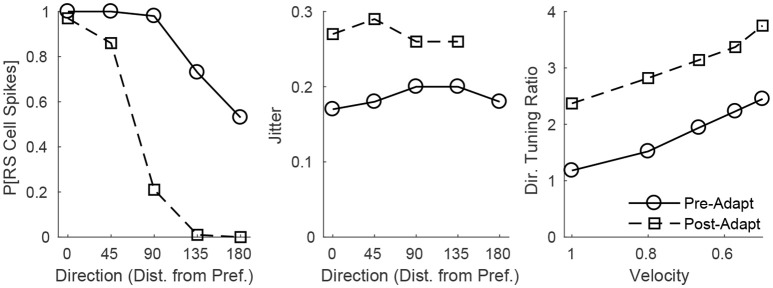
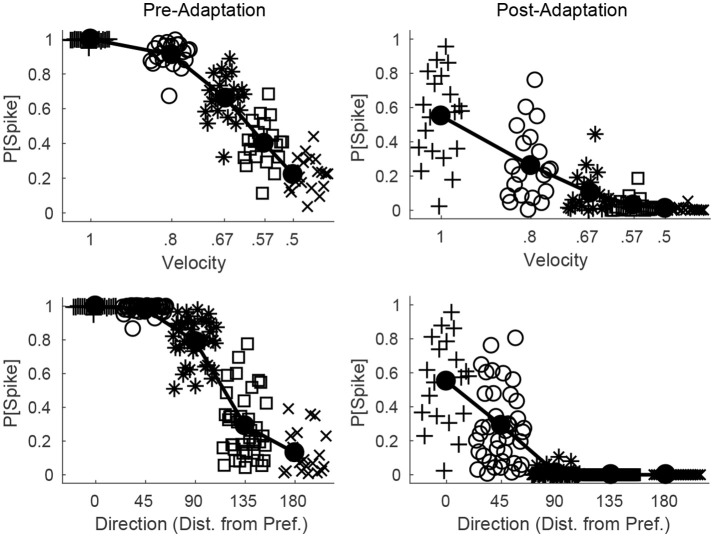
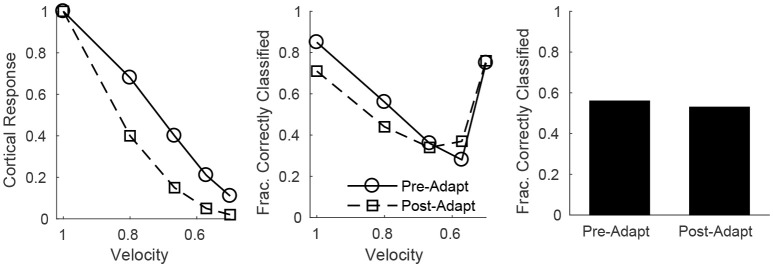
Two important stimulus features represented within the rodent barrel cortex are velocity and angular direction of whisker deflection. Each cortical barrel receives information from thalamocortical (TC) cells that relay information from a single whisker, and TC input is decoded by barrel regular-spiking (RS) cells through a feedforward inhibitory architecture (with inhibition delivered by cortical fast-spiking or FS cells). TC cells encode deflection velocity through population synchrony, while deflection direction is encoded through the distribution of spike counts across the TC population. Barrel RS cells encode both deflection direction and velocity with spike rate, and are divided into functional domains by direction preference. Following repetitive whisker stimulation, system adaptation causes a weakening of synaptic inputs to RS cells and diminishes RS cell spike responses, though evidence suggests that stimulus discrimination may improve following adaptation. In this work, I construct a model of the TC, FS, and RS cells comprising a single barrel system-the model incorporates realistic synaptic connectivity and dynamics and simulates both angular direction (through the spatial pattern of TC activation) and velocity (through synchrony of the TC population spikes) of a deflection of the primary whisker, and I use the model to examine direction and velocity selectivity of barrel RS cells before and after adaptation. I find that velocity and direction selectivity of individual RS cells (measured over multiple trials) sharpens following adaptation, but stimulus discrimination using a simple linear classifier by the RS population response during a single trial (a more biologically meaningful measure than single cell discrimination over multiple trials) exhibits strikingly different behavior-velocity discrimination is similar both before and after adaptation, while direction classification improves substantially following adaptation. This is the first model, to my knowledge, that simulates both whisker deflection velocity and angular direction and examines the ability of the RS population response to pinpoint both stimulus features within the context of adaptation.
啮齿动物桶状皮层中呈现的两个重要刺激特征是触须偏转的速度和角度方向。每个皮层桶状结构接收来自丘脑皮层(TC)细胞的信息,这些细胞传递来自单个触须的信息,并且TC输入由桶状规则发放(RS)细胞通过前馈抑制结构(由皮层快速发放或FS细胞提供抑制)进行解码。TC细胞通过群体同步编码偏转速度,而偏转方向则通过整个TC群体的脉冲计数分布进行编码。桶状RS细胞通过发放率对偏转方向和速度进行编码,并根据方向偏好分为功能域。在重复触须刺激后,系统适应性会导致RS细胞的突触输入减弱,并减少RS细胞的脉冲反应,尽管有证据表明适应性后刺激辨别能力可能会提高。在这项工作中,我构建了一个包含单个桶状系统的TC、FS和RS细胞模型——该模型纳入了实际的突触连接和动力学,并模拟了主要触须偏转的角度方向(通过TC激活的空间模式)和速度(通过TC群体脉冲的同步性),并且我使用该模型来研究适应性前后桶状RS细胞的方向和速度选择性。我发现,单个RS细胞的速度和方向选择性(在多次试验中测量)在适应性后会增强,但在单次试验中使用简单线性分类器根据RS群体反应进行的刺激辨别(比多次试验中的单细胞辨别更具生物学意义的测量)表现出截然不同的行为——速度辨别在适应性前后相似,而方向分类在适应性后显著改善。据我所知,这是第一个同时模拟触须偏转速度和角度方向,并在适应性背景下研究RS群体反应确定这两个刺激特征能力的模型。